
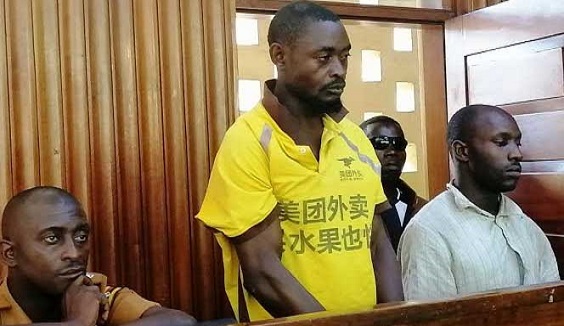
Kulaish Kamugisha in the dock today November 23, 2026
HABARI DAILY I Kampala, Uganda I With a trail of blood flowing in his path, Kulaish Kamugisha, alias Fred Mujulizi, has denied murdering a woman whose headless body was discovered in Masaka District, contradicting earlier police accounts that he had confessed to involvement in the killings.
Kamugisha, who is also facing disturbing allegations of involvement in the procurement of human body parts, pleaded not guilty to murder before High Court Judge Vincent Wagona during a mobile court session at Ssaza grounds in Masaka City on November 23, 2026.
“It is not true; I have never killed anyone,” Kamugisha told court, sending murmurs through a packed public gathering that had turned up to witness the proceedings.
The accused arrived at approximately 11am under tight security as the Judiciary conducted the hearing outside the conventional courtroom to enable residents and affected families to follow the proceedings.
Prosecutors accused Kamugisha of unlawfully causing the death of an adult woman with malice aforethought at Mazinga in Masaka District on September 28, 2026. The charge was read under Sections 171 and 172 of the Penal Code Act, which provide for the offence and punishment of murder.
After confirming that he understood the accusation, Kamugisha rejected the prosecution’s allegations, setting the stage for a trial that could test the credibility of earlier police statements, the circumstances surrounding the woman’s death and the evidence linking him to the crime.
His denial presents a significant departure from the account previously given by police during investigations, when detectives reportedly said he had admitted involvement in killings and helped them reconstruct crime scenes.
Investigators had earlier claimed that Kamugisha led them through the circumstances surrounding the killing and allegedly disclosed that a traditional healer had offered him money to obtain human body parts.
However, no detailed explanation had emerged by the time of his first appearance before the High Court to clarify why he had now changed his position and denied ever killing anyone.
The contradiction is likely to become an important aspect of the proceedings as prosecutors seek to establish whether the alleged admissions were voluntarily made and whether they can be supported by admissible evidence.
Under the law, previous police accounts and allegations cannot substitute for proof in court. The prosecution must establish beyond reasonable doubt that Kamugisha unlawfully caused the woman’s death with malice aforethought.
The case is further complicated by uncertainty surrounding the identity of the victim.
In a statement issued on October 11, police initially identified the deceased as Jackline Natukunda, reportedly a resident of Lukaya in Kalungu District.
The investigations had followed the discovery of a severed human head at Kako Cell along the Kako-Mukungwe Road on September 29, 2026. Detectives subsequently recovered a headless body at Butale Cell in Kyanamukaka, Masaka District.
However, police later acknowledged that they had not conclusively established the woman’s identity and appealed to members of the public to help identify her.
Police spokesperson Kituuma Rusoke said relatives and friends had not yet come forward to identify the deceased, raising questions about the initial identification of the victim as Natukunda.
Kamugisha, described by police as a moneylender from Kasala in Nyendo-Mukungwe Division, became a central suspect following investigations into the gruesome discoveries.
The allegations involving a traditional healer and the purported procurement of human body parts added another disturbing dimension to the investigations, although these claims must still be subjected to judicial scrutiny.
In a subsequent development, prosecutors amended the case, withdrawing three charges against Kamugisha and retaining a single count of murder. They also withdrew all charges against his co-accused, Huzair Kyambadde, before Kamugisha was committed to the High Court for trial.
The decision to conduct the proceedings at Ssaza grounds reflects the Judiciary’s mobile court programme, which seeks to bring justice closer to communities and allow members of the public to witness important proceedings.







About the Author