

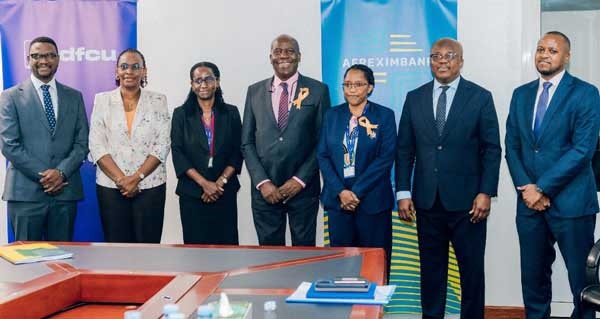
Charles Mudiwa, CEO of dfcu Bank (4th L), Humphrey Nwugo, Afreximbank’s Regional Director for Eastern Africa, among other officials pose for photos after the signing of a Landmark €30 million financing facility at the Afreximbank regional office in Kampala, Uganda. Photo by Simon Kabayo
HABARI DAILY I Kampala, Uganda I Ugandan exporters in businesses in agribusiness, manufacturing, trade and business, infrastructure and energy, financial services, hospitality and logistics, among others, have received a major boost following a €30-million (about Shs125 billion) financing facility extended by the African Export-Import Bank (Afreximbank) to dfcu Bank to support lending to enterprises across the country’s export value chain.
The latest financial commitment is part of Afreximbank’s growing investment in Uganda’s economy, aimed at improving access to trade finance, stimulating industrialisation, promoting value addition and strengthening the capacity of local businesses to compete in regional and international markets.
The €30-million facility, structured as a revolving short-term line of credit, marks the first time Afreximbank has extended such a financing arrangement to a Ugandan bank, signalling a new chapter in its engagement with the country’s financial sector.
Under the terms of the agreement, dfcu Bank will utilise the funding to provide credit to eligible businesses operating across Uganda’s export value chain, particularly those requiring working capital and financing for capital expenditure.
The beneficiaries will include enterprises in agribusiness, manufacturing, trade and business, infrastructure and energy, financial services, hospitality and logistics, among other sectors.
The funding is expected to help businesses finance day-to-day operations, purchase equipment, expand production facilities and undertake investments necessary to increase their productive capacity.
The agreement was signed on November 24, 2026, at Afreximbank’s Regional Headquarters in Kampala by Humphrey Nwugo, the bank’s Regional Director for Eastern Africa, and Charles Mudiwa, dfcu Bank’s Chief Executive Officer.
The facility also comes at a time when Uganda is pursuing an ambitious tenfold economic growth agenda, which requires substantial investment in productive sectors, industrial capacity, infrastructure and export-oriented enterprises.
Afreximbank says the offshore financing will help address some of the significant funding requirements necessary to unlock this economic transformation.
Speaking at the signing ceremony, Nwugo said the facility would strengthen access to financing for businesses involved in producing and exporting goods and services, while supporting the bank’s broader mandate of increasing Africa’s participation in international trade.
“This facility has the potential to contribute significantly to improving access to trade finance, trade-related financing and project financing in Uganda, particularly for eligible exports, value-added exports and transactions in the agribusiness, manufacturing, trade, infrastructure and energy, financial services, hospitality and logistics sectors.
“It also supports the implementation of Afreximbank’s mandate to promote the export of value-added commodities and manufactured products from its member states. Furthermore, it is consistent with Afreximbank’s strategy of financing exports that increase the foreign exchange-earning capacity of our member countries and enhance their productivity.”
Nwugo’s remarks underline the importance of financing businesses that can transform Uganda’s export profile by moving away from dependence on raw commodity exports towards value-added products and manufactured goods.
For instance, agricultural enterprises require capital to process, package and preserve produce before exporting it, while manufacturers need financing to acquire machinery, expand factories and improve production standards to meet international market requirements.
Such investments can increase export earnings, create employment and strengthen Uganda’s ability to generate foreign exchange.
Mudiwa said the partnership would increase dfcu’s capacity to finance businesses that are driving economic transformation and creating opportunities across the country.
“At dfcu, we believe that access to capital is a catalyst for transformation. This €30-million facility from Afreximbank enhances our capacity to finance businesses that are expanding Uganda’s productive economy, strengthening export value chains and creating sustainable growth opportunities.
“Beyond funding, this partnership demonstrates a shared commitment to unlocking Africa’s trade potential and empowering enterprises to compete more effectively in regional and international markets. Together, we are enabling businesses to scale, create jobs and contribute meaningfully to Uganda’s economic prosperity.”
The transaction builds on Afreximbank’s wider continental investment strategy of providing financial solutions to stimulate trade, industrialisation and economic integration among African countries.
The Cairo-headquartered institution is a Pan-African multilateral financial institution mandated to finance and promote intra-African and extra-African trade.
For more than 30 years, it has deployed innovative financing structures to transform Africa’s trade architecture, accelerate industrialisation and strengthen trade between African countries.
Beyond direct financing, Afreximbank has also supported the implementation of the African Continental Free Trade Area (AfCFTA) through the establishment of the Pan-African Payment and Settlement System (PAPSS), which was adopted by the African Union as a payment and settlement platform for the continental trade arrangement.
Working with the AfCFTA Secretariat and the African Union, the bank has also established a $10 billion Adjustment Fund to support countries participating in the free trade agreement.
The institution’s financial capacity provides a strong foundation for its investments across the continent. At the end of December 2025, its total assets and contingencies stood at more than $48.5 billion, while shareholder funds amounted to $8.4 billion.
In Uganda, the latest €30-million facility will be channelled through dfcu, a financial institution established in 1964 as a development finance institution.
Over the years, dfcu has supported businesses in various sectors of the Ugandan economy, including agribusiness, manufacturing, tourism, real estate, mining, construction, transport, communications, education, health and trade.







About the Author