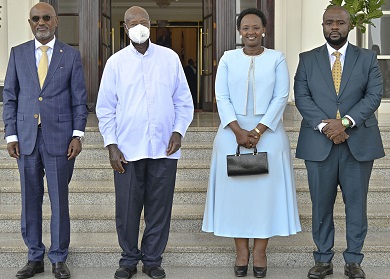
Janet Kataaha Museveni, the Education and Sports minister
HABARI DAILY I Kampala, Uganda I The Uganda National Examinations Board (UNEB) has released the 2025 Uganda Certificate of Education (UCE) results, registering a markedly higher pass rate than in 2024 and signaling steady progress under the Competency-Based Curriculum (CBC).
A total of 432,163 candidates from 3,975 centres registered for the examinations, representing a 20.2 percent increase from the previous year. Of these, 227,871 (52.7 percent) were female, while 204,292 (47.3 percent) were male. Attendance remained high, with 429,949 candidates (99.5 percent) sitting for the examinations, continuing a trend of declining absenteeism.
Overall performance improved significantly. UNEB reported that 428,628 candidates, representing 99.69 percent, qualified for the UCE certificate, recorded as Result 1. The proportion of candidates who did not qualify dropped sharply from 1.9 percent in 2024 to just 0.31 percent in 2025.
Result 2, awarded to candidates missing components such as project scores or Continuous Assessment marks, accounted for 1,191 candidates (0.28 percent), while Result 3, for candidates scoring below the basic level in all subjects, was recorded for only 130 candidates (0.03 percent).
CBC yields positive results
“This improvement demonstrates that the CBC is beginning to yield positive outcomes, with learners increasingly meeting the competency thresholds required for success,” UNEB noted.
Subject analysis revealed stronger performance in large-entry and compulsory subjects, notably Christian Religious Education (CRE), Geography and English Language, with more candidates attaining grade C and above compared to 2024. In English Language, 50.6 percent scored grade C, 26.8 percent grade D and 1.9 percent grade E.
In CRE, 64.9 percent scored grade C, 12.4 percent grade D and 1.1 percent grade E, while in Mathematics, 62 percent attained grade C, 10.9 percent grade D and 2.7 percent grade E. In the sciences, including Physics, Chemistry and Biology, there were encouraging reductions in the proportion of candidates scoring below grade D.
Girls outperformed boys
Despite the gains, UNEB cautioned that many learners still struggle to apply classroom knowledge to real-life problem solving, a core competency of the CBC.
Gender-based analysis showed that female candidates outperformed males in English Language and CRE, especially at exceptional and outstanding levels, while males posted marginally higher scores in Mathematics, Agriculture and the sciences. UNEB urged continued gender-sensitive teaching approaches to further narrow achievement gaps and sustain the positive momentum.