
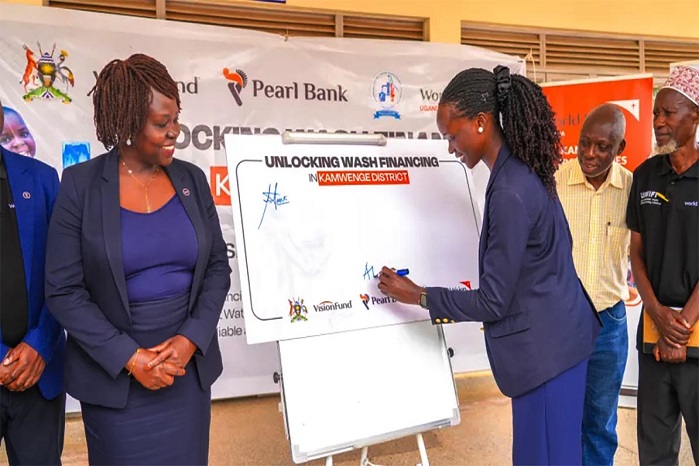
Carolyn Andama, the Head of Public Sector at Pearl Bank (2nd L), Augustine Asaba, the Branch Manager of Pearl Bank Kamwenge (L), Rita Awekonimungu, the Associate Relationship Manager at Pearl Bank (2nd R) and James Kaahwa, Program Operations Director of World Vision Uganda (R) at the official partnership launch of Pearl Bank, World Vision, and Vision Fund International in Kamwenge district aimed at rehabilitating water sources
HABARI DAILY I Kampala, Uganda I A new partnership, between Pearl Bank (formerly PostBank Uganda), World Vision Uganda and Vision Fund International, is set to strengthen gains Uganda has made in ensuring accessibility of water and sanitation for all.
The country has registered notable progress in advancing Sustainable Development Goal 6 (SDG 6) of the United Nations, which seeks to ensure the availability and sustainable management of water and sanitation for all.
This landmark initiative, which was announced recently in Kamwenge will lead to the rehabilitation of water infrastructure across Kamwenge district.
The project leverages the Water, Sanitation, and Hygiene (WASH) to Kamwenge District Water Management Association (KADWAMA) loan facility to repair non-functional boreholes and water sources, while strengthening community management systems to guarantee long-term sustainability.
Speaking at the launch in Kamwenge, Carolyn Andama, the Head of Public Sector at Pearl Bank, underscored the bank’s commitment to development financing with lasting social impact.
“A functioning water source is a lifeline for any community,” she said, noting that Pearl Bank’s purpose is to foster prosperity for Ugandans by enabling access to clean water, education, health, and economic opportunity.
Andama added that the project aligns with Uganda’s National Development Plan IV priorities on water security and rural development, contributing to inclusive growth.
“The new partnership directly addresses these obstacles by restoring critical water points, reducing the distance and time spent collecting water, and improving health, productivity, and livelihoods.”
The initiative combines physical rehabilitation of water sources with capacity building for local water management committees, ensuring that communities can independently maintain and manage their systems.
This integrated approach is expected to enhance sustainability and resilience, empowering communities to safeguard their own water security.
James Kaahwa, Program Operations Director at World Vision Uganda, emphasized the human impact of the initiative, saying access to safe water is fundamental to children’s well-being and community resilience.
By restoring water sources and strengthening locally led systems, he said, the partnership is laying the foundation for sustainable development.
Eng. Lamu Olweny, Commissioner for Rural Water Supply and Sanitation, applauded the collaboration, noting that improved water access translates into better health outcomes and economic development.
Kamwenge district will serve as the pilot, with plans to scale the model nationwide, reinforcing Uganda’s progress toward achieving SDG 6.
Although Uganda has made steady progress toward SDG 6, significant barriers remain in rural settings.
According to the Uganda Water Supply Atlas, overall water access in Kamwenge district stands at 77 percent. However, communities continue to face challenges including infrastructure breakdowns, low water yields, and maintenance gaps, all of which undermine consistent access to safe water.







About the Author