
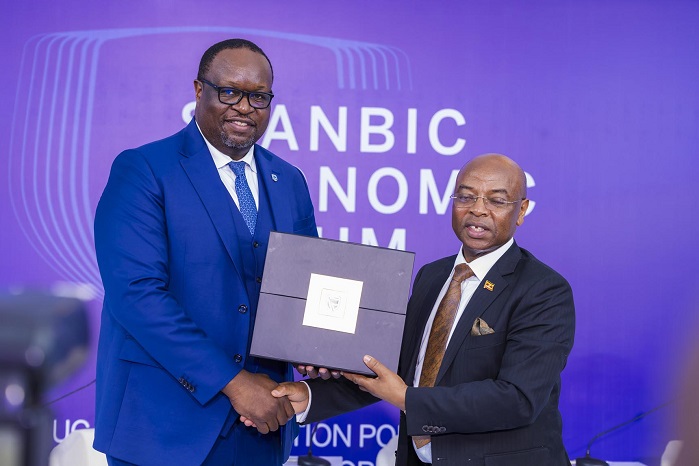
Stanbic Bank Chief Executive Mumba Kalifungwa with Prof. Augustus Niwagaba from Bank of Uganda during the recently held forum
HABARI DAILY I Kampala, Uganda I Stanbic Bank Uganda Chief Executive, Mumba Kalifungwa, has expressed strong excitement about the near completion of the East African Crude Oil Pipeline (EACOP), describing it as a transformational milestone that will fundamentally reshape Uganda’s economic future.
Speaking at the 5th Stanbic Economic Forum in Kampala under the theme “Uganda’s Inflection Point: Competing in a Rewired Global Economy,” Kalifungwa said Uganda has reached a decisive moment where leaders across government, business, finance and policy must move beyond observation and actively shape the country’s long-term prosperity.
He highlighted the EACOP, now estimated at 97 percent complete, as the most consequential infrastructure investment in Uganda’s history. With first oil expected later this year, Kalifungwa said the project will dramatically strengthen Uganda’s fiscal position, industrial capacity and regional influence.
“With an estimated 1.6 billion barrels of recoverable reserves and peak production of 230,000 barrels per day, this project will reshape Uganda’s economic trajectory,” he said. “But beyond the headline figures, the true value of oil and gas lies in job creation across the value chain, development of local suppliers, skills transfer, and the building of long-term national capability.”
Kalifungwa also reflected on the global forces redefining competitiveness, including shifting trade regimes, supply chain realignments, uncertainty around the African Growth and Opportunity Act (AGOA), and the rapid growth of artificial intelligence. He noted that Africa’s AI market is projected to nearly quadruple by 2030, urging Uganda to adopt inclusive strategies to benefit from emerging technologies.
“Artificial intelligence is no longer a distant frontier. The question is not whether Uganda participates, but how inclusively and competitively it does so,” he said.
He reaffirmed Stanbic Bank’s commitment to Uganda, citing its 35-year partnership in financing infrastructure, supporting enterprises, and promoting financial inclusion. Kalifungwa said the bank’s purpose, “Uganda is our home, we drive her growth,” is reflected in its focus on enterprise development, climate resilience, and corporate philanthropy, especially targeting women, youth and farmers.
Providing a broader economic outlook, Standard Bank Group’s Head of Africa Regions Economic Research, Jibran Qureishi, projected steady growth toward the seven percent GDP threshold. Following growth of 6.3 percent in FY 2024/25, Uganda’s economy is expected to expand between 6.5 and 6.7 percent in FY 2025/26, driven largely by oil-sector investment and infrastructure spending.
Qureishi, however, cautioned that the most significant macroeconomic benefits from oil revenues will become more visible closer to 2030, aligning with global production ramp-up trends. He also commended government fiscal discipline, noting that restraint in monetising future oil revenues has preserved economic stability and investor confidence.
Yet, he warned that strong macroeconomic performance does not always translate into improved household welfare, citing capital-intensive growth, inflation pressures and fiscal adjustments as ongoing challenges.
Now in its fifth year, the Stanbic Economic Forum continues to convene policymakers, business leaders and economic experts to assess Uganda’s development path. This year’s discussions underscored growing optimism, anchored by the nearing completion of EACOP, and the urgency to convert economic momentum into inclusive and sustainable growth.







About the Author