

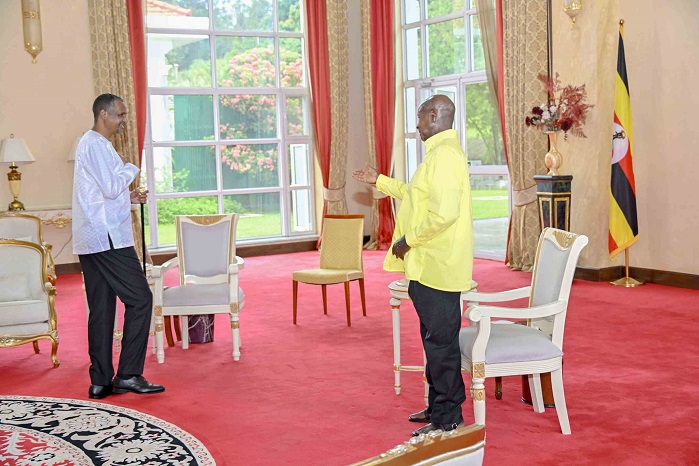
Museveni in deep discussions with Sudan’s Mohamed Hamdan Dagalo
HABARI DAILY I Kampala, Uganda I President Yoweri Museveni has warned that divisive politics and identity-based mobilisation lie at the heart of Sudan’s devastating conflict, cautioning that unless the country abandons such approaches, lasting peace will remain elusive.
Museveni made the remarks on Friday during high-level talks with Mohamed Hamdan Dagalo, the leader of Sudan’s Rapid Support Forces (RSF), at State House, Entebbe. The meeting focused on efforts to end the brutal war that has engulfed Sudan since April 2023 and to restore stability in the wider region.
Sudan has been locked in a destructive power struggle between the Sudan Armed Forces, led by Gen. Abdel Fattah al-Burhan, and the RSF, plunging the country into one of the world’s worst humanitarian crises. What began as fighting in the capital, Khartoum, rapidly spread across vast swathes of the country, displacing millions, crippling essential services, collapsing livelihoods, and leaving entire communities devastated.
Museveni said the tragedy unfolding in Sudan offers a stark lesson on the dangers of divisive politics, particularly the manipulation of ethnic, tribal, and identity differences for political gain. He argued that such politics inevitably breed hostility, mistrust and violence, tearing apart the social fabric of nations.
discussions between the two leaders at State House today
“When I last came to Sudan, I met President Bashir and advised against the politics of identity instead of the politics of interest,” Museveni said. “Identity politics is poisonous. It does not yield good results. What is important are shared interests that unite people.”
He stressed that Sudan’s conflict is not merely a military confrontation but a manifestation of deep-rooted political failures, where leaders prioritised narrow group interests over national cohesion. According to Museveni, this approach has polarised society, weakened state institutions and opened the door to armed confrontation.
The Ugandan leader urged Sudanese factions to abandon zero-sum politics and embrace dialogue, compromise and inclusive governance. He emphasised that sustainable peace can only be achieved when political actors recognise their shared destiny and commit to building systems that serve all citizens, regardless of ethnic, religious or regional identities.
The devastating impact of Sudan’s political divisions is evident across the country. More than 10 million people have been displaced internally and across borders, healthcare systems have collapsed, food production has been severely disrupted, and famine now threatens large sections of the population. Schools, hospitals and vital infrastructure have been destroyed, while lawlessness and insecurity continue to spread.
Observers say Sudan’s experience mirrors that of several conflict-ridden states where identity politics has been weaponised, creating cycles of revenge, exclusion and instability that are difficult to break. Museveni warned that unless such politics is decisively rejected, even post-war reconstruction efforts risk being undermined.
African-led solutions
He also called for African-led solutions to the crisis, arguing that regional engagement and home-grown peace initiatives are essential to ending the conflict. “Africans must take responsibility for resolving African problems,” he said, urging all parties to prioritise negotiations over military confrontation.
On his part, Gen. Dagalo thanked President Museveni for his hospitality and described him as a respected statesman whose leadership extends beyond Uganda’s borders. He acknowledged the scale of Sudan’s humanitarian catastrophe and admitted that the conflict has inflicted deep institutional and social damage.
“Sudan continues to face serious humanitarian and institutional challenges as a result of the war,” Dagalo said, stressing the urgency of a peaceful settlement. He expressed willingness to explore dialogue and said regional cooperation could play a key role in stabilising the country.
Dagalo also signalled interest in strengthening ties with Uganda and neighbouring countries, particularly in trade, education and regional integration, noting that economic cooperation could help rebuild trust and restore livelihoods.
The meeting comes amid renewed diplomatic efforts by regional leaders to broker peace in Sudan, as fears grow that prolonged instability could destabilise the Horn of Africa and the wider Great Lakes region.
For Museveni, Sudan’s descent into chaos serves as a cautionary tale for the continent. He warned that when leaders exploit identity for short-term political advantage, the long-term cost is often paid in blood, displacement and national collapse.
As Sudan struggles to find a path out of war, his message was clear: only inclusive politics grounded in shared national interests can heal divisions, rebuild institutions and restore peace.







About the Author