

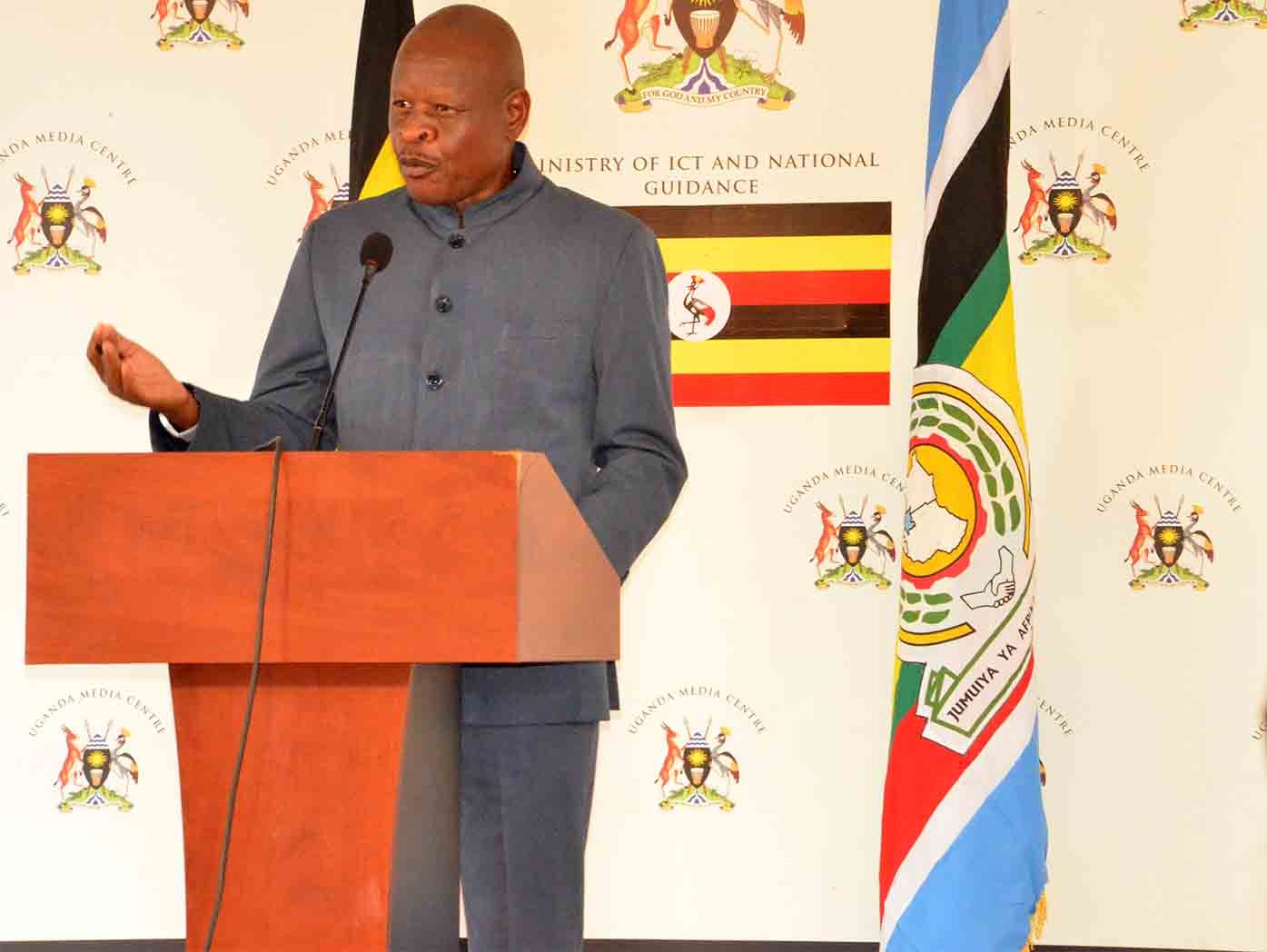
Gen. Wilson Mbasu Mbadi briefing the press at the Uganda Media Center today, 24 February 2026
HABARI DAILY I Kampala, Uganda I Uganda has placed trade and exports at the heart of its ambitious 10-fold Growth Strategy, viewing them as the main engine to propel the country into a $500 billion economy by 2040. With exports rising sharply and new policy reforms underway, government says the time has come to transform recent gains into sustained, large-scale economic growth.
Speaking ahead of the National Trade Review Conference 2026, the Minister of State for Trade, Industry and Cooperatives, Gen. Wilson Mbasu Mbadi, said Uganda recorded a remarkable export performance in the 2024/25 financial year, demonstrating the power of targeted reforms.
“Uganda recorded a strong export growth in financial year 2024/25, with total exports of goods and services reaching approximately $13.4 billion, of which merchandise exports alone accounted for about $10.6 billion,” Mbadi said, at a press briefing held at the Uganda Media Center today.
He added: “This represents a significant increase compared to the previous years, reflecting improved commodity prices, higher export volumes and expansion of markets. Although we have a trade deficit, it is suppressed by an overall favorable balance of payments for the whole country.”
The export growth, he explained, was largely driven by coffee, mineral products—especially gold—cocoa, sugar and fish, sectors that have benefited from deliberate government investments.
“These gains are not accidental. They are a result of deliberate visionary leadership and guidance by our President that has seen policy reforms, improved trade facilitation, industrial infrastructure development like industrial parks, cooperative strengthening and strong public-private collaboration,” Mbadi said.
But even as Uganda celebrates this progress, the minister emphasized that the country must now focus on how to scale up and sustain growth.
“As we celebrate this progress, we must now ask ourselves a strategic question: how do we convert these gains into sustained 10-fold growth strategy pillars that will propel Uganda into a $500 billion economy by 2040?” he asked.
Trade as the Growth Engine
To answer that question, the Ministry of Trade has convened the National Trade Review Conference 2026, scheduled for March 4–5, 2026, at Speke Resort Munyonyo, under the theme Trade-driven transformation: propelling Uganda to a $500 billion economy.
“This conference is specifically to analyze the country’s trade exports, imports, trade balance and trends by sector,” Mbadi said. “It is being held because Uganda is implementing an ambitious 10-fold growth strategy anchored on agro-industrialization, tourism, mineral development, science, technology and innovation, including creative industries.”
He stressed that trade is the engine of this strategy. “Trade connects production to markets, generates incomes and distributes wealth across the country. That is why the National Trade Review Conference will take stock of Uganda’s trade performance and readiness to support the 10-fold growth strategy.”
The conference will also generate actionable policy and regulatory reforms aimed at boosting exports and value addition.
“We shall be generating actionable policy and regulatory reforms to boost exports and value addition. We also intend to launch the revised National Trade Policy and the National Export Development Strategy during that conference,” he said.
Importantly, Mbadi noted that the conference will not merely be a discussion forum. “It will be a working platform to move from policy intent to implementation,” he said, adding that it will produce time-bound implementation metrics and a high-level national communiqué to guide follow-up action.
Key Strategic Pillars
Uganda’s 10-fold growth strategy through trade will focus on several strategic pillars. These include navigating a fragmented global trade system, preparing for Uganda’s graduation from Least Developed Country status, and scaling agro-industrial value chains to achieve predictable export growth.
“We shall also be looking at import substitution through increased industrialization, competing in regional markets—especially in the East African Community and the African Continental Free Trade Area—and mineral-based specialization with domestic value addition,” Mbadi said.
Other priorities include leveraging science, technology and innovation for high-value manufacturing, strengthening cooperatives and micro, small and medium enterprises (MSMEs) as engines of export competitiveness, and promoting quality, order and standardization in the marketplace.
“These discussions will lead to a clear, prioritized trade reform action aligned to the 10-fold growth strategy, and strengthen coordination between government, the private sector, academia, development partners and cooperative groups,” he said.
Transforming Uganda’s Export Profile
According to Mbadi, Uganda’s export profile is already evolving from a predominantly agricultural base to one increasingly supported by processed goods, minerals and manufactured products.
“Our industrial parks are expanding, cooperative groups are being revitalized and trade volumes are increasing,” he said. “The task before us is to safeguard competitiveness in a shifting global environment, deepen domestic value addition, expand regional markets and align production with standards and demand.”
He added that export-led growth must translate into jobs, incomes and shared prosperity. “The only way you can distribute wealth is through trade of goods and services. That is why our President normally says every Ugandan must be either producing a good or a service in order to create wealth.”
Expanding Markets and Infrastructure
Mbadi also highlighted efforts to expand market access, including zero-tariff access to China, which he said offers immense opportunities for Ugandan exporters.
“Zero tariff means Uganda will be able to access the Chinese market tariff-free. Uganda needs to take advantage of this offer to increase our exports, provided we comply with standards,” he said, noting the role of the Uganda National Bureau of Standards in supporting exporters.
On infrastructure, Mbadi thanked development partners such as the Foreign, Commonwealth and Development Office (FCDO) and TradeMark Africa for supporting the construction of one-stop border posts in Busia, Malaba, Elegu, Mutukula and Ntoroko, which have significantly reduced transit time and trade costs.
Formalizing the Informal Sector
Addressing concerns about street vendors, Mbadi clarified that government is pursuing formalization rather than eviction.
“We are not calling it eviction or displacement. It is a formalization process to support vendors to transition into organized markets where standards, compliance and traceability can be enforced while preserving livelihoods,” he said.
“Growth is possible.”
As Uganda pushes forward, Mbadi said the country has already proven that growth is possible. “The next step is scaling,” he said, quoting Tanzania’s founding president Julius Nyerere: “It is possible—just play your part.”
Through coordinated, evidence-based trade reforms, Mbadi believes Uganda can shift from protecting gains to multiplying them.
“If we focus on value-added exports rather than raw materials, and if we produce what we can consume rather than consuming what we don’t produce, Uganda can achieve the $500 billion economy by 2040,” he said.
With trade firmly positioned at the center of national strategy, Uganda’s path to transformation now hinges on execution, coordination and sustained investment in export competitiveness.







About the Author