
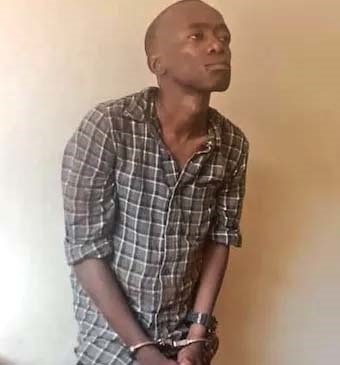
HABARI DAILY I Kampala, Uganda I Christopher Okello Onyum, the man accused of brutally killing four toddlers at a daycare centre in Ggaba, is now at the centre of chilling revelations that he may have committed a similar crime years earlier—this time against his own stepbrother.
As investigations intensify into the gruesome killings at Ggaba Early Childhood Daycare Centre in Makindye Division, detectives have uncovered disturbing details suggesting the suspect is a repeat offender with a violent past that had largely gone unpunished.
Police sources say that Onyum, who hails from Nwoya District, had previously been implicated in the killing of his two-and-a-half-year-old stepbrother in Kwania District in early 2020. The case, however, remains shrouded in uncertainty, with investigators now probing why the earlier incident did not result in a conclusive legal outcome.
Sources in the Police revealed that the suspect’s history may hold critical clues to the motive behind last week’s attack, particularly because the victims in both cases fall within the same age bracket.
“The sickle cell problem, at a later stage, damaged his mental stability,” the suspect’s father reportedly told detectives, while explaining his son’s long-standing health condition. Investigations also confirmed that the offender lived in the United States for over 20 years, a holder of an American passport and therefore an American cotizen.
Planned attack
According to investigators, the Ggaba killings were not spontaneous but carefully premeditated. During interrogation, Onyum reportedly confessed to planning the attack at least four days in advance.
He is said to have purchased multiple knives in separate locations across Kampala, including one from a supermarket in Bunga and others near the Old Taxi Park. Armed with these weapons, he set out on the morning of the attack from his residence in Kyanja.
On Friday last week, Onyum led a team of detectives from the Criminal Investigations Directorate in Kibuli, Kampala to his rented house located in Kisasizi zone in Kyanja, Nakawa division, as investigators continued to search for vital evidence. During the search, detectives recovered several documents, including his American passport, among other things.
Police also confirmed that Onyum had first visited the daycare days earlier, posing as a parent seeking admission for children he claimed belonged to his brother, who lives in the United States.
“The children that Onyum claimed to have wanted to be admitted at the daycare belong to his brother, who is currently living in the US. Surprisingly, he never brought the said children to the school at the time he went there to seek a vacancy,” one of the investigators said.
On the day of the attack, he returned to the facility, paid sh180,000 in admission fees via mobile money, and engaged the daycare administrators in conversation to allay suspicion.
Moment of horror
What followed next has left the Ggaba community in shock.
After completing the admission process, Onyum reportedly locked the two female administrators inside their office and secured the gate using padlocks found on the premises. He then proceeded to the children’s play area, where 14 toddlers had been left unattended during break time.
Armed with a knife, he launched a frenzied attack, stabbing the children indiscriminately. By the time help arrived, four children aged between two and three years had been killed.
An eyewitness recounted how a bodaboda rider, who witnessed the attack from across the road, quickly scaled the school fence and subdued the suspect.
“The bodaboda rider made an alarm prompting other people to gather,” the eyewitness said.
Angry residents attempted to lynch the suspect, but Police intervened in time, rescuing him from the mob. The situation quickly escalated, with furious community members lighting bonfires and clashing with security forces, who fired teargas and live bullets to disperse the crowd.
Parents, desperate for information about their children, were initially blocked from accessing the school, further fueling tensions.
Among the grieving was Simon Okurut, a special hire driver who lost his only child in the attack.
“I brought my child early in the morning as I usually do. My child had just spent two weeks at this school. I got a call and was told a killer had entered the school and killed children. I never expected my child to be among those killed. I had just wedded and that was the only child I had,” Okurut said, overcome with emotion.
Mental health questions
The case has also raised serious questions about mental health and the criminal justice system. Police doctors conducted a mental health assessment on Onyum shortly after his arrest to determine his state of mind at the time of the killings.
Investigators say the findings will be crucial in guiding the direction of the case, especially in light of claims that he suffers from sickle cell disease and possible related psychological complications.
“We established that the police medics were immediately summoned to conduct a mental health assessment on Onyum before formal interrogations could proceed. The assessment, an officer said, is expected to guide the course of the investigations,” a source noted.
Security officials are particularly concerned about the apparent pattern in the suspect’s alleged crimes, especially his targeting of very young children.
A wider concern
The tragedy comes against the backdrop of persistent violent crime in Uganda. According to the 2025 Police Annual Crime Report, a total of 4,238 murder cases were recorded in 2025, slightly down from 4,329 cases in 2024.
The report indicates that many of these killings stem from land disputes, domestic violence, mob justice, family misunderstandings, crimes of passion, and business rivalries. Notably, 338 victims were killed through hacking, underscoring the brutality of such crimes.
As detectives continue to interrogate Onyum, the focus remains on establishing a clear motive and determining whether earlier warning signs were missed.
The Inspector General of Police, Abas Byakagaba, who visited the scene shortly after the incident, appealed to the public to assist investigators.
He urged citizens to “volunteer any information about the suspect to assist in the investigations.”
For many, however, the bigger question lingers: how did a man allegedly linked to a prior child killing slip through the cracks, only to strike again with even deadlier consequences?
As the nation mourns the young lives lost in Ggaba, the case stands as a grim reminder of the urgent need for stronger intervention systems—particularly for individuals with known violent histories—before tragedy strikes again.