
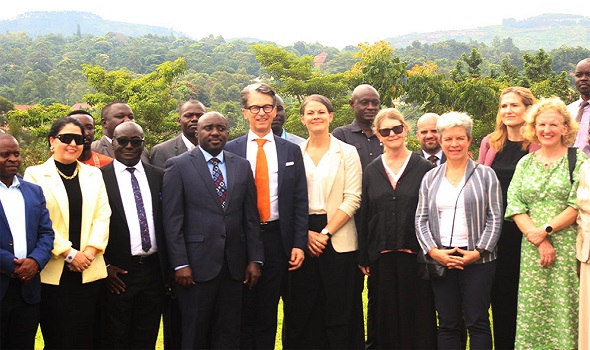
Jan Sadek, the EU Ambassador(5th Left) interacting with other officials after the announcement of the fund
HABARI DAILY I Kampala, Uganda I The European Union has announced an emergency funding package of 8 million Euros to support Uganda’s response to the ongoing Ebola outbreak, with the money expected to be directed toward surveillance, treatment, logistics, border screening and community awareness campaigns aimed at preventing further spread of the deadly virus.
Uganda has two confirmed imported cases of Ebola and one death, with no current evidence of local transmission within the country.
The funding comes at a time when Uganda is battling the Ebola Bundibugyo strain, with the Ministry of Health having already confirmed two cases and placed at least 127 contacts under close monitoring, including several health workers at Kibuli Muslim Hospital who attended to the deceased patient.
According to EU Ambassador Jan Sadek, the support package is intended to strengthen Uganda’s emergency response systems before the outbreak escalates into a wider health and economic crisis.
“The Ebola fight requires collective action from both Uganda and its development partners,” Sadek said while speaking to reporters during a visit to the Bunyoro sub-region on Tuesday.
The funds will be channeled through the International Federation of Red Cross and Red Crescent Societies to support Uganda’s Ebola response teams in critical operational areas.
Health experts say a significant portion of the money is likely to be spent on surveillance and contact tracing, which remain among the most important measures in containing Ebola outbreaks. Authorities are currently monitoring dozens of people who may have come into contact with infected patients, a process that requires transport, trained personnel, testing equipment and daily follow-up operations.
Another key area expected to consume a large share of the funding is infection prevention and control in hospitals and health facilities. This includes procurement of personal protective equipment for health workers, establishment of isolation units, sanitation supplies and training for frontline medical teams handling suspected Ebola cases.
Case management and emergency medical services are also expected to benefit from the EU support. Ebola treatment requires specialized facilities, intensive care support, ambulances and dedicated health personnel working around the clock in high-risk conditions.
Sadek further revealed that the EU will extend an additional 1 million Euros to the Uganda Red Cross Society to strengthen coordination of emergency activities across affected communities.
According to Sadek, the funding will support “risk communication, surveillance and contact tracing, emergency medical services, safe and dignified burials, hygiene promotion, and community engagement.”
Public health specialists say community sensitization campaigns are likely to become another major spending priority, especially in rural and high-risk districts. Ebola outbreaks are often controlled through aggressive public awareness efforts aimed at encouraging early reporting of symptoms, reducing panic and combating misinformation.
The funds are also expected to support safe and dignified burials, which are considered critical in preventing transmission of the virus. Burial teams require protective gear, transport, disinfectants and continuous training to safely handle Ebola victims.
Border screening and logistics operations are also likely to receive substantial funding, particularly because Uganda remains a regional transit hub with busy border points and movement corridors. Screening equipment, health declaration systems and deployment of emergency response teams at entry points may be strengthened using part of the EU package.
Sadek emphasized that the EU stands in solidarity with Uganda during the outbreak and is committed to ensuring rapid containment measures.
The EU ambassadors, led by Sadek, are currently on their annual joint mission in the Bunyoro sub-region where they are engaging local leaders on development priorities and regional challenges.
During meetings with Andrew Byakutaga and Hoima City officials, local leaders called for more EU investment in agriculture and livelihood programs.
Hoima City Mayor Edward Isingoma used the engagements to outline sectors where further European Union support could be directed, while Byakutaga emphasized the importance of agriculture to the region’s economy.
Sadek said the EU also remains interested in supporting tourism, coffee production and promotion of human rights within Uganda’s oil and gas sector.







About the Author