

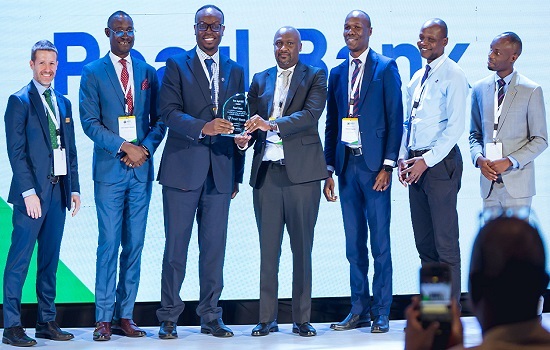
Julius Kakeeto (3rd L), Pearl Bank Uganda Managing Director, Martin Mugisha, Executive Director Operations at Pearl Bank (C), receiving the Best Agri-SME Lender Accolade at Aceli Africa Uganda Stakeholder Round table from Aceli Africa CEO, Brian Milder (L), Aceli Africa Country Director, John Robert Okware (2nd L). Looking on are officials from Pearl Bank and Aceli Africa during the Aceli Africa Uganda Stakeholder Roundtable held on 11th February 2026 at Four Points by Sheraton in Kampala
HABARI DAILY I Kampala, Uganda I Pearl Bank Uganda has proved critical to the agriculture sector by providing the capital and financial infrastructure necessary to scale operations, modernize farming and facilitate Uganda’s transition from subsistence to highly profitable agribusiness.
As government intensifies implementation of its Agriculture, Tourism, Minerals and Science and Technology (ATMS) agenda with a strong emphasis on commercialising agriculture, Pearl Bank is increasingly emerging as one of the financial institutions helping translate that vision into reality.
Agriculture remains Uganda’s largest employer, supporting the livelihoods of more than 70 percent of the population. Yet despite its central role in the economy, limited access to affordable financing continues to constrain investment in mechanisation, irrigation, processing, storage and value addition – key areas required to transform agriculture from subsistence activity into a commercially viable enterprise.
Boosting agriculture value chain
Recognising this challenge, Pearl Bank has increasingly focused on financing the entire agriculture value chain rather than primary production alone. The bank’s approach aligns closely with government’s objective of building competitive agricultural enterprises capable of supplying domestic, regional and international markets while contributing to economic growth and household incomes.
The bank’s intervention is already delivering tangible results. One beneficiary, Equator Seeds Limited, says financing from Pearl Bank enabled the company to purchase foundation seed, invest in irrigation and mechanisation, and expand farmer training programmes. The resulting increase in production boosted incomes for both the company and the farmers it serves, demonstrating how targeted agricultural financing can create benefits across entire value chains.

Industry analysts argue that such interventions are critical if Uganda is to achieve the objectives outlined in the national budget, particularly the transition from subsistence farming to commercial agriculture, agro-industrialisation and broader economic monetisation. Access to finance remains one of the most significant barriers facing farmers and agribusinesses seeking to scale operations, adopt modern technologies and increase productivity.
Nationwide coverage of 6,150 parishes
Pearl Bank’s ability to support agricultural transformation is strengthened by its extensive national footprint. With more than 11,500 agents, presence in 1,935 sub-counties and coverage in over 6,150 parishes nationwide, the bank has built one of Uganda’s deepest rural financial networks. This reach positions it to deliver financial services directly to farming communities and agricultural enterprises across the country, including areas traditionally underserved by formal banking institutions.
Government has also increased support for agricultural financing as part of its broader economic transformation agenda. According to the 2026/27 Budget Speech, the Agricultural Credit Facility (ACF) has cumulatively disbursed Shs1.35 trillion to more than 14,000 beneficiaries, while the Small Business Fund has extended over Shs82 billion to more than 4,000 enterprises.
In addition, government has committed Shs41 billion annually to support interest payments for large-scale commercial farmers cultivating more than 50 acres of grain and animal feed.
Co-funding the Agricultural Credit Facility
Earlier, while presenting the 2025/26 financial year budget, the Minister of Finance, Planning and Economic Development, Henry Musasizi, revealed that government had invested Shs371.1 billion in the Agricultural Credit Facility as co-financing with participating financial institutions. He further announced that the Large-Scale Commercial Financing Scheme would benefit from a Shs41 billion provision to cover interest payments on behalf of qualifying large-scale farmers.
As one of the participating financial institutions in these government-backed financing schemes, Pearl Bank has become an important channel through which public resources are reaching farmers and agribusinesses. By leveraging these partnerships, the bank is helping accelerate the shift from subsistence farming to commercially viable agricultural enterprises, directly supporting government’s ATMS agenda.

The bank’s contribution has not gone unnoticed. In April this year, Pearl Bank was recognised by Bank of Uganda for its outstanding partnership and responsiveness in implementing the Agricultural Credit Facility and Small Business Fund schemes. The recognition highlighted the bank’s role in accelerating growth within Uganda’s agricultural and business sectors in line with the National Development Plan IV and the government’s Tenfold Growth Strategy.
The recognition from the central bank further reinforces Pearl Bank’s growing reputation not only as one of Uganda’s leading financiers of agriculture but also as a strategic partner in advancing government’s efforts to transform agriculture into a commercially driven engine of economic growth.
This accolade followed another major achievement earlier in the year when Pearl Bank was named Uganda’s Best Agri-SME Lender by Aceli Africa during the Aceli Uganda Stakeholder Roundtable in Kampala. The twin recognitions come against the backdrop of strong growth in the bank’s agricultural lending portfolio.
24 percent growth in 2025
According to the bank, its agribusiness loan book grew by 24 percent in 2025 compared to 2024, driven by increased lending to farmers, cooperatives, processors, traders and agricultural SMEs. The growth reflects rising demand for agricultural financing and the bank’s commitment to supporting enterprise development across the sector.
Speaking after receiving the Aceli Africa award, Pearl Bank Supervisor Agriculture and Partnerships, Julius Akais, underscored the institution’s commitment to addressing financing gaps across agricultural value chains.
“The awards signify the contributions Pearl Bank has made to agricultural financing in Uganda and perfectly align with our purpose of Fostering Prosperity for Ugandans, which is implemented through our two high-impact goals of driving sustainable financial inclusion and stimulating entrepreneurship and enterprise,” Akais said.
His remarks reflect the bank’s broader strategy of supporting inclusive economic growth by extending financial services to productive sectors of the economy. As government places agriculture at the centre of its strategy to transform Uganda into a middle-income economy, Pearl Bank’s role is becoming increasingly significant.
With government reaffirming its commitment to the “full monetisation of Uganda’s economy through commercial agriculture, industrialisation, digital transformation and market access” in the 2026/27 Budget, institutions such as Pearl Bank are expected to remain critical partners in financing the investments needed to modernise agriculture, strengthen value chains and unlock the sector’s full economic potential.







About the Author