
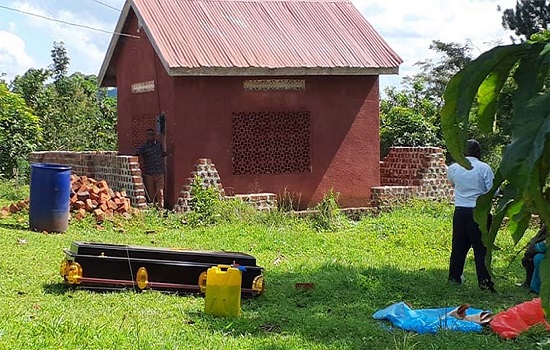
The tomb of the late singer Paul Job Kafeero witnessed a flurry of activities on Wednesday
HABARI DAILY I Kampala, Uganda I Fresh tears flowed and old wounds were opened as Police exhumed the remains of the late Kadongo Kamu singer Prince Paul Job Kafeero, in a dramatic court-sanctioned exercise aimed at collecting bone and tissue samples for DNA testing to resolve a bitter, long-running family dispute over the singer’s lineage and estate.
The operation, conducted on Wednesday at Kafeero’s gravesite in Busansula Village, Nkokonjeru Town Council, Buikwe District, brought to the surface nearly two decades of wrangles that have pitted family members against one another over inheritance, paternity claims, and ownership of the musician’s property.
The exhumation was carried out under a formal court order obtained by some of Kafeero’s children, who have been seeking scientific proof to establish the biological relationship of more than 20 individuals claiming to be heirs of the celebrated singer.
What began as a tightly controlled security operation quickly drew attention from residents and family members as police pathologists, forensic experts, and government officials supervised the delicate process.
Security personnel cordoned off roads leading to the gravesite early in the morning, restricting access to residents and journalists as the exercise got underway. By the time members of the media were allowed into the area, the exhumation had already been completed.
Kafeero’s remains were found placed in a casket, while Rhino Funeral Services oversaw the restoration of the grave following the collection of samples.
Authorities said the samples would be subjected to forensic analysis to determine once and for all who among the claimants is biologically related to the late singer.
The paternity dispute has become one of the most contentious aspects of the prolonged family conflict. More than 20 people have over the years claimed to be children of Kafeero, making the distribution of his estate increasingly complicated.
Legal representative Joseph Luzige, speaking on behalf of some of Kafeero’s children, said the family had exhausted other avenues and believed scientific testing was the only way to conclusively resolve the matter.
“The decision to exhume the body was not taken lightly,” Luzige said, adding that all individuals claiming to be Kafeero’s children were expected to undergo DNA testing.
He noted that the results would help establish the rightful beneficiaries of the estate and potentially end years of uncertainty and legal battles.
The dispute extends far beyond questions of paternity.
Kafeero’s estate, which once included approximately 26 acres of land and other valuable assets, has been at the centre of accusations, counter-accusations and court battles involving different factions of the family.
During interactions with journalists, some of Kafeero’s children, led by Stellah Nantongo, pointed to portions of land that they said formerly belonged to the musician.
They alleged that significant sections of the estate had either been sold, distributed or leased out amid internal disagreements, leaving only about four acres of the original property.
The group also claimed that access to parts of the estate had been restricted and raised concerns about transactions allegedly conducted without the consent of all beneficiaries.
Luzige warned that any property transactions undertaken without consensus among legitimate heirs could face legal challenges.
He said efforts would be made to recover any assets that may have been improperly disposed of if investigations establish wrongdoing.
The wrangles have not only divided family members but have also affected the wider community.
Residents of Busansula Village expressed mixed reactions to the exhumation. While some welcomed the court-directed process as a necessary step toward resolving the long-standing dispute, others questioned the need to disturb the remains of the late singer and expressed discomfort with the development.
Several residents also observed that tensions within the family have frequently spilled into public view, particularly during memorial events held in honour of the Kadongo Kamu icon.
Busansula Village chairperson Aloysious Kasimagwa distanced himself from allegations linking him to disputed land transactions.
Although he acknowledged that farming and construction activities have been taking place on land previously associated with Kafeero, he denied signing documents authorizing any sales.
Amid the controversy, Kafeero’s brother, Abubaker Nende, welcomed the government’s involvement in managing the sensitive process.
He specifically commended State Minister for Youth and Children Affairs Balam Barugahara for efforts aimed at restoring harmony within the family.
Nende also revealed that government had met the costs of the exhumation, DNA testing and restoration of the grave.
On the technical side, AIGP Dr. Moses Byaruhanga, Director of Uganda Police Health Services, confirmed that the exercise was conducted under a valid court order and with the agreement of the parties involved.
He explained that forensic experts collected samples from the remains, which have since been transferred to the Uganda Police Forensic Laboratory and the Government Analytical Laboratory in Wandegeya for detailed analysis.
According to Dr. Byaruhanga, the findings are expected to provide scientific evidence that will help settle the paternity dispute and bring clarity to the administration of Kafeero’s estate.
He urged all individuals claiming to be biological children of the late singer to cooperate fully with the DNA testing process.
“The purpose of this exercise is to bring finality to a dispute that has persisted for many years,” he said.
For a family that has spent nearly two decades battling over inheritance and legitimacy, the exhumation represents a decisive attempt to replace suspicion and accusation with scientific evidence.
Whether the DNA results ultimately heal divisions or deepen existing tensions remains to be seen, but for now, the remains of one of Uganda’s most celebrated musicians have become the centrepiece of a legal and emotional battle over identity, inheritance and family legacy.