
The late Alex Edward Mukulu Nsubuga Kigonya
HABARI DAILY I Kampala, Uganda I He was unrepentant in his little but funny way, a geneous of sorts, who parted ways with us on August 15. Alex Edward Mukulu Nsubuga Kigonya, the playwright, actor, musician, instrumentalist and restless truth-teller, closed his eyes at Kiruddu Hospital after a long fight with liver complications. He was 72.
The final curtain fell on a life that never once dimmed its lights or softened its edges. Mukulu was eccentric, sometimes abrasive, often brutally frank and, above all, unwilling to apologise for the artist he had chosen to become. He could make people laugh, make them uncomfortable and, occasionally, make them angry — sometimes within the same conversation.
But beneath the eccentricity was a serious artistic mission. He believed theatre had a duty to interrogate society, expose injustice and confront the realities of the day. He was not interested in theatre that merely pleased its audience. He wanted theatre that provoked it.
That conviction made him one of Uganda’s most influential theatre personalities and turned him into an unfiltered voice of a generation.
A boy who watched and listened
Mukulu was born in 1954 in Misebe village, Singo County, Buganda, into a Uganda still enjoying the first sweetness of independence. His father was Paulo Kayizi Lugaizi, while his mother, Victoria Ndagire, carried royal blood as the daughter of Prince Yokana Kimbugwe of Lungujja.
The seeds of his artistic life were planted early. While other children played ordinary games, Mukulu watched Rwandan tea-pickers in his neighbourhood dance and sing on payday. He listened to their stories, laughter and sudden sadness.
He was learning to observe people. An aunt who played the violin in the Kabaka’s palace and a grandfather who had once led a band there further exposed him to music and performance. The theatre lion was already taking shape.
He attended Namilyango Primary School and later Kololo Secondary School, where he became president of the drama club.
After O’level, he dropped out for a while and turned his attention to music. He taught himself to play the guitar and saxophone before joining Freddie Kanyike’s River Nile Band on Kimathi Avenue in 1974. There, he stood alongside young musicians such as Philly Bongoley Lutaaya.
Music would remain an important part of his identity, even after theatre became his principal platform.
The first curtain
In 1977, Mukulu staged his first play, Muzukulu wa Kabangala. The following year, he joined Makerere University to study music, dance and drama, while continuing to write and stage plays. For more than four decades, he would produce more than 30 plays.
His theatre became a vehicle for social commentary, historical reflection and political questioning. Perhaps the most memorable was 30 Years of Bananas, first performed as Uganda marked three decades of independence.
Through Kaleekeezi, a Rwandan refugee, Mukulu held up a mirror to Uganda’s journey — its coups, pain, stubborn hope and remarkable appetite for survival. The play did not allow the country to comfortably celebrate its history without examining its wounds.
Oxford University Press published the script in 1993, extending the work’s reach beyond the stage. Other productions followed, including Wounds of Africa, The Guest of Honour, Excuse Me Mzungu, I Killed the Archbishop, Radio Mambo Bado and The People’s President. Each, in its own way, dug into truths that many would have preferred to remain buried.
Theatre had to speak
Mukulu’s biggest complaint about the theatre was that it was becoming too comfortable. He believed theatre should respond to the society around it. “The theatre, which is supposed to boldly follow current events and speak out against injustice, has instead gone into comedy,” he complained.
For him, this was not an attack on comedy itself. Rather, it was a challenge to artists who had abandoned the social responsibility of their craft. He wanted playwrights to look at what was happening around them and respond. He wanted audiences to leave a theatre thinking, questioning and perhaps even arguing. That philosophy made him difficult to handle but impossible to ignore.
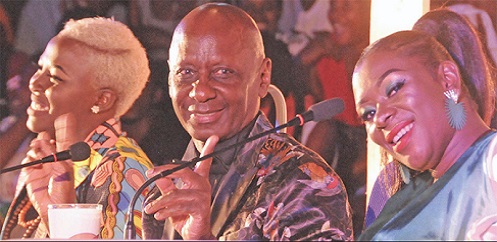
On the talent show Yolesa Ekitone, he became famous — or infamous — as the judge who refused to smile at mediocrity. When he watched a group of dancers whose performance failed to impress him, he bluntly told them: “You stink. You can’t dance before someone when you stink.”
The audience froze before erupting. That was Mukulu. His tongue was his weapon, and he used it freely.
The mentor without softness
Mukulu’s colleagues remember a demanding man who could be arrogant, swear freely and scorn those who could not keep pace with his mind. But his harshness was also part of his mentorship. He believed artists needed to be challenged rather than pampered.
Comedian Herbert Ssegujja was among those who experienced Mukulu’s tough hand and later appreciated what it taught him.
Mukulu did not mentor with softness. He demanded discipline, seriousness and excellence. His criticism could sting, but behind it was an insistence that theatre and performance mattered. To him, an artist was not simply someone who stood before an audience. An artist had a responsibility to society.
The musician never disappeared
Although theatre gave him his greatest public identity, music remained part of Mukulu’s DNA. He was an instrumentalist first, with the guitar and saxophone among his instruments. His songs — including Banakampala, Ensobi, Wakinyonyi, Nkulinze, Bukedde and Empilivuma — carried the same sharp social observation that characterised his theatre.
He sang about city life, human behaviour, culture and faith, as well as the quiet strength of women and children. His music was storytelling set to melody. Radio offered him another platform. Radio Mambo Bado was more than a title; it reflected his belief that the airwaves could carry uncomfortable truths.
When news of his death broke, Radio Simba and other broadcasters remembered him as one of their own. His influence had travelled from the stage to the concert platform, radio studio and television screen.
A solitary man with a restless mind
Away from the spotlight, Mukulu lived a largely solitary life. For many years, he lived alone in his house near Bulange, Mengo.
He needed silence to write and think. He once castigated a journalist for not knowing Wole Soyinka, an indication of the intellectual standards he expected from those who engaged him. He acknowledged that the demands of creating had left little room for ordinary friendship. Companionship, in his world, often came second to the work.
He married, divorced and raised four children, but still chose the solitary house. There were also the small, eccentric details that made him memorable. He boiled eggs with the seriousness of a master chef, although he claimed food itself did not interest him much. He slept whenever he was free. He played the guitar to stay young.
A return after 17 years
Mukulu’s relationship with the National Theatre was as dramatic as some of his plays. Following a disagreement with its management, he stayed away from the main stage for 17 years. During the dispute, he had reportedly said his body should never be taken to the National Theatre for public viewing. But Mukulu was also capable of changing his mind.
In 2024, after reconciling with a new theatre management, he returned to the National Theatre with Kulumbisi Ne Kulunkalu, his African version of Romeo and Juliet. He staged the play free of charge. The return was significant because it represented a reconciliation with an institution from which he had once walked away. In an extraordinary twist, the same National Theatre would later become the place where the public would view his body after his death. It was a final irony worthy of Mukulu himself.
Recognition did not tame him
Mukulu’s contribution to Uganda’s arts did not go unnoticed. In 2007, his Journey to Self-realisation opened the Commonwealth Heads of Government Meeting in Kampala. In 2012, he directed the grand production at Kololo to mark Uganda’s 50 years of independence. The Government later awarded him an Independence Medal. Yet he never behaved like a national treasure.
That was perhaps because he never considered himself finished. He remained restless. There was always another truth to expose, another performance to criticise, another question to ask. That is why his legacy cannot be measured simply by the more than 30 plays he wrote and directed. His real contribution was the attitude he brought to the stage.
He insisted that Ugandan theatre could be serious without becoming dull, political without becoming propaganda and provocative without losing its artistic soul. He turned the theatre right side up by reminding it what it was supposed to do.
The final curtain
Alex Mukulu died at 72 after more than four decades of confronting Uganda through drama, music, radio and an unsparing tongue. Now the stage has gone dark. But Mukulu leaves behind more than plays, songs and memories.