
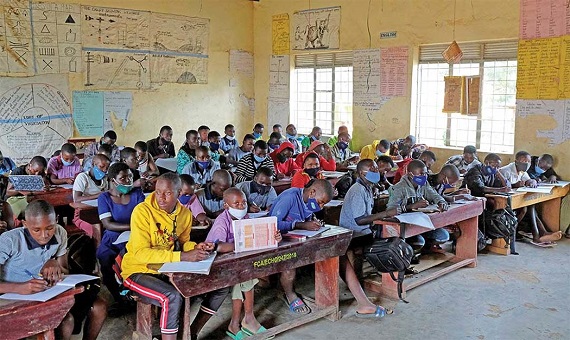
Uganda’s learners in class
HABARI DAILY I Kampala, Uganda I Talk of the impending closure of schools has proved to be worthless talk in the corridors of social media as the Government has reaffirmed its commitment to keeping educational institutions open despite the ongoing Ebola outbreak, dismissing widespread rumours of a nationwide shutdown as false and misleading.
As of June 2, 2026, Uganda is managing an active outbreak of the rare Bundibugyo Ebola virus strain, with nine confirmed cases, one death, and one recovery recorded so far. The situation has been designated as part of a Public Health Emergency of International Concern (PHEIC) by the World Health Organization (WHO) due to its cross-border spread from the neighboring Democratic Republic of the Congo (DRC).
As a result, the Ministry of Education and Sports has moved to calm fears among parents, learners and school administrators after a wave of misinformation circulated online and offline, claiming that schools had been ordered to close because of Ebola cases reported in the country.
Instead of resorting to closures and lockdowns, government officials say the focus remains on enforcing strict health and safety measures in schools while ensuring that learning continues uninterrupted.
The ministry’s position comes at a time when Uganda is managing an Ebola outbreak linked to cross-border transmission from the Democratic Republic of Congo. According to the Ministry of Health, the country had recorded nine confirmed cases and one death by May 31, 2026.
Despite the public health concerns, authorities have emphasized that there are no plans to suspend school activities, shorten the academic term, or impose district-wide lockdowns.
The reassurance follows the rapid spread of alarming messages on social media platforms, particularly X, formerly Twitter, and TikTok, where several users falsely claimed that schools had already been closed.
One account, identified as @kemigishaMackl4 and followed by more than 23,000 people, alleged that schools had been suspended due to Ebola and described the situation as severe. The claim attracted significant attention and generated tens of thousands of views.
Another social media user, Dorty Wallace, posted that schools and public gatherings had been shut down following reported Ebola cases.
The rumours gained further traction through edited videos that recycled footage from previous government addresses made during the COVID-19 pandemic in 2020. Some clips featured old remarks by President Yoweri Museveni and Uganda National Examinations Board executive director Dan Odongo, but were presented as if they related to the current Ebola outbreak.
Other misleading videos falsely claimed that five confirmed Ebola cases had been detected in schools, sparking panic among parents and communities.
The misinformation quickly spread beyond social media and found its way into communities, trading centres and marketplaces.
At Kalerwe Market in Kampala, traders were reportedly discussing claims that schools would close for a month beginning this week. Some compared the situation to the nationwide COVID-19 lockdowns experienced six years ago, while others speculated that any restrictions would only affect schools in border districts.
However, the Ministry of Education and Sports has categorically rejected the claims and urged Ugandans to seek information only from authorized government sources.
In a statement, the ministry’s spokesperson, Dr Dennis Mugimba, stressed that all education institutions remain open and that teaching and learning are continuing normally.
“Please ignore videos and social media messages speculating about the closure of educational institutions. Only trust information from authorised government sources as you continue with normal learning routines safely,” Dr Mugimba said.
His remarks underline the government’s determination to avoid disruptions to education, having learned lessons from the prolonged school closures experienced during the COVID-19 pandemic.
Rather than shutting schools, authorities are relying on preventive measures designed to reduce the risk of Ebola transmission within educational institutions.
Ahead of the reopening of the second school term, the Ministries of Health and Education jointly issued Standard Operating Procedures (SOPs) that all schools are required to implement.
The measures include regular handwashing with soap and clean water, routine temperature screening for learners and staff, establishment of isolation areas for suspected cases, and continuous monitoring for symptoms associated with Ebola.
Schools have also been advised to minimise unnecessary physical contact, strengthen hygiene practices and maintain vigilance in reporting any suspected infections.
Government officials believe these measures provide a safer and more sustainable approach than widespread closures, which could disrupt learning for millions of students.
Although some schools initially struggled to fully comply with the requirements due to logistical and financial challenges, authorities granted institutions a brief grace period to put the necessary systems in place.
Education officials maintain that compliance with the SOPs remains the most effective way of safeguarding learners while keeping schools operational.
The government’s message has therefore remained consistent: education must continue while health precautions are strengthened.
For parents and guardians worried by the flood of online speculation, officials insist there is no cause for panic and no basis for claims that schools are about to close.
Instead, authorities are urging the public to remain vigilant against misinformation, follow guidance from the Ministry of Health, and support schools in implementing preventive measures.
The Uganda Government continues to monitor and contain the Ebola outbreak, say officials. It appears determined to avoid the drastic measures seen during the COVID-19 era, opting instead for targeted health interventions that protect both public health and the right of children to continue learning.







About the Author