
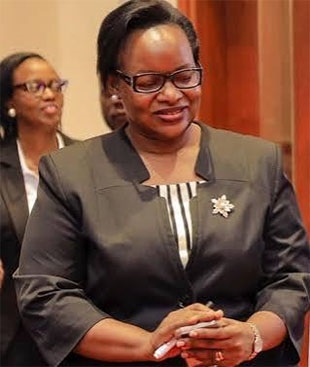
Mercy Kainobwisho
HABARI DAILY I Kampala, Uganda I What started like inhouse squabbles at the Uganda Registration Services Bureau (URSB) late erupted into a governance crisis, culminating in five senior URSB officials being served with mandatory leave letters on Friday after several days of forensic audit activity at the Bureau’s Kampala headquarters.
The dramatic turn of events led to the suspension of top officials including including Registrar General Mercy Kainobwisho, who were suspended and sent on mandatory leave following a presidential directive.
This action followed allegations of corruption, abuse of office, financial mismanagement and deepening divisions among senior managers, prompting President Yoweri Museveni to intervene and order an audit of the institution.
Others affected include Walid Kule, Assistant Commissioner for Business Registration; Alex Anganya, Deputy Registrar General for Finance and Administration; and Arthur Kwesiga, Commissioner for ICT. The officials were directed to step aside pending the completion of investigations into allegations raised by URSB Commissioner for Business Registration Gilbert Agaba.
A State House letter dated July 24, 2026, shows that Museveni directed several senior officials to go on leave pending an audit into alleged embezzlement of government funds, abuse of office, money laundering, maladministration and institutional mismanagement at URSB.
“This is to direct that the following persons go on leave until the audit I am instituting into the activities of URSB is finished,” Museveni said.
The presidential intervention came after Agaba raised a series of complaints about what he described as serious governance and accountability failures at the Bureau.
In a July 29 letter, Agaba listed several areas of concern, including alleged inflation of contracts for the development and maintenance of ICT systems, money laundering through the Non-Individual Register project, embezzlement and misappropriation of Bureau funds, irregular procurement practices, fraudulent registrations, weak internal financial controls and under-collection of revenue.
The allegations paint a picture of an institution where disputes over management and resources had increasingly become intertwined with questions about accountability.
Agaba said the concerns were serious enough to attract the attention of the Attorney General, who subsequently brought the matter to Museveni and the Inspectorate of Government.
“I am aware that the Hon. Attorney General considered the gravity of the issues raised and drew the matter to the attention of His Excellency the President and the Inspectorate of Government,” Agaba wrote, adding that the Inspectorate had since commenced investigations.
The whistleblower also claimed that he faced disciplinary action after raising the allegations, raising further questions about internal governance and the treatment of officials who challenge decisions by their superiors.
“I have reasonable grounds to believe that the investigations culminating in the impugned warning were neither impartial nor undertaken in good faith,” Agaba said.
Museveni’s intervention effectively moved the dispute beyond URSB’s internal management structures. In his July 24 directive, the President instructed the Inspector General of Government to lead the investigations, assisted by State House auditors Kawawa and Tumwine.
He also directed his Principal Private Secretary to arrange a meeting with URSB Board Chairman Stephen Katenta Butagira, signalling the seriousness with which the allegations were being treated at the highest level of government.
The audit and mandatory leave orders have since exposed another dimension of the crisis: bitter infighting within the Bureau’s senior management.
Sources familiar with the situation describe an increasingly fractured leadership, with disagreements allegedly affecting the ability of top managers to work together.
“The situation became so bad that top officials can’t agree on anything in top management meetings,” one source said.
Another source described senior managers as “sworn enemies” whose conflicts were driven by job competition, personal egos and disputes over control of internal budgets.
Such divisions can have consequences beyond personal rivalries. At a public institution responsible for business registration and related services, prolonged management disputes can undermine decision-making, weaken internal controls and create an environment in which questionable practices can go unchecked.
URSB has, however, stopped short of commenting on the specific allegations against individual officials. On August 17, the Bureau confirmed that an audit was underway, saying it was being conducted in accordance with established procedures and applicable laws.
The institution also sought to reassure the public that its operations had not been disrupted.
“URSB confirms that the audit is being undertaken in accordance with established procedures and applicable laws,” the Bureau said, adding that service delivery remained uninterrupted.
It said further information would be provided “where appropriate” after the processes are concluded.
The mandatory leave orders therefore represent a significant escalation from what initially appeared to be internal disagreements among senior officials. What began as clashes over management, positions and control of resources has now triggered a formal examination of the Bureau’s finances, procurement systems, ICT projects and governance structures.
The outcome of the audit and investigations will determine whether the allegations are substantiated and whether further administrative, disciplinary or criminal action follows.
For now, the suspension of senior URSB officials underscores how internal power struggles, when combined with allegations of corruption and weak accountability, can quickly develop into a full-blown institutional crisis requiring intervention from the highest levels of government.







About the Author