

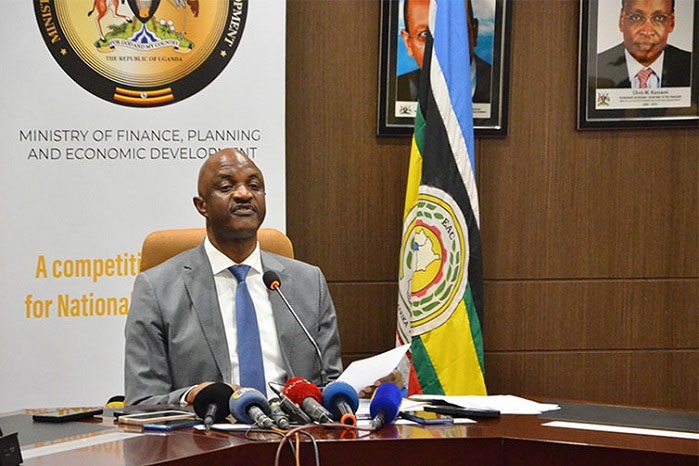
Ramathan Ggoobi
HABARI DAILY I Kampala, Uganda I Uganda’s economy is poised for stronger expansion, with Gross Domestic Product (GDP) growth projected to accelerate to between 6.6 percent and 7.0 percent in the Financial Year 2025/26, up from 6.3 percent recorded in FY 2024/25.
According to Ramathan Ggoobi, the Permanent Secretary and Secretary to the Treasury at the Ministry of Finance Planning and Economic Development, the growth outlook reflects deliberate government interventions and a resilient macroeconomic environment.
Speaking today during the announcement of the Quarter 4 financial releases for FY 2025/26 at the ministry’s headquaters in Kapala today, he said that Uganda’s economy continues to demonstrate strong resilience and momentum.
“We expect growth to accelerate to between 6.6 percent and 7.0 percent this financial year, up from 6.3 percent last year,” Ggoobi said. “This growth is broad-based and supported by both domestic and external factors,” he said.
By June 2026, Uganda’s GDP is projected to reach USD 68.4 billion (Shs 251.4 trillion), equivalent to USD 194.2 billion in Purchasing Power Parity (PPP) terms, with GDP per capita expected to rise to USD 1,399 (Shs 5.03 million).
Ggoobi attributed the improved outlook to a combination of strategic investments and policy interventions. “The drivers of this positive outlook include wealth creation programmes such as the Parish Development Model and Emyooga, continued infrastructure investments, increased foreign direct investment—especially in oil and gas and the ATMS sectors—as well as export growth and sustained political stability,” he explained.
He emphasized that Uganda is on the brink of a major economic turning point with the commencement of oil production later this year. “With the start of oil production, we anticipate even stronger performance, with double-digit growth projected in FY 2026/27,” Ggoobi noted.
The strength of the Ugandan shilling has also played a key role in supporting economic stability. Ggoobi said prudent economic management has ensured the currency remains resilient despite global uncertainties.
“The Ugandan shilling has performed strongly, reflecting our sound macroeconomic policies—an open capital account, diversified exports, a liberalised foreign exchange market, and an active FDI policy,” he said. “Our recent decision to import refined petroleum products directly from producers has further strengthened the currency.”
He added that peace and security have been critical in sustaining investor confidence. “Above all, sustained peace and security in the country has been a strong contributory factor to the stability of the shilling and the broader economy,” he said.
Despite minor depreciation pressures linked to geopolitical tensions in the Middle East, Ggoobi maintained that fundamentals remain solid. “Our foreign exchange fundamentals remain strong and robust, even as the shilling depreciated slightly to Shs 3,762.6 per US dollar as of end March 2026,” he noted.
Investor confidence has remained high, with both local and foreign investors showing optimism—even during an election year. “Uncharacteristically, we are seeing strong investor confidence during an election period. This is largely due to political and economic certainty, as well as the high return on investment, which averages about 14 percent,” Ggoobi said.
High-frequency indicators further confirm the positive trajectory. The Purchasing Managers’ Index averaged 53.7, while the Business Tendency Index stood at 57.6 in the first three quarters of the financial year—both indicating expansion. Meanwhile, the Composite Index of Economic Activity rose significantly, reflecting increased output across sectors.
Inflation has remained contained, averaging 3.3 percent—well below the government’s 5 percent target. “This stability has been supported by the appreciating shilling and easing global inflation, which has reduced the cost of imported goods,” Ggoobi explained.
Uganda’s external position has also strengthened, with foreign exchange reserves rising to USD 5.9 billion, equivalent to 4.1 months of import cover. “This growth has been driven by robust FDI inflows, particularly in the oil sector, as well as improved portfolio investments,” he said.
Additionally, remittances from Ugandans in the diaspora continue to grow, reaching USD 807.32 million in the first half of FY 2025/26.
With these fundamentals in place, Ggoobi expressed confidence that Uganda’s economy is firmly on a path of sustained growth. “All indicators point to a resilient, stable, and growing economy that is well-positioned for transformation,” he concluded.