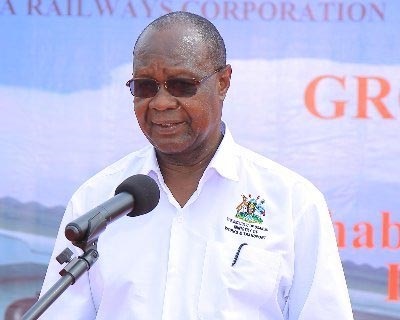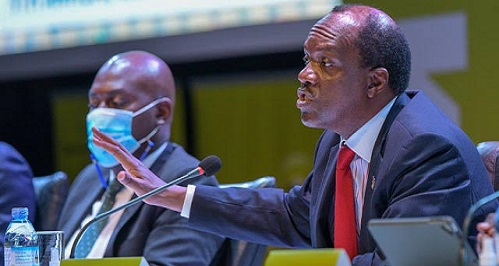

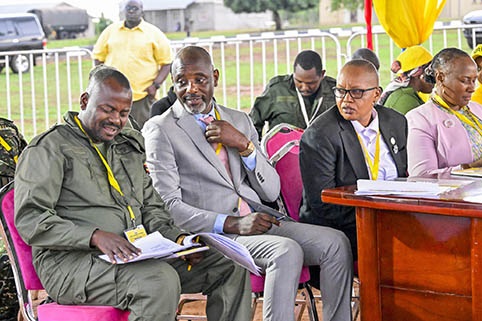
NRM leaders including Hon Haruna Kasolo, the minister in charge of Microfinance and SEC member (Left), Dr Muvawala, the NPA ED and Lydia Wanyoto (3rd Left), the NRM chairperson of the Women League and incoming MP, Mbale City, attending the retreat at NALI on 10th April 2026
HABARI DAILY I Kampala, Uganda I Priorities guided by the Fourth National Development Plan (NDPIV) will be critical in transforming Uganda into a modern economy, says President Yoweri Museveni.
He said that the country will be fine-tuned to achieve the 10-fold growth in the medium term.
In order to achieve the aspirations, the President earlier today outlined ten strategic priorities aimed at expanding Uganda’s economy tenfold, urging leaders to focus on wealth creation and solving real societal problems.
“To achieve the NDPIV objectives, the government will prioritise strategic interventions that expand the economy and improve livelihoods,” President Museveni said, during the ongoing retreat of newly elected Members of Parliament (MPs) and the party -leaning independents at the National Leadership Institute (NALI), Kyankwanzi.
His remarks followed presentations by officials from the National Planning Authority (NPA), including Executive Chairperson Dr Pamela Mbabazi and Executive Director Dr. Joseph Muvawala.
The President emphasised commercial agriculture and value addition as central to economic growth, noting that Uganda must move away from exporting raw materials.
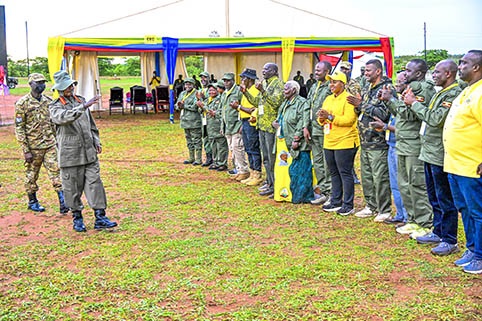
President Museveni arriving at the retreat
“If we add value to products like coffee—through roasting, grinding and packaging—we can earn much more compared to exporting it in raw form,” he explained.
He also highlighted the need to monetise the economy through initiatives such as the Parish Development Model (PDM) and Emyooga, to bring more Ugandans into the money economy.
The President underscored the importance of investing in the knowledge economy, particularly science, technology and innovation.
“We must invest in science and technology, including producing vaccines, automobiles and electronics,” he said.
He further pointed to key infrastructure investments, including high-speed rail, the metre gauge railway, and energy systems to support industrialisation, as well as industrial parks and export processing zones.
The President also stressed the need to reduce the cost of borrowing through institutions such as the Uganda Development Bank (UDB) and Uganda Development Corporation (UDC).
On social services, he called for cost-effective interventions to expand access to education and healthcare.
“We must ensure every parish has a primary school and every sub-county has a secondary school, while strengthening preventive healthcare,” he said.
Other priority areas include investment in the creative industry, preparations for the African Cup of Nations (AFCON), and infrastructure development in the Greater Kampala Metropolitan Area.
President Museveni also addressed urban challenges, particularly traffic congestion.
“Traffic jams in Kampala require significant investment, but we shall solve them,” he assured, adding that corruption must be decisively tackled.
On his part, the Senior Presidential Advisor on Political Mobilization, Moses Byaruhanga who presented a paper on mobilization and service delivery, emphasized that leadership requires a practical approach to problem-solving.
“Leaders must diagnose societal challenges and provide solutions, just like a doctor treats a patient,” he said.
Byaruhanga urged legislators to focus on identifying and solving community challenges.
“As leaders, you must understand the problems affecting society and work towards providing solutions,” he advised.







About the Author