
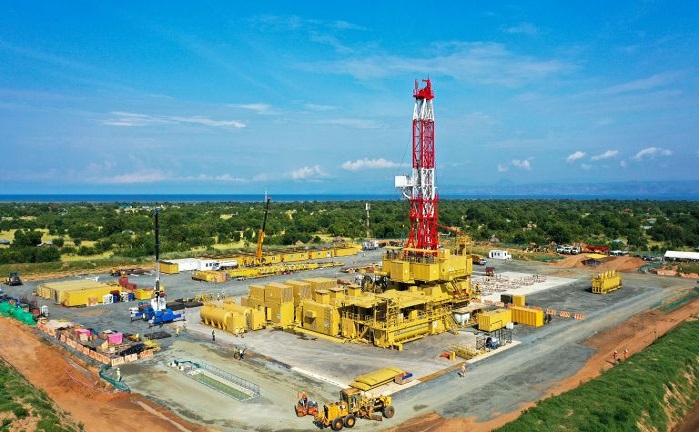
Aerial view of Kingfisher Well Pad on the shores of Lake Albert in western Uganda
HABARI DAILY I Kampala, Uganda I Uganda is on course to emerge as one of Africa’s fastest-growing economies in 2026, with new projections from the International Monetary Fund placing the country among the top performers on the continent. According to the IMF’s April 2026 outlook, Uganda’s economy is expected to expand by about 7.5 percent this year and accelerate further to over 8 percent in 2027, positioning it as the second fastest-growing economy in Africa.
The strong growth trajectory places Uganda just behind Guinea and ahead of several regional peers, while also making it the top-performing economy in East Africa. Economists attribute this surge to a combination of structural reforms, major investments, and the long-anticipated start of oil production.
At the heart of Uganda’s economic momentum is the expected commencement of commercial oil production in the Lake Albert region. After years of exploration and infrastructure development, the country is now on the brink of becoming an oil-producing nation—a shift that is expected to significantly boost government revenues, attract foreign investment, and stimulate growth across multiple sectors.
In its outlook, the IMF notes that oil production could push Uganda’s growth into double-digit territory in the 2026/27 financial year if implementation proceeds as planned. However, Abebe Aemro Selassie cautioned that while oil presents enormous opportunities, it also exposes the country to global price volatility and fiscal risks.
“Oil exporters may benefit from higher revenues but remain vulnerable to volatility and the risk of pro-cyclical fiscal responses,” he said during the release of the regional economic outlook.
Beyond oil, Uganda’s aggressive investment in infrastructure is playing a critical role in driving growth. Over the past decade, the government has poured resources into roads, energy generation, and digital connectivity, improving the country’s productive capacity and lowering the cost of doing business. These investments are now beginning to pay off, attracting both local and foreign investors seeking to tap into Uganda’s expanding economy.
The agricultural sector, which remains the backbone of Uganda’s economy, is also undergoing transformation. Increased emphasis on modern farming techniques, irrigation, and value addition—particularly in commodities such as coffee, livestock, and fisheries—is boosting productivity and export earnings. This shift from subsistence farming to commercial agriculture is strengthening rural incomes and expanding the country’s economic base.
At the same time, the services sector continues to register strong growth, driven by financial services, telecommunications, and trade. A relatively stable macroeconomic environment—characterised by controlled inflation and a resilient banking sector—has supported private sector expansion and consumer demand.
Uganda’s growth is increasingly being powered by domestic activity, with the private sector taking a leading role. Businesses are benefiting from improved access to credit, a growing middle class, and government initiatives aimed at fostering entrepreneurship. This internal dynamism is helping to cushion the economy from external shocks while sustaining high growth rates.
Government policy has also been central to the country’s economic outlook. Initiatives such as the Tenfold Growth Strategy and the Parish Development Model (PDM) are designed to stimulate grassroots economic activity, promote financial inclusion, and transition households into the money economy. By targeting increased production and export competitiveness, these policies aim to sustain long-term growth beyond the oil boom.
Regional and continental trade frameworks are further enhancing Uganda’s prospects. Membership in the East African Community (EAC) and participation in the African Continental Free Trade Area (AfCFTA) are opening up larger markets for Ugandan goods and services. This expanded market access is expected to boost exports and encourage industrialisation, key pillars of sustained economic growth.
Compared to its neighbours, Uganda’s projected growth stands out. Rwanda is expected to grow at around 7.2 percent in 2026, while Tanzania and the Democratic Republic of Congo are projected at about 5.9 percent. Kenya and South Sudan are forecast to grow at below 5 percent, underscoring Uganda’s relative economic strength in the region.
Despite the optimistic outlook, the IMF has warned of potential risks that could derail growth. Delays in oil production, global financial instability, rising public debt, and external shocks could all impact the country’s trajectory. Additionally, managing the transition to an oil economy without undermining other sectors will require careful policy coordination.
Nevertheless, Uganda enters 2026 with what the IMF describes as the strongest economic momentum in a decade. With oil production on the horizon, sustained infrastructure development, and a diversifying economy, the country appears well-positioned to consolidate its place among Africa’s fastest-growing economies.
If these drivers are effectively managed, Uganda’s rise to the top tier of African economies may not only be sustained but could mark the beginning of a new era of accelerated development and transformation.