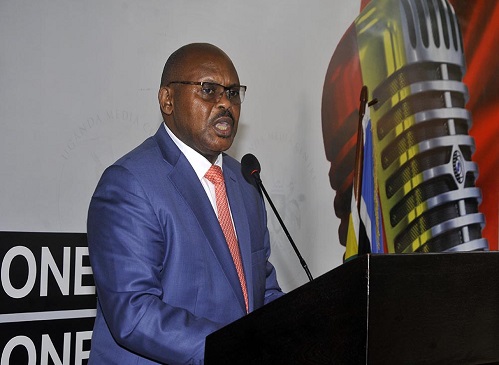

Dr. Rogers Matte from the National Planning Authority signs the report on behalf of Amos Lugoloobi, the minister of Finance in charge of Planning, as Dr. Chris Mukiza, the UBOS Executive Director (2nd Left) looks on
HABARI DAILY I Kampala, Uganda I Uganda’s labour market remains heavily tilted toward informality, with new findings showing that millions of citizens continue to earn a living outside the formal economy.
This is despite government’s efforts to create sustainable and decent jobs.
According to the latest National Human Resource (Manpower) Survey, which was released by the Uganda Bureau of Statistics (UBOS) at its headquarters at Statistics House today, total employment in formal establishments stood at 2,204,918 workers in 2023.
“Of these, 1,326,825 were male while 878,093 were female. In stark contrast, the informal non-household sector employed a staggering 7,183,414 Ugandans in 2024, with women accounting for 3,771,893 and men 3,411,521,” reads part of the report.
The figures highlight a persistent structural challenge: the dominance of informal employment in Uganda’s economy, where the majority of workers remain outside regulated systems that offer job security, social protection, and stable incomes.
Presenting the findings, UBOS Executive Director Dr. Chris Mukiza said the data provides a clear picture of the country’s labour dynamics and should guide policy reforms.
“The survey is designed to provide comprehensive information on employment size, workforce characteristics, and labour demand to inform planning and decision-making,” he said.
Slow pace of growth
Dr. Mukiza noted that while the formal sector continues to grow gradually, the pace is still insufficient to absorb the rapidly expanding labour force, particularly among young people entering the job market each year. He emphasized that the large informal sector—though vital for livelihoods—presents challenges related to productivity, taxation, and worker welfare.
The survey, conducted between February 2024 and March 2025, covered both formal and informal establishments, as well as tertiary training institutions.
It involved a nationally representative sample of 3,100 formal establishments and 10,692 informal establishments, with response rates of 83 percent and 93 percent respectively.
Micro-enterprises
Findings show that employment in the formal sector is concentrated in establishments with five or more employees, as micro-enterprises with fewer workers were not covered in this round. However, UBOS acknowledged this gap and indicated that a specialized survey will be conducted to capture data from smaller businesses.

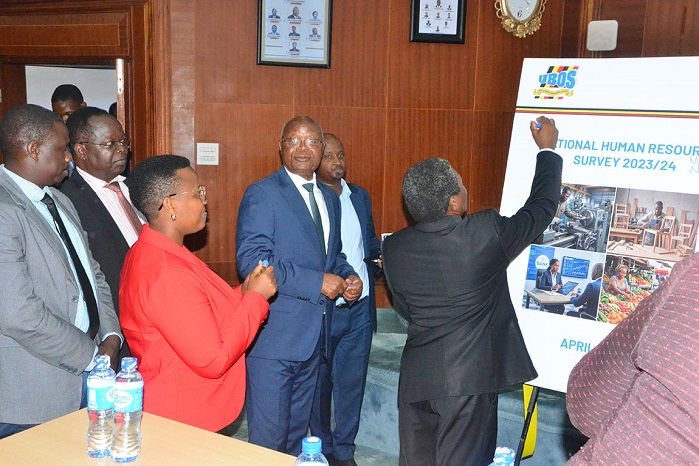
Officials attending the unveiling of the National Human Resource (Manpower) Survey launch
Beyond employment numbers, the report also sheds light on workplace conditions and labour practices. Encouragingly, the proportion of workplaces with occupational health and safety policies increased significantly from 19 percent in 2016/17 to 53 percent in 2024.
This suggests growing awareness among employers about the importance of safe working environments.
Skills mismatch
However, challenges remain. The survey points to persistent skills mismatches in the labour market, where employees’ qualifications do not always align with job requirements. This disconnect continues to affect productivity and limits the ability of businesses to compete effectively.
Dr. Mukiza stressed the importance of aligning education and training systems with labour market needs. The survey collected detailed information on tertiary institutions, revealing that Uganda had 1,459 training and certificate-awarding institutions in 2023, of which 1,010 were privately owned and 449 public.
Enrolment rose from 364,617 in 2021 to 484,746 in 2023, reflecting increasing demand for higher education.
“This growth in enrolment is a positive sign, but it must be matched with quality and relevance to ensure graduates possess skills that meet industry demands,” Dr. Mukiza said.
The findings also underscore the importance of transitioning workers from informal to formal employment. Informal jobs, while widespread, often lack written contracts, social security contributions, and legal protections. This leaves workers vulnerable to income shocks and limits their long-term economic security.
Government has identified formalisation of the informal sector as a key strategy for boosting economic growth and improving livelihoods. By encouraging businesses to register, comply with regulations, and expand, authorities hope to create more stable jobs and widen the tax base.
Gender balance crucial
The survey further highlights the role of gender in employment patterns. While men dominate formal employment, women make up a significant share of the informal workforce, raising concerns about inequality in access to decent work opportunities.
Analysts say addressing this imbalance will require targeted interventions, including skills development, access to finance, and supportive policies that enable women to transition into formal employment.
Technology-led growth
The data also points to the growing role of technology in the workplace. More organizations are adopting information and communication technologies (ICT) to improve efficiency, signaling a shift toward modernisation. However, this trend also demands a workforce equipped with digital skills.
Dr. Mukiza urged policymakers, private sector players, and development partners to make full use of the findings. “Evidence-based planning is essential if we are to address employment challenges and ensure inclusive growth,” he said.
Speaking on behalf of the Minister of State for Planning, Dr. Rogers Matte from the National Planning Authority, said the findings provide a vital assessment of government interventions.
“The results we have just received today are crucial for government in understanding the outcomes of the programmes we have implemented over the years regarding skills-based education,” he noted.
Dr. Matte highlighted that the data will guide reforms in Uganda’s private sector-led economy, particularly in promoting labour rights and transitioning workers from informal and casual employment to more stable, long-term contracts.
“These results should inform a broad spectrum of reforms… especially the much-needed mass transition from casual employment to permanent and well-defined long-term contracts,” he said.

Mercy Kanyesigye signing the report, as the UBOS ED, Dr Mukiza, among other officials look on
Dr. Matte urged stakeholders to utilise the findings to strengthen policies, noting that “robust evidence” remains key to effective planning, improved productivity, and sustainable national development.
Mercy Kanyesigye, the National Female Youth MP-elect called for stronger workplace support systems to safeguard the mental well-being of Uganda’s labour force, emphasizing its role in boosting productivity and economic growth.
“We should have more workplaces supporting their human resources regarding stress management. It is important that our labour force remains in a good mental health state to perform at maximum capacity,” she said.
Kanyesigye noted that government efforts to reform education are already addressing skills gaps in the economy. “Government remains committed to ensuring that we churn out graduates with the right skills easily employable to close existing skill gaps,” she explained, pointing to curriculum reforms aimed at equipping learners with practical, market-relevant competencies.
Paul Okot-Okello, the Commissioner for District Administration, who represented the Permanent Secretary at the ministry of Local Government, emphasized that decentralisation has placed significant responsibility on local governments to manage human resources effectively.
“Except for security and international relations, all other functions have been devolved,” he said, noting that local governments are responsible for recruiting, deploying, and assessing staff.
He stressed that access to reliable data is critical in guiding these processes. “Accessing data like what you will receive today… is very, very important to help local governments properly plan for recruitment, employment, and training based on facts rather than assumptions.”
He further called for strengthening youth employment systems, supporting small enterprises, and investing in innovation, reaffirming government’s commitment to translating survey insights into actionable policies and programmes at local government level.
Speaking on behalf of the Board Chairperson Dr. Albert Byamugisha, Stephen Mukitale, MP for Buliisa welcomed stakeholders and underscored the Bureau’s oversight role in ensuring the production of reliable, demand-driven statistics.
“On behalf of the board of directors, I welcome you, and would like to emphasise that the survey provides critical insights into Uganda’s workforce structure, including skills gaps, gender inclusion, and the transition from informal to formal employment,” he said.
He added that the data is essential for tracking progress on employment efforts, decent work and occupational health standards, gender inclusion, and social security mechanisms
The report is expected to guide policy formulation and help Uganda address challenges posed by its large informal sector while strengthening workforce development strategies.







About the Author