
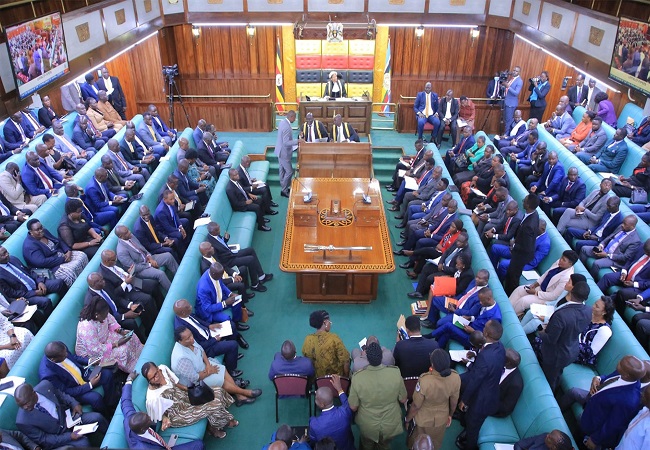
Parliament’s session that passed the bill into law
HABARI DAILY I Kampala, Uganda I Following its passage by Parliament on Tuesday, May 5, after weeks of intense debate, amendments and public scrutiny, the Protection of Sovereignty Law has began to roar, and will not leave Ugandans the same.
The Protection of Sovereignty Bill, 2026 is expected to reshape how Uganda regulates foreign influence, political activity, and certain economic interactions. While lawmakers insist the revised law is more balanced and constitutionally aligned, its real impact will ultimately be felt in the daily lives of citizens, businesses, civil society actors and even Ugandans living abroad.
At its core, the law targets individuals or entities described as “agents of foreigners”—those who act on behalf of foreign interests in ways that may influence Uganda’s politics, governance or national security. For ordinary Ugandans, one immediate takeaway is that the law no longer broadly applies to “any person,” as was initially feared. Parliament narrowed its scope to avoid sweeping up citizens engaged in legitimate activities.
Remittances to be affected
This means that most Ugandans going about their daily lives—running businesses, receiving money from relatives abroad, or participating in community initiatives—are unlikely to be directly affected by the law. Lawmakers deliberately removed provisions that would have cast too wide a net, acknowledging that the earlier draft risked unintended consequences across society.
One of the most significant safeguards introduced is the protection of legitimate financial flows. Diaspora remittances, which many Ugandan families rely on for school fees, medical care and household support, are explicitly exempted. Similarly, foreign direct investment, trade financing, humanitarian aid and commercial loans will not be restricted under the new law.
For a market vendor in Kampala, a farmer receiving support from relatives overseas, or a startup entrepreneur attracting foreign investment, this clarification is crucial. It means their livelihoods should not be disrupted by additional bureaucratic hurdles that were initially proposed in the Bill’s earlier version.
In fact, Parliament replaced a controversial requirement that would have forced individuals and organizations to seek prior government approval before receiving foreign funds. Instead, the law now introduces a declaration system. Agents of foreigners will be required to declare funding sources rather than obtain permission in advance.
For ordinary citizens, this reduces the risk of delays in accessing funds and avoids the creation of a system that could have slowed down economic activity. Lawmakers argued that a permission-based regime might have strained Uganda’s financial system and discouraged investment.
The Bill also introduces exemptions for key sectors that directly affect everyday life. Financial institutions, universities, research bodies and health facilities are shielded from the law’s restrictive provisions. This means hospitals can continue receiving international medical support, researchers can collaborate globally, and banks can operate without fear of regulatory overlap.
New criminal offences
However, the law does introduce new criminal offences that could have indirect effects on citizens, particularly in areas related to information sharing and public discourse. One such provision is the offence of “economic sabotage,” which carries heavy penalties—up to 10 years in prison or fines reaching Shs1 billion for individuals.
Economic sabotage is defined as knowingly spreading false information or engaging in acts that harm Uganda’s economic system. While the intention is to protect the country from destabilizing misinformation, critics argue that the definition could affect journalists, activists and even ordinary social media users if not carefully enforced.
For the average Ugandan who uses platforms like WhatsApp, Facebook or X (formerly Twitter) to share information, this raises questions about how freely they can express opinions on economic matters without risking legal consequences.
Another area of concern is the Bill’s broad definition of “political activities.” The law covers actions aimed at influencing government decisions, public policy, elections and even ideologies deemed inconsistent with Uganda’s Constitution or cultural norms. While this provision is aimed at curbing foreign interference, it could affect how civil society organizations and advocacy groups operate.
NGOs should think twice
For instance, a local NGO receiving foreign funding to advocate for policy change may now need to carefully assess whether its activities fall within the scope of the law. Although exemptions exist, the line between legitimate advocacy and regulated activity may not always be clear.
The law also tightens accountability around firearms and hazardous materials, as seen in cases like that of suspected transnational criminal Keith Mugisha. While not directly linked to the Bill, such developments highlight a broader government focus on national security. For citizens, this could translate into stricter enforcement measures and increased scrutiny in certain areas.
Importantly, Parliament scaled back the powers of the Minister, removing earlier provisions that would have allowed sweeping discretion to label individuals as foreigners or agents. This change introduces more predictability and reduces the risk of arbitrary decisions that could have affected innocent citizens.
Procedural safeguards have also been added, including clearer definitions of offences, requirements for proof of intent, and adherence to due process. These measures are meant to ensure that enforcement does not violate constitutional rights.
Parliament mounted spirited opposition
Opposition Members of Parliament mounted strong resistance to the Protection of Sovereignty Bill, 2026, raising procedural, economic and constitutional concerns during a tense parliamentary sitting.
The debate was marked by sharp disagreements, particularly over how dissenting voices were handled. Nakawa West MP Joel Ssenyonyi questioned the fairness of proceedings during the Committee Stage, citing Rule 215(2) of Parliament’s Rules of Procedure. He expressed concern that members presenting minority views, including Jonathan Odur, were allocated less time compared to those supporting the majority report.
Ssenyonyi challenged the Speaker on whether Parliament was deliberately sidelining dissenting opinions, warning that such actions undermine democratic debate. He questioned whether minority arguments were being treated as irrelevant despite their significance in shaping legislation.
Kilak South MP Gilbert Olanya strongly criticised the Bill, describing it as overly punitive. He argued that the proposed sanctions could negatively impact the economy and called for the legislation to be withdrawn, redrafted and reintroduced with more balanced and proportionate penalties.
Mukono Municipality MP Betty Nambooze also rejected the Bill, citing limited public participation in its development. She accused the committee of ignoring widespread public input, claiming that views from over 700 stakeholders were sidelined in favour of just a handful of presentations.
Nambooze warned that this exclusion violates citizens’ rights to be heard, further fuelling opposition concerns that the law was rushed through without adequate consultation.
Law laced with controversy
Despite these changes, the Bill remains controversial. Several lawmakers argued that it could still infringe on civil liberties and freedom of expression. Concerns were also raised about limited public participation during its drafting and the extent of amendments made at a late stage.
For ordinary Ugandans, the real impact of the Sovereignty Bill will depend on how it is implemented. If applied narrowly and fairly, it could strengthen national security without disrupting daily life. However, if enforced broadly or inconsistently, it may create uncertainty, particularly in areas involving speech, activism and foreign collaboration.
Ultimately, the law reflects a balancing act—between protecting Uganda’s sovereignty and preserving the freedoms and economic opportunities that citizens depend on.