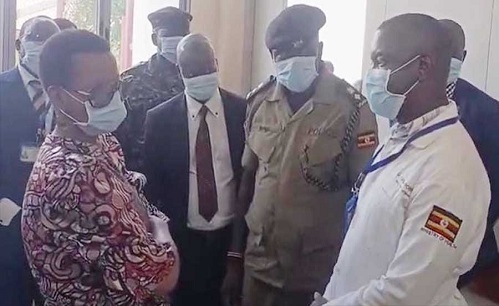


The late Joseph Sseruwooza
HABARI DAILY I Kampala, Uganda I Had the diagnosis of heart failure been made on time, the deceased journalist, Joseph Sseruwooza, would still be here with us today.
That is the painful conclusion emerging from accounts of the final hours of the BBS Terefayina reporter and presenter, whose sudden death in the early hours of Friday, June 19, 2026, has left colleagues, friends and the wider media fraternity in shock.
Sseruwooza, a respected Parliament reporter and host on BBS Terefayina’s current affairs programme Zuukuka N’Ensonga, reportedly died from a heart attack and related cardiac complications after a dangerous blockage in a major coronary artery went undetected for several hours.
Details from those who were with him during his final moments suggest that what initially appeared to be a stomach-related illness may have delayed the identification of a life-threatening heart condition.
According to his colleague and friend, Rafat Musoke, Sseruwooza first complained of severe chest pain on Thursday morning. However, like many people who experience symptoms that can resemble gastrointestinal disorders, he believed he was suffering from ulcers.
The assumption would prove costly.
Musoke said Sseruwooza informed him that he was feeling unwell and requested him to stand in on the morning programme. As the day progressed, his condition deteriorated. A call from Sseruwooza’s wife alerted Musoke that the journalist was getting worse, prompting him to rush to their home and drive him to Gombe Medical Services Hospital.
Upon arrival, doctors reportedly treated him as an emergency case. Medical personnel noted that he was struggling to breathe and that his oxygen saturation levels had fallen below 90 percent, an indication that his body was under severe distress.
At around 3 p.m., he was placed on a ventilator to assist his breathing.
Despite these alarming symptoms, attention initially remained focused on what was believed to be an ulcer-related condition. Doctors reportedly administered antibiotics and conducted tests aimed at determining whether previous medication had been ineffective.
Yet Sseruwooza continued to complain of persistent and severe chest pain.
Hours passed as medical teams sought answers. By evening, doctors reportedly informed relatives and friends that he had received sufficient antibiotics and that administering more could amount to an overdose. They advised that he could return home.
However, even as they left the facility, Sseruwooza insisted that he still felt seriously unwell. Concerned by his continued discomfort, they turned back and returned to the hospital.
That decision may have revealed the true cause of his suffering, albeit too late.
Doctors subsequently ordered a chest scan. According to Musoke, the results were available almost immediately and exposed a critical blockage in one of the main arteries supplying blood to the heart. The clot had significantly restricted blood flow, placing him at imminent risk of a fatal cardiac event.
The discovery dramatically changed the course of treatment.
Medical staff reportedly informed the family that they had roughly one hour within which urgent intervention was needed to restore blood circulation and prevent irreversible damage to the heart muscle. An ambulance was quickly arranged to transfer him to the Uganda Heart Institute in Mulago for specialized cardiac care.
During the journey, there was renewed hope. Musoke recalled that Sseruwooza appeared stronger and was communicating normally, giving relatives confidence that he would survive the ordeal.
Upon arrival at the Uganda Heart Institute at around 2 a.m., doctors immediately began preparations for an emergency procedure to clear the blocked artery. Medical teams worked to stabilize him and ready him for surgery.
But fate had other plans.
Before the life-saving operation could be undertaken, Sseruwooza’s condition reportedly worsened. His blood pressure suddenly spiked, triggering severe complications associated with the heart attack and the prolonged blockage. Despite efforts by specialists to save him, he passed away at approximately 4 a.m.
His death has reignited discussion about the challenges of recognizing heart attack symptoms, particularly when chest pain is mistaken for ulcers, acid reflux or other stomach ailments. Medical experts often warn that delayed diagnosis can significantly reduce survival chances, especially when a major coronary artery is involved.
For colleagues at BBS Terefayina, however, the debate is overshadowed by grief. They have lost a dedicated journalist whose reporting from Parliament earned him respect across Uganda’s media landscape.
What remains is the haunting question of whether an earlier diagnosis of the arterial blockage could have altered the outcome and saved a life that ended far too soon.







About the Author