
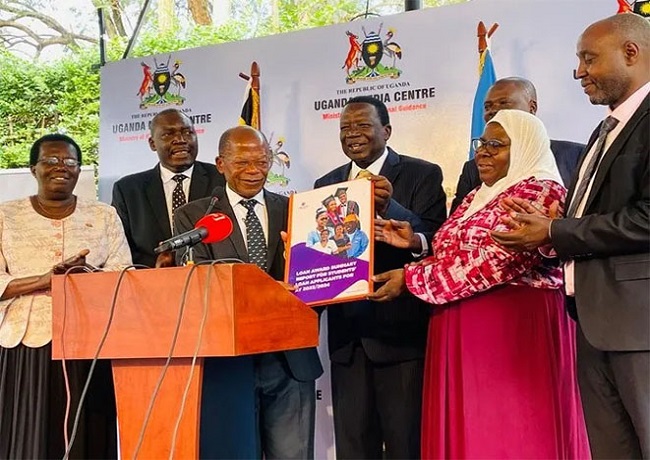
Dr Chrysostom Muyingo, the minister in charge of Higher Education (3rd Left) unveiling the higher education policy in Kampala recently
HABARI DAILY I Kampala, Uganda I The education subsector has grown with leaps and bounds in the last four decades. The Ministry of Education and Sports has registered many achievements one of the most notable ones being the expansion of the Higher Education Students Financing Loan Scheme.
In a recently issued statement titled: The Significant Strides by the Education and Sports Sector – 1986 to 2026,” the ministry says that in 2014, the government introduced the Higher Education Students Financing Loan Scheme.
“The programme initially started with fewer than 1,500 beneficiaries but has steadily expanded to 2,000 beneficiaries in 2025/2026 and is projected to offer loans to 2,500 to 3,000 new beneficiaries in 2026/2027 following an additional resource of UShs.10 billion,” said Dr Dennis Mugimba, the Spokes Person, Ministry of Eductaion.
This means that at least 2,000 students have already qualified for the Shs10 billion boost earmarked for the 2026/2027 expansion phase.
According to the ministry, more than 16,000 Ugandans have so far benefited from the student loan programme. “To date, more than 16,000 Ugandans have benefited through the Students’ Loan Scheme of which a third are females,” Mugimba said.
15 million Ugandans served
The statement, issued ahead of the May 12, 2026 presidential swearing-in ceremony, further says that the country has witnessed sweeping reforms that have expanded access to education from primary school to university level, while also registering major progress in sports development.
The ministry highlighted how the sector has grown from serving a population of 15 million people in 1986 to supporting an estimated 53 million Ugandans today.
“The population in 1986 was 15 million people compared with an estimated 53 million people in May 2026; an increase of more than three and a half times,” Mugimba said.
He noted that the number of educational institutions has expanded dramatically over the years. “On account of the policy of liberalization of the economy under the NRM government, as of May 2026, the people of Uganda are served by 79,819 education schools and institutions of learning that include 45,466 primary schools, 7,503 secondary schools, 1,494 post-primary institutions, 126 international schools, and 55 universities and degree awarding institutions,” he said.
UPE blossoms
The ministry described the introduction of UPE in 1997 as the single biggest turning point in Uganda’s education journey.
“The turning point in Uganda’s Education journey under the NRM administration has been the introduction of UPE in 1997,” Mugimba said.
He explained that enrolment doubled almost immediately after the programme was launched.
“Within one year of introduction of UPE, enrolment in Primary Schools doubled from 2.5 million to 5 million pupils to over 9 million to-date,” he noted.
According to the ministry, before UPE was introduced, education remained inaccessible to many families because of school fees and related charges.
“Prior to the introduction of UPE, Primary Education in Uganda was largely a preserve of public schools yet fees and other charges in these schools were the biggest barrier to access to education opportunities in the country,” Mugimba explained.
He said the policy fundamentally changed the country’s social and economic trajectory.
“After 29 years of implementing UPE and having at least twenty million learners go through the Program, it is resoundingly self-evident that UPE has perhaps been the greatest catalyst in the socio-economic transformation of Uganda inspite the imperfections that still linger in the program,” he said.
The ministry reported that Uganda’s primary school net enrolment ratio has grown from between 35 and 46 percent in the early 1980s to 91 percent today.
“This means that 9 out of every 10 children aged 6 to 12 years in Uganda is enrolled in primary school,” Mugimba stated.
UPE learners hit 2.1 million
The gains have also translated into higher literacy levels nationwide. “UPE has ultimately fueled the rise in literacy rate of 79 percent amongst persons aged 15 years and above in Uganda as of 2021, and 85 percent for the 15- to 24-year-olds as of 2024,” he added.
The ministry also pointed to major expansion under Universal Secondary Education, introduced in 2007.
“Currently, enrollment in secondary education has grown more than eleven times to 2.1 million learners largely on account of the introduction of U.S.E. in 2007,” Mugimba said.
Government secondary schools have also increased significantly. “The government’s aggressive expansion of availability of public secondary schools from 527 in 1986 to 1,515 in 2025 reflects a three-fold growth,” he said.
One of the flagship interventions under USE has been the construction of seed secondary schools in underserved sub-counties.
“At the core of the growth strategy of access to affordable secondary education has been the government’s policy of a public secondary school per sub county where there is no such school,” Mugimba explained.
“This policy alone is responsible for the 250 completely new Seed Secondary Schools built in the last ten years with a further 116 under construction,” he added.
The ministry said transition rates from primary to secondary education have improved sharply because of increased access to affordable public schools.
“The increased presence of affordable public secondary schools under the U.S.E. program is responsible for the four-fold improvement in transition rate from primary to secondary education from less than 15 percent in the early 1980s to 60 percent as of 2025,” Mugimba said.
Gender gains remarkable
The statement also highlighted strides made in gender parity.
“Before the introduction of UPE in 1997, only about 34 to 40 percent of girls would enroll in primary education. However, this has since changed to a ratio of one-to-one meaning that for each boy enrolled in primary education, a girl is also enrolled,” he said.
At university level, the government says affirmative action policies have significantly increased female participation in higher education.
“Earlier in 1990, the NRM government introduced 1.5 points affirmative action for girls joining Higher Education,” Mugimba said.
“This raised enrolment of girls in higher education from as low as 17 percent in the late 1980s to the current rate of 44 to 47 percent in public universities,” he added.
He emphasized that the scheme specifically supports bright but economically disadvantaged learners.
“The scheme targets academically strong students who are economically disadvantaged to access higher education,” he explained.
Science teachers, education expands
The ministry also highlighted achievements in science education, technical training, innovation and sports.
“Whereas by 1986, there were only 2,182 Science and Mathematics teachers in the Secondary Education system, this number has since increased more than six-fold to 14,000 in public Secondary Schools,” Mugimba said.
Government investment in laboratories has also expanded. “Whereas only 40 percent of the 645 public Secondary Schools had science laboratories by the year 2000, the government has since constructed and equipped 800 laboratories in public schools,” he added.
In sports, the ministry described the transformation as equally significant.
“Government funding of sports has grown from less than UShs.300 million in the late 1990s to more than UShs.500 billion in recent financial years; that is growth in funding that is more than 1,600 times,” Mugimba said.
Sports Facilities at the peak
Uganda has also expanded sports infrastructure across the country.
“In 1986, the government had one national stadium at Nakivubo. As of today, the government has developed stadia in an athletics facility at Teryet, stadia in Hoima City and Namboole in addition to Akii-Bua Olympic Stadium coming up in Lira City together with twelve mini-stadia,” he said.
Uganda’s medal tally has also improved substantially over the years.
“Uganda has won 13 Olympic Medals, more than 50 Commonwealth Medals as well as over 80 medals in African Games and Competitions,” Mugimba noted.
He attributed part of this success to stronger talent identification systems within schools.
“Strong sports talent identification and nurturing has been achieved through coordination with Sports Federations/Associations and education institutions of learning. These include the Uganda Secondary Schools Sports Association,” he said.
The ministry says the reforms implemented over the last four decades have laid the foundation for a more inclusive, skilled and competitive Uganda, with education and sports playing a central role in national transformation.







About the Author