

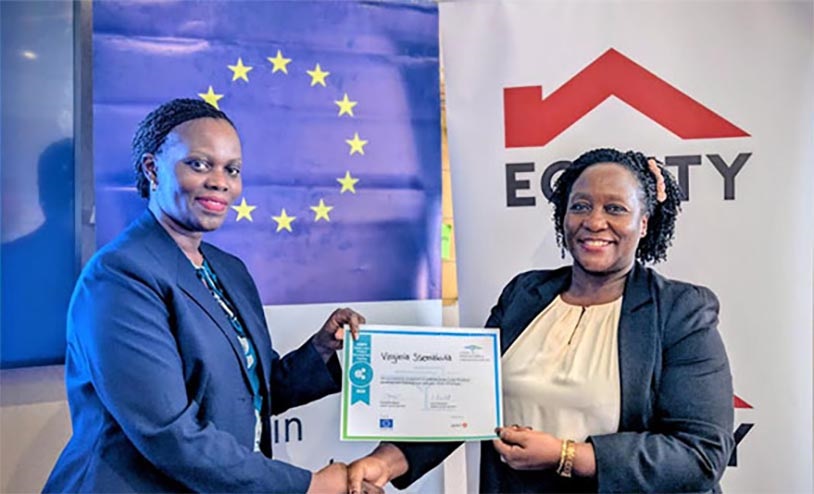
Equity Bank’s Catherine Psomgen hands a certificate of excellence to Virginia Ssemakula, Pillar Head Energy, Environment and Climate Change at Equity Bank Uganda
HABARI DAILY I Kampala, Uganda I Equity Bank Uganda is deepening its commitment to sustainable development through a strategic focus on partnerships that accelerate the growth of green finance, positioning itself as a key catalyst in Uganda’s transition to a low-carbon economy.
This commitment was underscored during the graduation ceremony of a three-day Green Loan Product Development Training held at the Golden Tulip Hotel in Kampala, where Catherine Psogmen, Director of Public Sector and Social Investment at Equity Bank Uganda, served as Chief Guest.
The training was conducted under the Uganda Green Enterprise Finance Accelerator (UGEFA) Project, implemented in partnership with the European Union and adelphi GLOBAL.
Sustainable Finance
Psogmen emphasized that strategic partnerships and regulatory alignment are critical pillars in advancing sustainable finance. “As a bank, we appreciate the partnership we have with the European Union and adelphi GLOBAL under the UGEFA Project. We learned something important about scoping opportunities. This is critical, especially in understanding the regulatory environment and the terrain within which we operate,” she said.
She noted that compliance with emerging regulatory frameworks, including Uganda’s green taxonomy and climate risk regulations, is no longer optional. “The expectations vary, and we need to demonstrate that we have a sustainable organization. You have our commitment that we will indeed implement and grow the numbers when it comes to refinancing,” she added, reaffirming Equity Bank’s determination to translate training into tangible impact.
The intensive training brought together 20 operational staff drawn from key departments, including Product Development, Finance, ESG and Sustainability, Public Sector and Social Investment, Credit and Front Office, Risk, Reporting and Data, Marketing, and Branch Operations. Facilitated by UGEFA’s Green Finance Experts, the program aimed to strengthen internal capacity to attract new clients and mobilize green finance opportunities.
Green loan products
Participants were equipped with practical tools to design and roll out green loan products that balance commercial viability with measurable environmental benefits. Core areas covered included eligibility criteria, risk management, pricing models, and go-to-market strategies, ensuring that staff could confidently structure products aligned with both market needs and climate priorities.
Uganda’s green SME sector continues to face persistent financing challenges, with many enterprises struggling to access capital due to limited collateral, insufficient credit histories, and longer payback periods linked to sustainable investments. For financial institutions, green lending has often been constrained by high transaction costs, difficulties in evaluating emerging technologies, and perceived risk exposure.
However, the growing demand for sustainable finance and the rollout of Uganda’s National Green Taxonomy are opening new frontiers. Banks that invest in internal expertise and innovation are increasingly well-positioned to unlock these opportunities, expand their client base, and strengthen ESG compliance.
National development goals
Virginia Ssemakula, Pillar Head for Energy, Environment and Climate Change at Equity Bank Uganda, highlighted that building internal capacity is foundational to scaling sustainable finance solutions. She said strengthening staff expertise enables the bank to develop tailored green products that respond to real market needs while aligning with national development goals and global climate commitments.
The training concluded with a clear outcome: a practical foundation for launching bank-ready green loan products and a strengthened institutional framework for mobilizing green finance.
Through its strategic partnerships under UGEFA, Equity Bank Uganda is reinforcing its role not just as a financial intermediary, but as a driving force behind Uganda’s green enterprise growth and long-term sustainable development journey.







About the Author