
Dr Olive Lomokol
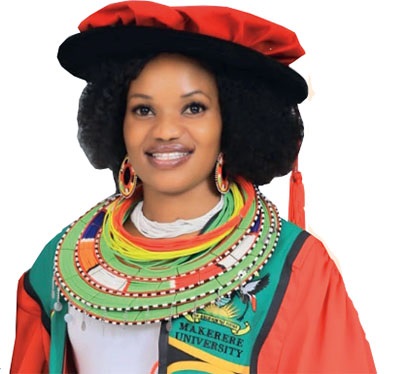
HABARI DAILY I Kampala, Uganda I When Dr Olive Lomokol walks into a classroom today as a scholar, researcher and peacebuilding specialist, it is difficult to imagine that there was a time when simply staying in school was a daily battle.
Long before she became one of the few women from the Karamoja sub-region to earn a doctorate, Lomokol was a young orphan struggling to keep her siblings together and find enough money to survive.
Her story is one of resilience, sacrifice and an unwavering belief that education could offer her and her siblings a future beyond the hardship that had defined their childhood.
On August 22, relatives and friends in Namalu Sub-county, Nakapiripirit district, will gather for a mega celebration in her honour. The occasion will celebrate not only her academic achievement, but also a remarkable journey that has seen her become the first woman in Nakapiripirit district to obtain a PhD.
Lomokol graduated with her doctorate from Makerere University in February and currently serves as a post-doctoral research fellow at the Makerere Institute of Social Research.
But her journey to the academic pinnacle began with loss. “I grew up surrounded by hardship, but I loved school,” Lomokol says.
Her father, the late Mwalimu Linos Muron, was a former headteacher who did not have much materially but placed enormous value on education. He ensured that his six children went to school.
When Lomokol’s mother died, she was only five years old. Yet, she says, her father’s love and care shielded her from fully appreciating the emptiness that comes with losing a parent.
“Dad’s love and care were sufficient,” she recalls. That sense of security disappeared several years later when her father also died. Lomokol was just 13.
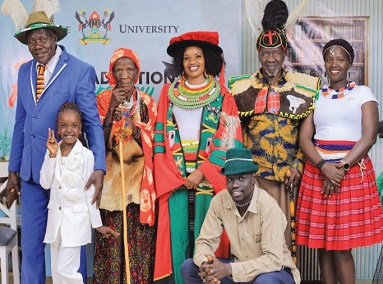
Dr Lomokol and some of immediate family members
Suddenly, childhood ended and responsibility arrived. Relatives wanted to divide the children among themselves, but Lomokol, the second-born, resisted the idea. She wanted the siblings to remain together in the home where their father had been buried.
“I chose we remain in our home where dad was buried, rather than moving in with relatives,” she says.
It was a decision that placed an enormous burden on the shoulders of a teenage girl. With no parents to provide for them, Lomokol had to find ways of putting food on the table while continuing with her education.
She fetched water for money, brewed local beer and made mandazi to make ends meet. “I fetched water for a fee, brewed local beer and made mandazi to make ends meet,” she says.
The work was physically demanding, but Lomokol now looks back at those difficult years as an important part of her formation.
The jobs taught her responsibility, discipline and resilience. They also gave her an appreciation for honest work that she has carried into her academic and professional life.
Her struggle was made harder by the social expectations surrounding young women in rural communities.
Like many girls in Karamoja and other rural parts of Uganda, she faced pressure to abandon education and get married. Marriage was presented to her as a practical solution — someone else would provide for her and her siblings, relieving her of the enormous responsibility she had assumed.
For Lomokol, however, immediate security was not enough. She believed education could give her something more lasting.
She held on to her dream of staying in school, helped along the way by bursaries and Good Samaritans who recognised her potential.
She attended St Mary’s Girls Primary School before joining Kangole Girls Senior Secondary School for O’level. She later went to Moroto High School for A’level.
Her academic journey continued at Uganda Martyrs University, Nkozi, where she pursued a bachelor’s degree in ethics and development studies.
She subsequently obtained a master’s degree in sustainable peace and conflict management and another master’s degree in social studies before pursuing an interdisciplinary PhD at Makerere University.
But Lomokol’s doctorate was not simply an academic exercise. It was also an attempt to challenge how Karamoja has been understood and portrayed for decades.
Her thesis, titled “Shifting Perspectives on ‘Pastoral Violence’: The Persistence of the ‘Karamoja Problem’ in Uganda,” interrogates the origins and persistence of the narrative that has often presented Karamoja as a problem requiring a solution.
Her research was evaluated as outstanding and exceptional, earning a score of 92 per cent. At the heart of her work is a deceptively simple question: How did Karamoja come to be framed as a “problem” in the first place?
Rather than accepting explanations that place the blame primarily on culture, Lomokol examines the region through the lenses of history and politics.
Her work challenges the tendency to reduce Karamoja to images of insecurity, poverty, cattle raids and pastoral violence.
Instead, she invites Ugandans and others to understand Karamoja as a society with its own history, political wisdom and complex social realities.
For a woman who grew up experiencing some of the region’s hardships firsthand, the research carries a deeply personal dimension. Her academic achievement also carries symbolic significance.
“I am the fourth woman from Karamoja to earn a PhD and the first in Nakapiripirit district,” she says.
Her achievement comes at a time when education is increasingly being recognised as a powerful tool for transforming the lives of young people in communities that have historically faced social and economic disadvantages.
Lomokol’s own life demonstrates that academic success does not necessarily begin with privilege.
Sometimes, it begins with a child fetching water for money, making mandazi or taking on responsibilities that would ordinarily belong to adults.
It begins with refusing to give up. And it continues with the willingness to seize every opportunity that comes along. For young people facing circumstances similar to those she endured, Lomokol’s message is straightforward.
“Never be ashamed of honest work. Before I became a scholar, I did odd jobs to survive.” She urges young people to invest in themselves, read widely, ask difficult questions, seek mentors and remain curious.
“The world belongs to those who keep learning,” she says. She also warns young people against measuring their lives against the apparent success of others.
“Do not compare your beginnings with someone else’s success. People often display their achievements, but rarely their struggles. Walk your journey with patience and confidence.” For young women in particular, she has an even more direct message.
“Never allow your circumstances to define your future.” Lomokol believes that where a person begins can influence their journey, but should never determine where they end up.
Degrees may open doors and talent may create opportunities, she says, but character, humility and consistency are what keep those doors open.
She also encourages young women to understand the importance of setting boundaries. “Saying no is not selfish. Protecting your peace is vital,” she says.
On August 22, the people of Namalu will celebrate a daughter who refused to allow tragedy to define her.
They will celebrate the orphan who became a caretaker, the girl who worked to keep her siblings alive, the young woman who rejected the pressure to surrender her education, and the scholar who went on to question the very narratives used to describe her homeland.
For Lomokol, the PhD is more than a collection of academic titles after her name. It is evidence of what can happen when determination survives hardship.
And for Nakapiripirit, her achievement is a historic milestone — a reminder that even from the most difficult beginnings, a child with a dream, support from others and the courage to keep learning can rise to places few imagined possible.







About the Author