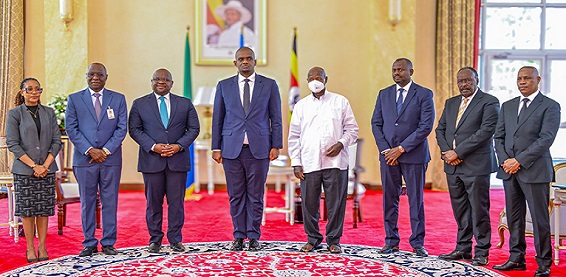
Museveni meeting the Tanzanian delegation led by Vice President, Deogratius Ndejembi, at State House, Entebbe on Wednesday, 4th November 2026
HABARI DAILY I Kampala, Uganda I President Yoweri Museveni has emphasised the need for sustained engagement between Uganda and Tanzania, to ensure the timely implementation of strategic projects aimed at accelerating economic growth.
“This will lead to the strengthening of regional integration and improving the livelihoods of our respective citizens,” he said after holding talks with Tanzania’s Vice President, Deogratius Ndejembi, at State House, Entebbe.
The talks focused on strengthening bilateral relations and advancing joint development projects between the two neighbouring countries.
Ndejembi was in Uganda for a one-day working visit aimed at deepening cooperation between Uganda and Tanzania and reinforcing their longstanding partnership.
During the meeting, the Tanzanian Vice President conveyed warm greetings from President Samia Suluhu Hassan to President Museveni and reaffirmed Tanzania’s commitment to strengthening relations with Uganda.
He noted that the two countries share common interests, development priorities and aspirations for regional prosperity, underscoring the importance of continued cooperation in advancing their mutual interests.
Museveni welcomed the visiting Vice President and reaffirmed Uganda’s commitment to working closely with Tanzania to advance shared development priorities.
He stressed the importance of continued dialogue and cooperation between the two governments in consolidating the longstanding relations between the neighbouring countries.
Uganda and Tanzania maintain strong historical ties and are strategic partners in regional trade, infrastructure development, energy cooperation and economic integration.
The meeting reaffirmed the commitment of both countries to deepen bilateral cooperation and pursue shared development objectives for the mutual benefit of their people.
Uganda-Tanzania trade hits $2.7bn
Uganda’s trade relationship with Tanzania is expanding rapidly, with bilateral commerce estimated at between $2.23 billion and more than $2.7 billion, but the growing exchange is increasingly characterised by a substantial trade imbalance favouring Tanzania.
Recent trade figures indicate that Tanzania exports approximately $2.7 billion worth of goods to Uganda, while Uganda’s exports to its southern neighbour are estimated at only $300 million. The imbalance translates into a deficit of about $2.4 billion, equivalent to approximately Shs9 trillion, highlighting the challenge facing Uganda as it seeks to benefit more from regional trade.
The figures underline Tanzania’s growing importance as a source of essential imports for Uganda, while also exposing the limited penetration of Ugandan products into the Tanzanian market.
Tanzania supplies critical imports
Uganda relies heavily on Tanzania for a range of products required by households, businesses and industries. These include petroleum products and fuels, agricultural commodities such as rice and maize, gold, cereals and industrial raw materials.
Iron, steel and cement are particularly important to Uganda’s construction and manufacturing sectors, which depend on reliable supplies of these materials to sustain production and infrastructure development.
Tanzania’s strategic position along the Central Corridor also makes it an important trade gateway for Uganda, providing access to international markets through its transport network and the port of Dar es Salaam.
The growing trade relationship is therefore not merely about the exchange of goods but also reflects the interconnectedness of the two economies, particularly in energy, transport, agriculture and industrial development.
EACOP strengthens economic ties
One of the most significant developments underpinning Uganda-Tanzania economic cooperation is the East African Crude Oil Pipeline (EACOP), a 1,443-kilometre infrastructure project valued at more than $3.55 billion.
The pipeline will transport Uganda’s crude oil from the oilfields in Hoima to Tanzania’s port of Tanga for export to international markets.
Beyond its role in the petroleum industry, the project is expected to deepen cooperation between the two countries through infrastructure development, investment and associated business opportunities.
Both countries are also members of the East African Community (EAC), whose regional integration framework provides mechanisms for promoting trade, reducing barriers and facilitating the movement of goods and services.
Trade is supported by transport connections through the Central Corridor and Lake Victoria, including routes linking Mwanza in Tanzania to Port Bell in Uganda. The two governments also engage through the Joint Permanent Commission (JPC), which provides a platform for addressing bilateral economic and diplomatic concerns.
Trade barriers threaten growth
Despite the expanding relationship, non-tariff barriers continue to undermine the full potential of bilateral trade.
Ugandan exporters have periodically raised concerns over restrictions affecting access to the Tanzanian market, including quotas and duties on products such as sugar, milk and steel.
Such measures increase the cost of doing business, create uncertainty for exporters and undermine the regional integration commitments both countries have made under the EAC framework.
The governments have consequently held bilateral discussions aimed at eliminating trade bottlenecks and improving market access.
For Uganda, the challenge is to narrow the trade gap by expanding the range and competitiveness of locally manufactured and agricultural products entering Tanzania.







About the Author