
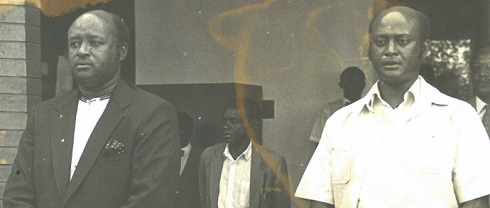
Kaboyo (left) with his late brother Prince James Mugenyi who died in September 2016
HABARI DAILY I Kampala, Uganda I The Uganda Police in its wisdom has failed to uncover the mystery surrounding the death of several Tooro Kingdom royals, including King Patrick Matthew Kaboyo Olimi III, whose sudden death in 1995 remains one of the most intriguing episodes in the modern history of the ancient kingdom.
Kaboyo, father of the late King Oyo Nyimba Kabamba Iguru Rukidi IV, died on August 26, 1995, after developing severe stomach complications in Kampala and later collapsing shortly after reaching Tooro.
More than three decades later, questions surrounding what exactly killed the former Omukama have never been conclusively answered.
The mystery was deepened by the fact that his sister, Princess Elizabeth Bagaya, attempted to have samples of his vomit examined after his death. But the effort was abandoned after members of the royal establishment objected to a post-mortem examination on traditional grounds.
That decision meant that a potentially crucial opportunity to establish the medical cause of death was lost.
For a royal family that has now lost another monarch in the person of King Oyo, the circumstances surrounding Kaboyo’s death have inevitably returned to public discussion.
Kaboyo’s final journey
Kaboyo’s death came at a particularly important moment in his life and reign. He had returned to Uganda from London, where he had accompanied his wife, Best Kemigisa, while arrangements were being made for the treatment of their daughter, Princess Cecilia Komukyeya, who was suffering from leukaemia.
At the time, Kaboyo was preparing to reshuffle his cabinet. He had confided in his full brother, Prince Jimmy Mugenyi, that he intended to replace his then prime minister, John Sanyu Katuramu, with Stephen Kapimpina Katenta Apuuli, popularly known as Ambassador Katenta Apuuli.
But before he could announce the changes, the King developed stomach problems while at Uganda House in Kampala.
As his condition deteriorated that night, he reportedly became concerned about dying away from his kingdom.
He instructed his driver to take him to Tooro. “Take me to my kingdom. I don’t want to die from here. Omukama has to die in his kingdom,” Kaboyo reportedly told the driver.
At around 1am, the visibly distressed King began his journey from Kampala to Tooro. But his condition did not improve.
After arriving in Tooro, Kaboyo developed further stomach problems before collapsing and dying on August 26, 1995.
He was only 49. The abruptness of the illness, the timing and the absence of a definitive post-mortem examination have since left a gap in the historical record.
The post-mortem that never happened
Princess Bagaya, Kaboyo’s sister, apparently had enough concern about the circumstances of his death to collect samples of his vomit for examination. Her intention was straightforward: determine what had caused the King’s sudden deterioration and death.
But the attempt ran into an obstacle that was cultural rather than scientific. Royals, including Sylvester Katama, reportedly objected to subjecting the deceased King to a post-mortem, arguing that Tooro tradition did not permit such an examination of a deceased Omukama.
Bagaya eventually gave up her effort. That decision is perhaps the biggest unanswered question surrounding Kaboyo’s death.
What would an examination of the samples have revealed? Was the King’s death caused by a sudden natural illness, poisoning, an undiagnosed medical condition or something else?
There is no established evidence in the information available to definitively answer those questions. And because the post-mortem was not carried out, the uncertainty became permanent.
A royal family marked by sudden deaths
The questions surrounding Kaboyo’s death become even more striking when viewed against the background of other deaths involving people connected to the Tooro royal family.
In October 2007, Roger Mugenyi, a 33-year-old cousin and manager of celebrated musician Juliana Kanyomozi, died at Kadic Hospital in Bukoto after suffering severe head injuries.
Mugenyi had reportedly been beaten by traffic police officer Norbert Ojok, who accused him of overtaking vehicles along the Kampala-Ggaba Road.
A post-mortem examination subsequently indicated that Mugenyi had suffered a blood clot on the brain resulting from the severe beating.
Ojok was charged with murder before Buganda Road Magistrate Susan Kanyange on October 15, 2007. The significance of Mugenyi’s death to the Tooro story lies in his royal connection.
He was a relative of Kaboyo. His mother, Princess Rachael Kabasweka, was Kaboyo’s younger sister. Kaboyo had reportedly paid Mugenyi’s school fees at St Leo’s College Kyegobe and Namasagali College in Kamuli.
Unlike Kaboyo’s death, however, Mugenyi’s case had a documented medical explanation linking his death to physical injuries.
His death nevertheless illustrates how violence and sudden deaths have touched people close to the Tooro royal household.
Kaboyo’s complicated history
The mystery surrounding Kaboyo’s death cannot easily be separated from the extraordinary political history through which he lived.
Born on September 9, 1945, to King George Rukidi III and Kezia Byanjeru, Kaboyo became Omukama following his father’s death in December 1965. His coronation took place at St John’s Cathedral in Kabarole on March 2, 1966.
But his reign lasted barely a year. In 1967, the Milton Obote government abolished Uganda’s traditional monarchies, forcing Kaboyo into exile. He first went to Kenya, where President Jomo Kenyatta, a friend of his late father, helped him obtain employment in a tea corporation.
He later moved to England. When Idi Amin seized power in 1971, Kaboyo returned to Uganda hoping the new regime would restore the monarchies. His family became deeply entangled in the politics of the period. His full brother Jimmy Mugenyi joined Amin’s military, while his sister Bagaya was appointed Uganda’s roving ambassador and later foreign minister.
Bagaya eventually fled to Britain and was joined there by Kaboyo.
After Amin’s fall in 1979, Kaboyo returned to Uganda and entered politics, joining Yoweri Museveni’s Uganda Patriotic Movement.
He later went into exile again after the beginning of Museveni’s armed struggle against Obote in 1981.
From king to diplomat
When Museveni came to power in 1986, Kaboyo’s political and royal experience made him useful to the new administration.
He was appointed Uganda’s High Commissioner to Tanzania in 1987 and later served in Havana, Cuba. It was during his diplomatic posting in Tanzania that he married the young Best Kemigisa. Their son, Oyo, was later born at Nsambya Hospital in Kampala while Kaboyo was serving in Cuba.
The child would eventually become one of the world’s youngest monarchs. Kaboyo returned to the Tooro throne in 1993 when Uganda restored traditional and cultural institutions. But only two years later, he was dead.
A death that closed a chapter—and opened questions
The circumstances of Kaboyo’s final hours remain particularly haunting because he appeared to know that he was seriously ill.
His insistence that he be taken to Tooro because “Omukama has to die in his kingdom” gave his final journey an almost prophetic character.
But it also raises questions that history cannot now easily answer. Why did his stomach illness deteriorate so rapidly?
What exactly was contained in the samples collected by Princess Bagaya? Would a medical examination have revealed a natural cause of death or something unexpected?
And, perhaps most importantly, why was there no alternative scientific examination capable of settling the matter?
There is no evidence in the supplied record establishing that Kaboyo was murdered or poisoned. The mystery arises principally from the absence of a definitive medical finding.
That distinction matters. Speculation cannot substitute for evidence, particularly when dealing with the death of a member of a royal family.
Oyo’s death revives an old royal question
The death of King Oyo in the United States on August 27, 2026, has brought renewed attention to the history of his family.
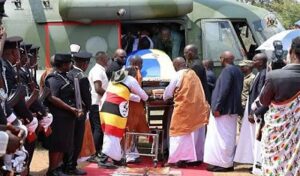
King Oyo’s body being loaded onto an a UPDF helicopter on September 4th 2026, for his final journey to Kyegegwa and eventually Fort Portal City before his final sendoff
Oyo’s death, like that of his father, occurred away from Tooro. But unlike Kaboyo’s case, Oyo’s death occurred in a modern medical environment in the United States, where he had been receiving treatment.
His remains have since been returned to Uganda and are scheduled to be buried at the Karambi Royal Tombs on September 12.
As Batooro prepare to lay their King to rest, the unresolved circumstances surrounding Kaboyo’s death remain part of the family’s historical memory. They are also a reminder of how traditional practices, political history and modern forensic science can collide.
For Tooro, the question is no longer merely who died, but what history failed to establish about how some of its most prominent royals died.
Kaboyo’s death remains the clearest example. A King became suddenly ill, insisted on being taken home, collapsed and died. His sister sought answers, but tradition closed the door on the post-mortem that might have provided them.
And with that decision, one of the enduring mysteries in Tooro’s modern history was carried into the grave with the late Omukama.







About the Author