
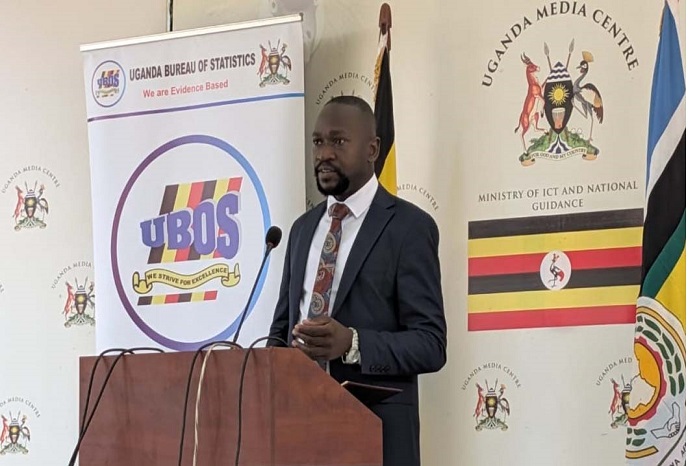
Mr Didacus Okoth, the UBOS Principal Public Relations Officer
HABARI DAILY I Kampala, Uganda I The Uganda Bureau of Statistics (UBOS) has launched a structured release calendar for the dissemination of statistical reports from completed national surveys and censuses, a move officials say will strengthen evidence-based planning and decision-making across the country.
The announcement was made during a press conference held at the Uganda Media Centre, where UBOS Principal Public Relations Officer Didacus Okoth represented the Bureau’s Executive Director, Dr Chris Mukiza.
Okoth told journalists that the new calendar will ensure timely dissemination of statistical findings to government institutions, development partners and the public.
“The Uganda National Bureau of Statistics has come up with a structured release calendar for surveys and censuses,” Okoth said. “This release calendar is going to take effect this month for the first part of the year up to May 2026. Thereafter, we shall again provide more guidance to the country as far as statistics is concerned.”
He emphasized that the bureau regularly conducts major national surveys and censuses and that the scheduled releases will allow stakeholders to access crucial data needed for planning.
“As you may be aware, the Bureau has routinely conducted censuses and surveys. Most of us are familiar with the Population and Housing Census which we conducted recently. With the support of the public and stakeholders, it was a very successful exercise and we were able to publish the report,” Okoth said.
“Going forward, the Bureau has also conducted other surveys and censuses. That is why we are here today to inform the country that we are preparing ourselves to receive these very important statistics which will guide planning, decision-making and any conversation that matters to the public.”
Malaria Indicator Survey First on the Calendar
According to Okoth, the first report under the new release calendar will be the Uganda Malaria Indicator Survey Report, scheduled for release on March 12.
“This Thursday the Bureau will disseminate the Uganda Malaria Indicator Survey Report,” he said. “This exercise was launched by the Minister of Health, Dr. Jane Ruth Achieng, in December 2024.”
Okoth explained that UBOS worked with multiple stakeholders to collect comprehensive data on malaria prevalence and control interventions across the country.
“Since the launch of that exercise, the Bureau has worked with a number of stakeholders to collect data on malaria prevalence and malaria control. The report will help the country understand the causes of malaria and the control measures that government has put in place to reduce its impact on the population,” he said.
He noted that malaria remains one of Uganda’s leading causes of illness and death, making the survey’s findings critical for public health planning.
“We all know that malaria is one of the leading causes of death in Uganda, and this report will give us detailed statistics which will help guide planning in the health sector,” Okoth added.
The report will be officially launched at Statistics House in Kampala and is expected to attract top government officials.
“We expect a number of delegates at the launch,” he said. “We shall have the Minister of Health, the Minister of Finance, permanent secretaries and development partners who have been working with us closely to ensure that this report comes out.”
Reports on Vulnerable Children and Poverty
The second release on March 19 will focus on Orphans and Other Vulnerable Children, presented as Volume Four of the census monographs.
“This statistical information report focuses on children who are not under good care of their parents,” Okoth explained. “For example, the orphans who may have lost one parent or both parents and therefore are not able to easily access social services like other children.”
He noted that the report will highlight challenges faced by such children in accessing education, healthcare and other essential services.
“We also have children who live in refugee settlements. Some of them came from other countries without their parents. When you look at such situations, you realize that accessing services such as education, health care, birth registration or immunization becomes a challenge,” he said.
“That is why the Bureau is deepening its research to ensure that the country and responsible institutions receive this information so that they can plan better for this category of citizens.”
On March 26, UBOS will release the Multidimensional Poverty Index Census Monograph, which examines poverty beyond income levels.
“Most people associate poverty with lack of money,” Okoth said. “But multidimensional poverty looks at other deprivations that people face in their lives.”
He cited poor sanitation and lack of access to education as examples of non-income indicators of poverty.
“You may find that a household does not have proper sanitation facilities. One toilet may be shared by more than a hundred people. Children may also be deprived of education because they lack basic school materials such as books, pens or pencils,” Okoth explained.
“This type of poverty analysis is very critical for Uganda to understand so that we can continuously improve the lives of our people.”
Education and Labour Data to Follow
On April 9, UBOS will release the Baseline Education Census Report, which provides detailed information on Uganda’s education system.
“We collected data from primary schools, secondary schools, tertiary institutions and universities,” Okoth said. “This report will give detailed information on infrastructure in schools, the level of staffing, enrollment numbers and other important indicators.”
Another major report scheduled for April 23 will focus on the country’s labour supply.
“The social survey focuses on labour supply – the people who graduate from different higher education institutions and the skills they acquire,” he said.
Okoth explained that the report will provide more detailed insights into professional training in the country.
“For example, if Makerere University graduates doctors, we want to know the categories of doctors. We want to know how many physicians, how many neurologists or pediatricians have graduated,” he said.
“It is not just about saying doctors have graduated. It is about understanding the different categories of professionals who are joining the labour market.”
First Aquaculture Census
UBOS will also release Uganda’s first comprehensive Aquaculture Census Report on April 30.
“This survey was undertaken last year and it is going to be the first of its kind in Uganda focusing specifically on fish farming,” Okoth said.
The report will provide detailed information on fish species, farming practices and production systems used by farmers across the country.
“We shall look at the types of fish Ugandans farm and the farming practices used. Some farmers use cages on Lake Victoria while others use ponds,” he explained.
“This report will provide a comprehensive picture of the aquaculture sector and guide fish farmers as well as policymakers.”
Living Standards Survey
The final release under the current calendar will take place on May 7 with the Uganda Harmonized Indicator Survey, covering multiple waves of data collection.
“This report focuses on the standard of living and the conditions under which people live in their households,” Okoth said.
“It also examines issues such as poverty, employment and overall welfare in the country.”
He emphasized that the entire release calendar demonstrates UBOS’ commitment to providing reliable data for national development.
“We want the country to keep these dates on its diary and follow up on the releases,” Okoth said. “As a bureau, we shall walk the talk and ensure that these reports are made available as scheduled.”
According to UBOS officials, the dissemination of these reports is expected to play a critical role in guiding government policies, development programs and investment decisions aimed at improving the lives of Ugandans.







About the Author