

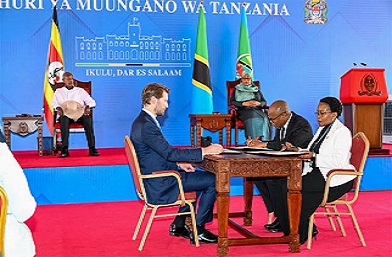
A Vitol Bahrain E.C. official pens the agreement with a Tanzanian counterpart, showing the international dimension of the MoU
HABARI DAILY I Kampala, Uganda I Billed as one of the biggest joint, regional energy and oil undertakings in East Africa, Uganda and Tanzania have signed a multi-billion-dollar memorandum of understanding aimed at transforming the Tanga Regional Energy Hub into a major centre for petroleum processing, storage, logistics and industrial development.
The agreement, signed at State House in Dar es Salaam on August 5, 2026, brings together the Uganda National Oil Company (UNOC), Tanzania Petroleum Development Corporation (TPDC) and global energy trader Vitol Bahrain E.C.
The signing was witnessed by President Yoweri Museveni and his Tanzanian counterpart, President Samia Suluhu Hassan, during Museveni’s state visit to Tanzania.
Officials estimate that the expansive Tanga Regional Energy Hub could attract more than US$20 billion in energy and industrial investments, potentially making it one of the largest integrated energy developments in Sub-Saharan Africa.
Crude Exports to Regional Industrialisation
At the heart of the agreement is an ambition to change how East Africa uses its petroleum resources.
Rather than limiting the region to producing and transporting crude oil for export, Uganda and Tanzania want to establish infrastructure that allows more value to be captured within the region through refining, storage, distribution, petrochemicals and related industries.
The project builds on the foundation created by the 1,443-kilometre East African Crude Oil Pipeline (EACOP), which is being developed to transport Uganda’s crude from the Albertine Graben to the Port of Tanga.
Tanzania’s Minister for Energy, Deo Ndejembi, captured the broader ambition by describing the pipeline and hub as complementary components of the same industrial strategy.
“EACOP transports molecules. The Tanga Regional Energy Hub transforms those molecules into prosperity,” Ndejembi said.
The proposed hub will include petroleum refining facilities, large-scale storage tank farms, marine jetties, logistics infrastructure, petrochemical activities and systems for distributing petroleum products across regional markets.
Hoima Refinery to Complement Tanga
Ugandan officials stressed that the Tanga project is not intended to replace Uganda’s planned refinery in Hoima. Instead, the two projects are expected to complement each other, with the Hoima refinery primarily serving Uganda’s domestic refining requirements while Tanga develops into a broader regional logistics and industrial platform.
Energy and Mineral Development Minister Dr Monica Musenero Masanza said the partnership reflects Africa’s longstanding desire to stop exporting raw resources without capturing sufficient value from them.
She argued that East Africa must move towards local value addition and develop a knowledge-based economy supported by highly skilled employment in engineering, operations, maintenance and technical analysis.
The strategy is also consistent with the African Union’s Agenda 2063, which places industrialisation, regional value chains and value addition at the centre of Africa’s economic transformation.
Uganda currently spends an estimated US$2 billion annually importing petroleum products, making the development of domestic and regional refining capacity strategically important for energy security.
Wider Energy Cooperation
The MoU also broadens Uganda-Tanzania energy cooperation beyond crude oil. Feasibility and Front-End Engineering Design studies for a proposed bidirectional refined petroleum products pipeline between the two countries are expected later this year. Studies for a cross-border natural gas pipeline are also expected to be completed by October 2026.
The two countries are additionally pursuing electricity infrastructure. Uganda has secured US$250 million in World Bank financing for its section of a planned 400-kilovolt electricity interconnector, which is expected to strengthen electricity trading under the Eastern Africa Power Pool.
The partnership therefore stretches across petroleum, gas, electricity and associated infrastructure, creating the possibility of a more integrated regional energy market.
Vitol Brings Global Expertise
The participation of Vitol Bahrain E.C. adds an international commercial dimension to the project.
Vitol, one of the world’s major independent energy trading companies, already works with UNOC in petroleum storage and downstream logistics in Uganda.
Its participation is expected to provide access to international petroleum markets, technical expertise and potential financing networks, while strengthening the commercial profile of the proposed hub.
The project also builds on more than a decade of Uganda-Tanzania energy cooperation, including the 2017 Inter-Governmental Agreement and subsequent Host Government and EACOP agreements.
Oil Boom
The ambitious plans come as Uganda moves closer to commercial oil production from the Tilenga and Kingfisher projects, with first oil targeted for 2026–2027.
Yet the development of EACOP and related petroleum infrastructure continues to attract criticism from environmental organisations and climate campaigners over biodiversity, greenhouse gas emissions, land acquisition and the displacement of affected communities.
International financial institutions have also become increasingly cautious about financing major fossil-fuel infrastructure amid the global transition towards cleaner energy.
However, the Tanga hub is therefore likely to face scrutiny over environmental safeguards, climate resilience, local content, regulatory compliance and long-term commercial viability.







About the Author