
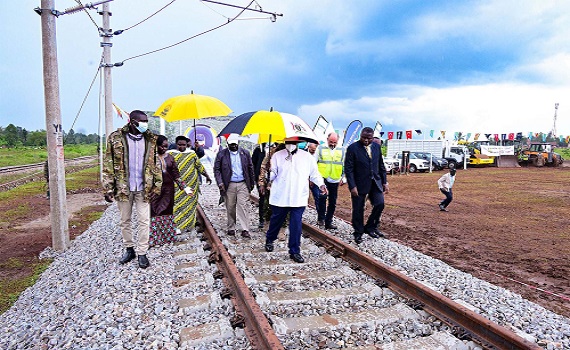
President Museveni unveiled the construction of the SGR several years ago
HABARI DAILY I Kampala, Uganda I Uganda’s transport infrastructure set up is set to receive a drastic boost following the approval of €650.75 million ($754.8 million) in financing from the Islamic Development Bank (IsDB) for the construction of the long-awaited Standard Gauge Railway (SGR) between Malaba and Kampala.
The funding, approved by the IsDB Executive Board during its 51st Annual Meetings in Baku, Azerbaijan, represents the largest single-project financing package ever authorized by the bank for Uganda and marks a major milestone in one of the country’s most ambitious infrastructure projects.
The financing is expected to accelerate the implementation of the 272-kilometre Malaba-Kampala railway corridor, a strategic transport link that will connect Uganda to Kenya’s standard gauge railway network and ultimately to the Port of Mombasa, East Africa’s busiest maritime gateway.
The project is widely regarded as a game-changer for Uganda’s transport sector, with the potential to significantly reduce logistics costs, improve cargo movement, and strengthen regional trade.
Road transport costly
For years, Uganda’s economy has relied heavily on expensive road transport, with more than 90 percent of freight currently moved by trucks. This dependence has contributed to high transport costs, traffic congestion, frequent road maintenance requirements, and increased pressure on national highways.
The completion of the SGR is expected to ease these challenges by shifting a substantial portion of cargo traffic from roads to rail.
Authorities estimate that once operational, the railway will reduce cargo transit times between Mombasa and Kampala from the current average of about five days to less than 24 hours. Transport costs are also projected to decline by as much as 40 percent, providing significant savings for businesses and enhancing Uganda’s competitiveness as a trade and investment destination.
Beyond the main railway line, the IsDB financing package will support the construction of 232 kilometres of feeder lines and several critical infrastructure components. These include the Jinja Nile Bridge, the Mbuya-Kampala tunnel, six railway stations, and three locomotive workshops.
Modern rail transport ecosystem
Together, these facilities will create a modern rail transport ecosystem capable of supporting both freight and passenger services while improving connectivity across the country.
The latest financing builds on a broader $800 million IsDB Group framework agreement signed in May 2025 to support climate-resilient transport and trade infrastructure in the region. The agreement reflects growing confidence in Uganda’s efforts to modernize its transport systems and enhance regional economic integration.
The SGR project has experienced multiple delays since it was first conceived over a decade ago. Construction was initially awarded to China Harbour Engineering Company (CHEC), which was expected to help secure financing for the project. However, financing challenges persisted, leading the government to reassign the construction contract to Turkish engineering firm Yapi Merkezi, which is currently leading implementation of the eastern line.
To keep the project moving despite funding delays, the government has undertaken preliminary works using bridge financing. Activities such as the production of railway sleepers and the establishment of construction camps have already commenced. Uganda has also explored innovative financing options, including the issuance of Islamic bonds, commonly known as Sukuk, to complement traditional funding sources.
Citi Bank brought onboard
According to the Ministry of Finance, the overall financing structure for the project envisions export credit agencies covering 60 percent of project costs, development finance institutions contributing 25 percent, and Sukuk financing accounting for the remaining 15 percent. Global banking giant Citibank has been appointed lead arranger and coordinator for the broader financing package.
The entire Malaba-Kampala SGR project is valued at approximately $3.16 billion, and Uganda aims to achieve full financial closure by November 2026. The recent IsDB approval significantly narrows the financing gap and strengthens confidence that construction can proceed at the required pace.
Beyond Uganda, the railway forms part of a wider regional vision to connect East and Central Africa through an integrated standard gauge railway network. Future extensions are planned to link Uganda with Rwanda, South Sudan, and the Democratic Republic of the Congo, creating a seamless transport corridor that will facilitate trade, lower business costs, and promote economic growth across the region.
The IsDB financing represents more than just a funding milestone. It signals the beginning of a transformative shift in the country’s transport sector, one that promises faster movement of goods, reduced logistics costs, improved regional connectivity, and enhanced economic competitiveness for decades to come.







About the Author