Peace negotiators face a myriad of huddles
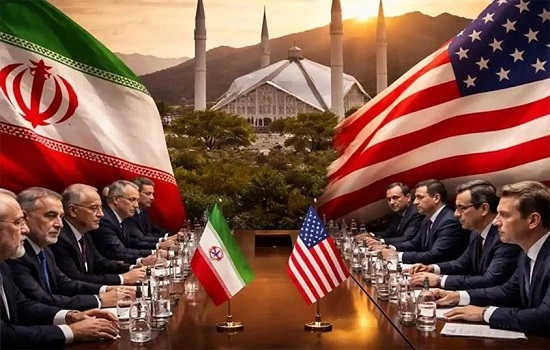
HABARI DAILY I Kampala, Uganda I Controversy mars the just signed peace pact between US President Donald Trump and Iranian President Masoud Pezeshkian, even as the agreement is being hailed by supporters as the most significant diplomatic breakthrough between Washington and Tehran in decades.
The two leaders have signed a landmark 14-point memorandum of understanding (MoU), known as the “Islamabad MoU,” aimed at ending the recent military confrontation involving the United States, Israel and Iran. The agreement was initially signed digitally by President Trump while attending the G7 summit in France before being formally endorsed by President Pezeshkian. A hard copy was later signed by Trump during a state dinner hosted by French President Emmanuel Macron at the Palace of Versailles.
Brokered primarily through Pakistani mediation efforts, the memorandum took immediate effect upon signing and lays out an ambitious framework for ending hostilities, restoring economic relations and preventing future military escalation. However, despite widespread international praise, the agreement has already generated significant controversy over its implementation, unresolved provisions and the sharp rhetoric that has accompanied its announcement.
At the heart of the accord is an immediate and permanent cessation of hostilities. The agreement commits all parties to ending military operations across the region, including in Lebanon, where fighting has intensified in recent months. It also requires all signatories to respect Lebanon’s sovereignty and territorial integrity.
Lebanon huddle
Yet questions about the durability of the ceasefire emerged almost immediately after the agreement was announced. Iranian Foreign Ministry spokesperson Esmail Baghaei warned that continued Israeli military operations in southern Lebanon could be interpreted as a violation of the accord. His remarks followed reports of fresh Israeli strikes in the region, highlighting the fragility of the security arrangements underpinning the deal.
Another contentious issue concerns the Strait of Hormuz, one of the world’s most strategically important shipping routes through which a substantial share of global oil exports passes. Under the agreement, Iran has pledged to immediately reopen the strait to all commercial vessels and guarantee safe passage without imposing fees or restrictions for at least 60 days.
In return, the United States has agreed to dismantle its naval blockade of Iranian ports, with the process expected to be completed within 30 days.
While the reopening of the waterway has been welcomed by global markets and shipping operators, uncertainty remains over what will happen after the initial two-month period expires. Iranian Parliament Speaker Mohammad Bagher Ghalibaf, who played a key role in negotiations, stated that the strait would not necessarily return to its pre-war status and suggested that Iran could eventually introduce service fees for vessels using the route.
Those comments have fueled concerns among shipping companies and international traders who fear that future restrictions or charges could undermine one of the agreement’s most celebrated provisions.
Nuclear question
The memorandum also addresses one of the most contentious issues in US-Iran relations: Tehran’s nuclear programme.
Iran has formally reaffirmed its commitment never to develop or acquire nuclear weapons. The agreement further provides for the dilution of Iran’s highly enriched uranium stockpiles under the supervision of the International Atomic Energy Agency (IAEA).
The provision represents a compromise between the two sides. Previous US demands had called for the complete removal of enriched uranium from Iranian territory, while Tehran insisted on retaining control of its nuclear infrastructure. Critics in Washington argue that dilution does not eliminate Iran’s technical capacity to resume enrichment activities in the future, while hardliners in Iran have accused their government of conceding too much to Western pressure.
The economic dimensions of the agreement have also generated debate.
The United States has agreed to terminate economic sanctions imposed on Iran, potentially opening the door for renewed trade, investment and oil exports. The memorandum includes provisions allowing Iran to regain access to frozen assets estimated at up to $24 billion, with a significant portion potentially released during the early stages of implementation.
$300 billion reconstruction bill
In addition, the agreement outlines a proposed $300 billion reconstruction and economic development programme designed to help rebuild Iran’s economy after years of sanctions and conflict.
Although Trump had previously dismissed reports of such a fund, senior US officials later confirmed that it forms part of the memorandum. They stressed, however, that Washington will not directly finance the initiative and that participation by regional partners will depend on Iran’s compliance with the agreement.
Skepticism remains widespread on both sides.
Perhaps the most controversial moment surrounding the accord came when Trump publicly warned Iran against violating its commitments.
Raining bombs
“If they don’t comply, we’ll bomb the hell out of them,” the US president said while speaking at the G7 summit.
The statement drew criticism from analysts who argued that threatening military action while simultaneously promoting a peace agreement sends conflicting signals about Washington’s intentions.
Iranian leaders responded with their own warnings. Ghalibaf declared that Iran remained deeply suspicious of the United States and insisted that Tehran would remain prepared for any potential confrontation.
“Our finger is on the trigger,” he said in comments carried by Iranian state media.
The exchange underscored the profound mistrust that continues to define relations between the two countries despite the breakthrough agreement.
The memorandum establishes a strict 60-day timetable for negotiators to convert the framework into a permanent treaty. Discussions are expected to focus on unresolved issues including sanctions implementation, nuclear verification mechanisms, maritime governance and broader regional security arrangements.
Switzerland signing ceremony
Although a formal signing ceremony involving senior American and Iranian officials had been expected in Switzerland, uncertainty remains over whether it will proceed now that the memorandum has already been formally executed.
Trump has indicated that the 60-day deadline should be viewed as flexible and could be extended if negotiations are making progress. Nevertheless, both sides face significant pressure to transform the preliminary framework into a durable settlement.
For now, the Islamabad MoU represents a remarkable diplomatic achievement that has temporarily halted a conflict that threatened to engulf the wider Middle East. Yet the controversies surrounding its provisions, the lingering distrust between Washington and Tehran, and unresolved questions about regional security suggest that the path to a lasting peace remains uncertain.







About the Author