
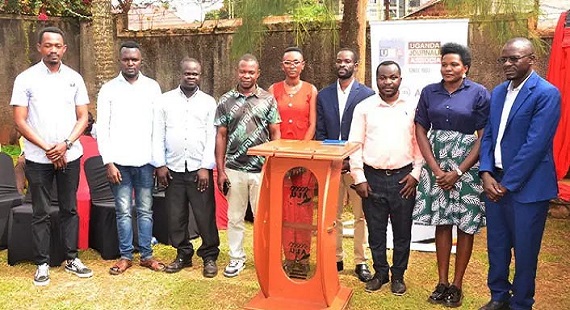
Vision journalists Emmanuel Kirunda (4th R) and Jay Rizik Kalungi Agonzibwa (5th R) were elected UJA President and Vice Presidents respectively, pause with members after the elections
HABARI DAILY I Kampala, Uganda I A last minute agreement finally led to a major political realignment within the Uganda Journalists Association (UJA), handing journalists from Vision Group key leadership positions and effectively placing the media house at the centre of the association’s new executive leadership.
The agreement followed intense competition for the association’s presidency, with New Vision journalist Emmanuel Kirunda emerging as the winner after his main challenger, Jay Rizik Kalungi Agonzibwa, stepped aside during Saturday’s Annual General Assembly.
Kirunda, who previously served as UJA Secretary General, was subsequently declared president, while Kalungi, also a journalist with Vision Group, was named Vice President, giving the media organisation two influential positions in the association’s leadership.
The elections were held on November 7, 2026, at UJA offices in Keti Falawo, Kawempe, under the supervision of lawyer Gilbert Mbonye, who served as returning officer.
The outcome marked a significant shift in the association’s leadership, ending the tenure of outgoing president Mathias Rukundo and ushering in a new executive team dominated by journalists seeking to strengthen the organisation’s influence and improve the welfare of media practitioners.
Last-minute deal changes the race
The presidential contest had initially appeared competitive, with both Kirunda and Kalungi presenting manifestos outlining their respective plans for transforming the association.
However, the race took an unexpected turn shortly after the presentations when Mbonye invited the two candidates for private consultations lasting approximately five minutes.
The candidates, accompanied by their campaign agents, left the assembly and held discussions inside the association’s offices.
When they returned, members were informed that Kalungi had withdrawn her presidential candidature, leaving Kirunda as the sole candidate.
Kalungi was subsequently declared Vice President, effectively transforming what had been a contested election into a negotiated leadership arrangement.
The agreement ensured that both Vision Group journalists secured senior positions in the association, giving the media house considerable representation in the new executive.
Kirunda promises press freedom reforms
Kirunda’s campaign focused on rebuilding UJA’s institutional structures, defending press freedom, improving journalists’ working conditions and promoting professional development.
He outlined seven priority areas, arguing that the association needed stronger leadership to effectively respond to the challenges confronting journalists.
He cited his previous involvement in defending journalists whose rights had been violated, particularly the 2022 court petition challenging the beating of journalists at the United Nations offices in Kololo.
Kirunda said he participated in legal proceedings against the Attorney General and eight military officers over the incident.
He also highlighted his role in securing the release of journalist Remmy Asiteza, who had spent more than two months in detention.
He pledged that his administration would not abandon journalists facing arrests, intimidation, unlawful detention and other forms of harassment.
Beyond press freedom, Kirunda promised to address economic challenges affecting journalists, including poor remuneration and unfavourable working conditions.
He also proposed strengthening journalists’ digital presence, improving professional standards and establishing stronger partnerships with development organisations.
Kalungi pushes welfare agenda
Although Kalungi relinquished the presidency, her manifesto highlighted several issues likely to feature prominently in the new administration.
She placed particular emphasis on journalists’ financial security, medical support, education and professional inclusiveness.
Among her proposals was the establishment of a Savings and Credit Cooperative Organisation (SACCO) to enable journalists to access affordable loans and improve their financial stability.
She also proposed an emergency medical assistance programme to support journalists struggling to meet treatment expenses.
Other priorities included scholarships for female journalists, mentorship opportunities for young journalists and measures to address divisions within the association.
Her emphasis on welfare could provide an important foundation for the new executive as it seeks to unite members behind a common agenda.
New executive takes charge
The assembly also elected Ronald Kabuye as Secretary General, Issa Kigongo as Treasurer and Tadeo Damba as Organising Secretary. Rachael Namuli Nakabugo was elected Secretary for Production, while Daniel Mukisa secured the position of Secretary for External Relations.
Hakim Mubiru became Secretary for Health and Social Welfare. Regional representation went to Ismail Bategeka for Western Uganda, Ivan Keziron Wakibi for Eastern Uganda and Joseph Omagor for Northern Uganda.
The new leadership inherits an association facing significant challenges, including persistent concerns about journalists’ safety, poor remuneration, professional standards and divisions among members.







About the Author