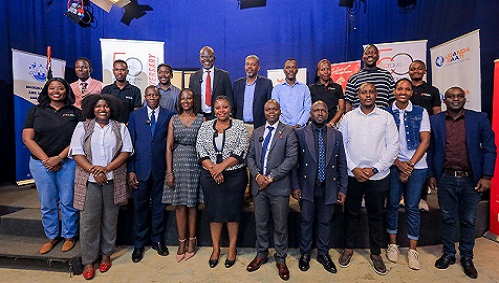

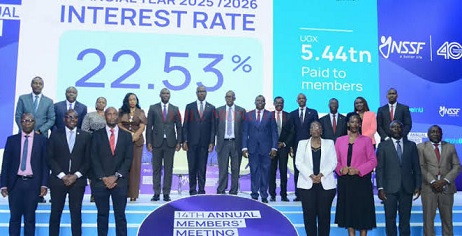
Finance minister, Henry Musasizi (6th L) joins NSSF board members and other delegates pause for a group photo following the announcement of the payout at Serena Kampala Hotel today, 24th September 2026
HABARI DAILY I Kampala, Uganda I The 22.53 per cent interest rate declared for National Social Security Fund (NSSF) members for the financial year ended June 30, 2026, is more than just another annual return. It represents the highest interest rate in the Fund’s 40-year history and means a substantially larger share of NSSF’s investment earnings will be transferred directly to members’ retirement savings.
The declaration means NSSF members will collectively receive about Shs5.44 trillion in interest, compared with Shs2.79 trillion distributed at a rate of 13.5 per cent for the financial year ended June 30, 2025.
What 22.53% means for savers
In simple terms, the interest rate determines how much NSSF adds to members’ accumulated savings for the year.
For example, a member whose qualifying balance was Shs10 million at the beginning of the financial year would, using a simple illustration, receive about Shs2.253 million in interest at 22.53 per cent.
The actual amount credited to an individual account will depend on NSSF’s calculation of the member’s balance and contributions during the year, meaning the illustration should not be treated as a guaranteed Shs2.253 million payment for every member with Shs10 million.
Nevertheless, the significance of the rate is clear: members’ retirement savings have received a substantial boost without requiring them to make any additional contribution.
NSSF’s previous official declarations show how sharply the return has risen. The Fund paid 10 per cent for 2022/23, 11.5 per cent for 2023/24 and 13.5 per cent for 2024/25. NSSF confirmed that the 11.5 per cent rate in 2023/24 resulted in Shs2 trillion being credited to members, while the 13.5 per cent rate for 2024/25 was also reflected in the Fund’s subsequent reporting.
The latest 22.53 per cent therefore marks a major acceleration in the return paid to savers.
Why the rate matters
For a retirement fund, the interest rate is important because inflation gradually reduces the purchasing power of money.
NSSF has previously said its objective is to preserve and grow the real value of members’ savings, with returns targeted above long-term inflation. In declaring the 11.5 per cent rate in 2024, the Ministry of Finance noted that it was above both the 10-year average inflation rate and that year’s inflation rate.
A return of 22.53 per cent, therefore, represents a substantial increase in the nominal value of members’ savings, assuming inflation remains considerably below that level.
The impact becomes particularly significant when the interest is retained in the account and continues earning returns in subsequent years. Retirement savings can consequently benefit from the compounding effect over a long working life.
Income from investments
The interest paid to members is not money created by NSSF. It comes from the Fund’s investment activities.
NSSF invests members’ savings across different asset classes, including government securities, equities and real estate. In its 2023/24 reporting, the Fund said interest income, dividend income and real estate income all contributed to its earnings.
For the year ended June 30, 2025, NSSF reported earnings of Shs3.52 trillion, up from Shs3.2 trillion the previous year. Interest income rose from Shs2.34 trillion to Shs2.88 trillion, while dividend and real-estate income also increased. Assets under management grew to Shs26 trillion.
The reported 22.53 per cent declaration therefore needs to be viewed against the Fund’s broader investment performance rather than as an ordinary bank deposit rate.
Boost to retirement balances
The Shs5.44 trillion to be credited to members represents almost twice the amount distributed in the previous financial year.
For individual savers, the immediate effect is an increase in their NSSF balance. For the Fund as a whole, it represents a significant transfer of investment earnings to the people whose contributions form its capital base.
The higher return also demonstrates the importance of leaving retirement savings invested for longer periods. NSSF provides age, withdrawal, survivors and other benefits under the applicable rules, while eligible members can access certain benefits under specified conditions.
Members’ balances
Members can monitor the effect of the declaration through NSSF’s digital services, including its online platforms and mobile services.
The 22.53 per cent rate ultimately means that millions of Ugandans saving through NSSF will enter the new financial year with significantly larger retirement balances.







About the Author