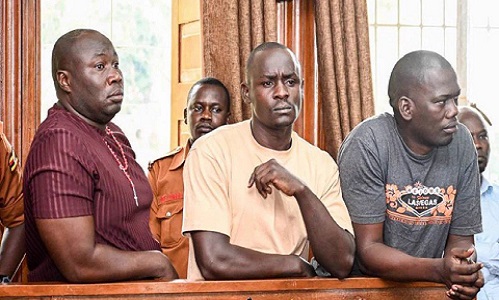

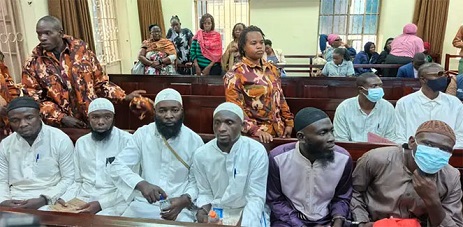
A cross section of the convicts
HABARI DAILY I Kampala, Uganda I After eight years of grieving and searching for the truth, the family of slain businesswoman Susan Magara finally witnessed the conclusion of one of Uganda’s most shocking criminal cases after the High Court Criminal Division sentenced two of the principal perpetrators of her kidnapping and murder to death.
The judge described their actions as among the “rarest of rare” crimes deserving the maximum punishment under the law.
On Wednesday, August 5, 2026, High Court Judge Alex Mackay Ajiji sentenced Hajara Nakandi and Abbas Musa Buwembo to death after finding that they played the most direct, crucial and brutal roles in Magara’s abduction, prolonged captivity, torture and eventual murder in 2018.
The judge, however, sentenced their seven co-conspirators—Yusuf Lubega, Mahad Kisalita, Ismail Bukenya, Abubaker Kyewokya, Hassan Wasswa, Hussein Kato Miiro and Muzamir Ssali—to life imprisonment after determining that although they participated in the kidnapping enterprise, their involvement was secondary compared to that of Nakandi and Buwembo.
Confiscation and sale of properties ordered
Justice Ajiji also ordered the confiscation and sale of all properties acquired using the ransom money, directing that the proceeds be handed over to Magara’s family.
In delivering the sentence, the judge identified Buwembo as the individual who personally executed the most violent acts against the 28-year-old victim.
Court findings showed that Buwembo amputated two of Magara’s fingers to force her family into paying ransom, administered ketamine before her death and ultimately suffocated and manually strangled her.
Justice Ajiji ruled that these acts demonstrated extraordinary brutality and a complete disregard for human life, making Buwembo’s role significantly more aggravated than that of the other convicts.
Nakandi’s role
Nakandi was equally singled out for her central role in facilitating Magara’s prolonged suffering.
According to the court, she ensured that the captive remained blindfolded throughout her detention, exposing her to continuous psychological torment while enabling the kidnappers to conceal their identities and prolong the illegal confinement.
The prosecution had also linked Nakandi to providing the house where Magara was held and influencing the decision to kill her after the ransom had been paid.
Justice Ajiji said the offences fell within the “rarest of rare” category because they were meticulously planned, financially motivated and carried out with exceptional cruelty.
Shs700 million ransom paid
The court noted that the kidnappers did not merely abduct Magara for financial gain but subjected her to sustained torture over nearly three weeks before killing her even after successfully receiving approximately Shs700 million, equivalent to about $200,000, from her family.
The judge found that this deliberate betrayal of the ransom arrangement demonstrated exceptional depravity that far outweighed any mitigating factors raised by the defence.
In rejecting pleas for leniency, Justice Ajiji held that the aggravating circumstances—including mutilating the victim, inflicting prolonged psychological torture and murdering her despite receiving the ransom—left no legal or moral justification for imposing a lesser sentence.
The court further emphasized that the death penalty was necessary to deter organised kidnapping-for-ransom syndicates that continue to threaten public safety.
Maximum sentence necessary
Justice Ajiji observed that such crimes particularly expose women and other vulnerable members of society to extreme violence and that imposing the maximum sentence under the Penal Code Act would send a strong warning to criminal networks contemplating similar offences.
The judgment concludes a case that horrified Uganda in February 2018.
Magara, a former cashier at Bwendero Dairy Farm and daughter of businessman John Magara, was abducted on February 7, 2018, while driving home through Lungujja in Kampala.
A friend who was speaking to her on the telephone at the time heard a violent struggle followed by screams before the call abruptly ended.
Her Toyota RAV4 was later discovered abandoned with its engine still running and her mobile phones left inside, prompting an extensive police investigation.
The kidnappers initially demanded as much as $1 million before eventually accepting about $200,000 from the family.
To pressure the family into paying, they severed two of Magara’s fingers and delivered them together with a disturbing video showing her pleading for help.
Despite receiving the ransom, the gang murdered her between February 25 and February 27, 2018.
Her body was later dumped at Kitiko-Birongo along the Entebbe Expressway, where it was recovered by investigators.
Traces of suffocation
Medical evidence presented during the trial established that Magara had been injected with ketamine before dying from suffocation, corroborating the prosecution’s account of the brutal manner in which she was killed.
The prosecution maintained throughout the trial that the kidnapping had been carefully planned and motivated solely by financial gain, adding that the decision to kill Magara was taken because the kidnappers feared she could identify them if released.
While Nakandi and Buwembo received the ultimate sentence for orchestrating and carrying out the torture and murder, the remaining seven convicts were found guilty of participating in surveillance, transporting the victim, guarding her during captivity, collecting the ransom and sharing the proceeds of the crime.
The judgment brings to a close one of Uganda’s longest-running murder trials and stands as one of the strongest judicial statements yet against organised kidnapping, affirming that crimes marked by calculated brutality, prolonged torture and financial extortion will attract the harshest punishment available under the law.







About the Author