
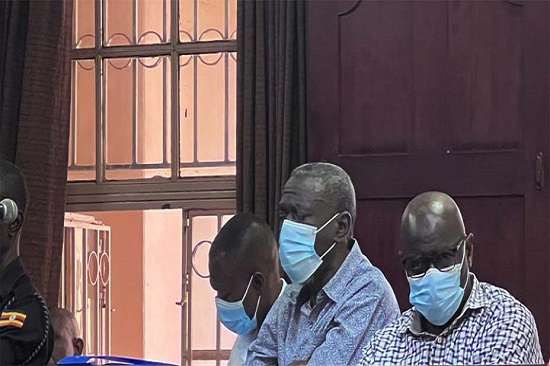
Kiiza Besigye (Center) with his co-accused appearing in court earlier today
HABARI DAILY I Kampala, Uganda I The defense team has raised serious concerns regarding the judge’s scheduling timelines and the swift dismissal of a previous mandatory bail application, and are preparing to petition the Constitutional Court to halt the treason trial of veteran opposition politician Dr. Kizza Besigye.
Besigye’s lawyers argue that the High Court has imposed an unreasonably tight trial schedule that violates his constitutional right to a fair hearing by denying the defence adequate time and facilities to prepare its case.
At the heart of the planned constitutional challenge is a seven-day window that the defence says is grossly insufficient for reviewing newly disclosed prosecution evidence and preparing for the presentation of witnesses.
The latest legal battle unfolded during proceedings before Justice Emmanuel Baguma, who directed that court reconvene on June 8 for a final pre-hearing session and the swearing-in of assessors before the substantive hearing begins with the presentation of prosecution witnesses.
While the prosecution views the schedule as a necessary step toward advancing a case that has been pending for months, Besigye’s lawyers insist that the pace of the proceedings undermines fundamental constitutional safeguards and risks compromising the integrity of the trial.
Leading the defence team, Erias Lukwago told court that the lawyers need significantly more time to analyse evidence, consult with their clients and formulate a proper defence strategy.
“We request at least a month to be able to work out modalities with our clients. We cannot do it here because prison officers are always listening, yet we need to consult with them in confidence,” Lukwago told the court.
According to the defence, one of the strongest grounds for Constitutional Court intervention is the sheer volume of evidence recently disclosed by the prosecution. The lawyers revealed that they had been served with approximately ten hours of audio and video recordings in addition to a large collection of documentary exhibits.
Lukwago argued that reviewing the material, assessing its evidential value and preparing responses within a matter of days is practically impossible, particularly in a case involving treason charges.
The defence contends that the compressed schedule creates an unfair advantage for the prosecution, which has had months to gather and analyse the evidence, while the accused persons are expected to prepare their response within a fraction of that time.
A second major argument relates to the alleged violation of Besigye’s constitutional rights. The defence maintains that the right to adequate time and facilities to prepare a defence is a non-derogable right protected under Article 44 of the Constitution.
Lawyers argue that proceeding with the trial before the defence has had sufficient opportunity to study the evidence and consult with the accused persons would amount to a serious infringement of fair trial guarantees.
They further contend that constitutional protections become even more critical in a capital offence such as treason, where the consequences of conviction are severe and the need for procedural fairness is paramount.
The legal team is therefore seeking constitutional interpretation on whether the seven-day preparation period ordered by the High Court meets the standards required under the Constitution.
The dispute has also revived concerns surrounding witness disclosure. Earlier in the proceedings, the prosecution had applied for permission to identify witnesses alphabetically as Witness A through Witness F, with their identities only being disclosed seven days before they took the stand.
The defence strongly opposed the proposal, arguing that it would deprive them of sufficient time to investigate the witnesses and prepare effective cross-examination.
Although the prosecution later withdrew the application, Lukwago argued that the current scheduling arrangements effectively produce the same result. He accused the prosecution of attempting to achieve through procedural timelines what it could not obtain through its witness protection application.
The prosecution, led by Chief State Attorney Richard Birivumbuka, rejected the defence’s complaints and maintained that adequate disclosure had already been made. Prosecutors pointed to earlier disclosures provided on January 21 and March 4, 2026, together with supplementary materials recently served on the defence.
However, Besigye’s lawyers maintain that the latest disclosures substantially expanded the evidence on which the state intends to rely, making additional preparation time necessary.
Another key reason for the planned Constitutional Court petition is concern over what the defence perceives as judicial impartiality. The lawyers have questioned several decisions made by the court, including the handling of procedural disputes and the rejection of earlier applications, including a mandatory bail request.
Besigye has previously sought an opportunity to personally address the High Court regarding what he described as concerns over the court’s impartiality and handling of his case.
The defence also criticised the court’s decision not to sanction the prosecution for delays in serving documents. Lawyers noted that some prosecution materials were served after agreed deadlines and that documents were initially delivered only to lawyers representing third accused Denis Oola before eventually being served on Besigye’s legal team.
Justice Baguma declined requests for sanctions and directed that proceedings continue.
Further concerns were raised over inconsistencies in prosecution disclosures. Defence lawyers noted that while earlier indications suggested that six prosecution witnesses would testify, affidavits from only five witnesses had been served.
According to the defence, such discrepancies create uncertainty and further complicate trial preparations.
The latest dispute unfolds alongside another constitutional petition filed by Besigye in February. In that case, the opposition leader is challenging the legality of trying civilians before military courts and questioning the constitutionality of provisions contained in the UPDF Amendment Act.
The new constitutional challenge would therefore become part of a broader legal campaign aimed at testing several constitutional questions arising from Besigye’s prosecution.
During Monday’s proceedings, prosecution lawyer Fred Mpanga suggested that the Constitutional Court be asked to provide guidance on whether a seven-day period following disclosure of witness identities satisfies constitutional requirements for a fair trial.
Justice Baguma said his ruling on the proposed Constitutional Court referral would be delivered through the Judiciary’s Electronic Court Case Management Information System (ECCMIS).
As the court prepares to make its decision, the case is increasingly evolving into a major constitutional contest over fair trial rights, judicial conduct, disclosure obligations and the extent to which courts must ensure that accused persons are given sufficient time and facilities to mount an effective defence.
For Besigye’s lawyers, the central issue remains clear: no criminal trial, particularly one involving treason charges, should proceed before the accused has been afforded a meaningful opportunity to prepare his defence in accordance with the Constitution.







About the Author