
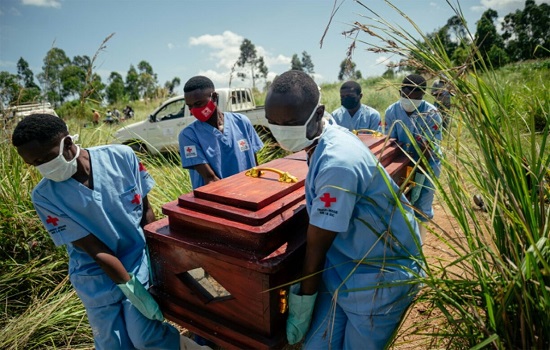
A victim of Ebola being taken to his final resting place
HABARI DAILY I Kampala, Uganda I As President Yoweri Museveni addresses the nation on the Ebola situation, attention is increasingly shifting from fears of a nationwide lockdown to concerns about the broader economic and social implications of the outbreak, including the possibility of Uganda facing regional isolation due to travel restrictions and heightened border controls.
Government and health officials have consistently ruled out a nationwide lockdown or the closure of schools, emphasizing that the country’s response strategy is focused on targeted containment measures rather than broad restrictions that could disrupt economic activity.
However, the continued presence of Ebola cases within Uganda, coupled with a larger outbreak in neighboring Democratic Republic of Congo (DRC), raises concerns about how neighboring countries and international partners may respond.
Uganda is currently managing a localized Ebola outbreak caused by the Bundibugyo virus strain. According to data from the Ministry of Health and the World Health Organization (WHO), the country has recorded 19 confirmed cases and two deaths. Of the confirmed cases, 14 are imported from the DRC while five resulted from local transmission, primarily involving healthcare workers and transport personnel.
13 patients under medical care
Health authorities report that 13 patients remain under medical care, while four have recovered and been discharged. Most cases have been linked to travelers crossing from the DRC and have been concentrated around specialized isolation facilities in Kampala and neighboring Wakiso District.
Despite the outbreak, Uganda’s health officials maintain that the situation remains under control. WHO Director-General Tedros Adhanom Ghebreyesus recently commended Uganda’s response efforts, describing them as prompt and effective. Encouragingly, the Ministry of Health has reported consecutive days without new infections, suggesting that contact tracing, quarantine measures, and surveillance systems are helping contain transmission.
Nevertheless, the outbreak has already prompted stricter border controls. Uganda has suspended public transport links and closed formal border checkpoints with the DRC in an effort to prevent additional imported cases. Authorities continue to monitor porous border areas where some individuals reportedly attempt to cross at night seeking medical treatment.
While these measures are designed to protect public health, they could also contribute to Uganda’s gradual isolation from regional trade and movement networks if neighboring countries decide to impose additional restrictions on travelers or goods originating from Uganda.
The Bundibugyo strain presents unique challenges because there is currently no approved vaccine or specific antiviral treatment available. Unlike the more widely known Zaire strain of Ebola, management depends largely on early detection, supportive care, and strict infection prevention measures.
Museveni focuses on public vigilance
President Museveni’s address is therefore focusing on strengthening public vigilance rather than introducing sweeping restrictions. Officials indicate that the President is likely to reiterate the importance of observing Standard Operating Procedures (SOPs), including regular handwashing, avoiding handshakes, and seeking medical attention immediately when symptoms appear.
The President is also expected to provide updates on cross-border collaboration with the DRC and ongoing surveillance efforts aimed at containing the outbreak at its source. Regional cooperation remains a critical component of Uganda’s strategy, given that most confirmed cases originated outside the country.
In addition, guidance on public gatherings is expected to feature prominently in the address. Authorities have already suspended non-essential and unstructured public events such as concerts and marathons as a precautionary measure. Further directives may be issued to ensure that large gatherings do not become avenues for disease transmission.
Public confidence is low
Although Uganda appears unlikely to return to the strict lockdowns witnessed during previous Ebola outbreaks in districts such as Mubende and Kassanda, the country still faces the challenge of maintaining public confidence and regional trust. The success of ongoing containment efforts will not only determine the trajectory of the outbreak but also whether Uganda can avoid the economic and diplomatic consequences that often accompany cross-border health emergencies.
For now, health experts say vigilance, early reporting, and continued cooperation between Uganda and its regional partners remain the country’s strongest tools in preventing the outbreak from escalating into a wider crisis.







About the Author