
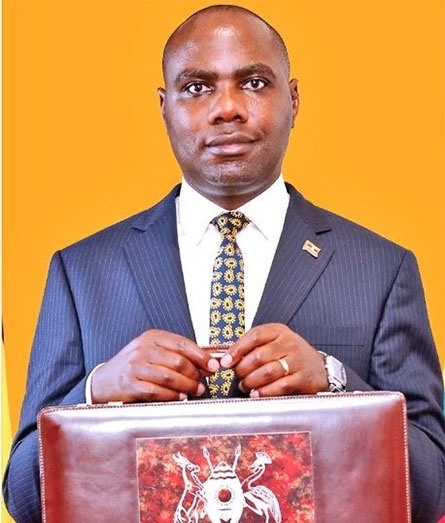
Uganda’s Finance minister, Henry Musasizi
HABARI DAILY I Kampala, Uganda I The Uganda Government has unveiled a record Shs84.39 trillion national budget for the 2026/27 financial year, signalling an ambitious push toward industrialisation, wealth creation, and human capital development as the country prepares to enter a new phase of economic growth driven by the commencement of commercial oil production.
The budget, the largest in Uganda’s history, is aligned with the Fourth National Development Plan (NDP IV) and the government’s long-term vision of expanding the economy from its current size of approximately $50 billion to $500 billion by 2040.
At the heart of the spending plan is the government’s strategy to accelerate structural transformation through investments in the ATMS sectors—Agro-industrialisation, Tourism, Manufacturing, and Science, Technology and Innovation. Officials believe these sectors hold the greatest potential to create jobs, increase exports, raise household incomes, and drive sustainable economic growth.
The Shs84.39 trillion budget will be financed through a combination of domestic revenue mobilisation, borrowing, grants, and petroleum-related income. Domestic taxes and non-tax revenues are expected to contribute Shs45.96 trillion, accounting for the largest share of financing. Government also plans to raise Shs25.94 trillion through domestic borrowing and refinancing arrangements.
External financing in the form of project support and grants will contribute Shs12.49 trillion, while petroleum revenues and local government revenues are projected to generate Shs1.77 trillion.
A significant portion of the budget has been allocated to development programmes and non-wage recurrent expenditures, which will receive Shs55.33 trillion. This reflects government’s emphasis on financing infrastructure, industrial development, and service delivery programmes that support long-term economic transformation.
Human capital development remains another major priority, with Shs13.5 trillion earmarked for health, education, and social services. Government officials argue that investment in people is critical to improving productivity and ensuring inclusive growth.
Meanwhile, Shs11 trillion has been allocated to wealth creation initiatives, including programmes such as the Parish Development Model, which aims to integrate households into the money economy and boost rural incomes.
Security has also received a substantial allocation of Shs10.2 trillion, while wages and salaries for public servants will account for Shs9.71 trillion.
Despite government optimism, the budget has attracted scrutiny from civil society organisations and economists. Critics have expressed concern over Uganda’s growing debt burden, noting that debt servicing and interest payments are expected to consume approximately Shs33.4 trillion, nearly 40 percent of total expenditure.
Some analysts argue that heavy debt obligations and investments in long-term industrial projects could limit resources available for immediate household poverty alleviation and social welfare interventions.
However, government maintains that the budget is designed to lay the foundation for accelerated economic growth, increased industrial production, job creation, and Uganda’s transition into a prosperous middle-income economy as commercial oil production begins.
MINISTRY OF FINANCE, PLANNING
AND ECONOMIC DEVELOPMENT
BUDGET SPEECH
FINANCIAL YEAR 2026/2027
Full Monetisation of Uganda’s Economy through
Commercial Agriculture, Industrialisation, Expanding and
Broadening Services, Digital Transformation and Market Access.
THEME:
b BUDGET SPEECH FINANCIAL YEAR 2026/27
BUDGET SPEECH FINANCIAL YEAR 2026/27 i
The Republic of Uganda
________________________________
Budget Speech
Financial Year 2026/2027
_________________________________
Theme: Full Monetisation of Uganda’s Economy through Commercial
Agriculture, Industrialisation, Expanding and Broadening Services, Digital
Transformation and Market Access.
Delivered By
HENRY MUSASIZI (MP)
Minister of Finance, Planning and Economic Development
Thursday 11th June 2026
Kololo Independence Grounds
PREAMBLE
Your Excellency the President of the Republic of Uganda,
Your Excellency the Vice President,
The Right Honourable Speaker of Parliament,
Your Lordship the Chief Justice,
The Right Honourable Deputy Speaker,
Your Lordship the Deputy Chief Justice,
The Vice Chairman of the NRM Party,
The Right Honourable Prime Minister,
The Right Honourable Deputy Prime Ministers,
Honourable Ministers and Ministers of State,
Your Excellencies, Heads of Diplomatic Missions,
Honourable Members of Parliament,
Former National Leaders,
Traditional Leaders,
Religious Leaders,
Distinguished Guests,
Ladies and Gentlemen.
A. INTRODUCTION
1. Mr. Speaker, in accordance with Article 155 of the Constitution of
the Republic of Uganda and the Public Finance Management Act,
Cap. 171, and on behalf of His Excellency the President, I present
to Parliament and the people of Uganda the National Budget for
Financial Year 2026/27 as approved by Parliament.
2. In this Speech, I will:
i) Present the recent performance of the economy and the
outlook for the year ahead;
ii) Account to the people of Uganda on commitments made in
FY 2025/26 that is coming to an end in a few days;
iii) Highlight Government priorities for FY 2026/27; and
iv) Outline the strategy for financing the Budget.
B. BACKGROUND
3. Rt. Hon. Speaker, allow me to begin by congratulating His Excellency
the President and the National Resistance Movement upon the
resounding victory in the recently concluded general elections.
In addition, I congratulate His Excellency the President upon
assuming Chairmanship of the East African Community. This is in
recognition of his exemplary leadership and passion for advancing
regional integration and pan-Africanism. I also congratulate Her
Excellency the Vice President, Rt. Hon. Speaker, Rt. Hon. Deputy
Speaker, Rt. Hon. Prime Minister, Colleague Honourable Ministers,
Honourable Members of Parliament, and all other leaders elected
to serve our country during this important phase of Uganda’s
development.
4. Mr. Speaker, I wish to thank His Excellency the President for the
confidence he has placed in me and my political leadership team
by entrusting us with the responsibility of leading the Ministry
of Finance, Planning and Economic Development. We accept
this responsibility with humility, determination and a clear
understanding of the task before us.
5. That task is to accelerate wealth creation, eliminate poverty, create
productive jobs, and transform Uganda into a 500 billion-dollar
economy in the shortest possible time.
6. Mr. Speaker, Uganda enters this new political term from a position
of strength. Unlike many previous election cycles that were
characterised by high inflation, exchange-rate instability and
macroeconomic uncertainty, our economy remains stable and
resilient, and is growing rapidly.
7. Mr. Speaker, this achievement is not accidental. It is a result of
deliberate and consistent policy choices under the leadership of
His Excellency the President and the NRM Government. For more
than three decades, Government has prioritised peace and security,
macroeconomic stability, infrastructure development, human
capital development, wealth creation and regional integration.
8. As a result, Uganda has built one of the strongest foundations for
socio-economic transformation on the African continent. Uganda
has:
i) Sustained long-term economic growth above 5 percent
despite repeated global shocks;
ii) Surpassed the lower-middle-income threshold of USD 1,136,
with gross national income per capita reaching USD 1,389;
iii) Recorded one of the strongest external sector performances
in recent history, nearly doubling exports over the last five
years;
iv) Expanded access to health, education and social services;
v) Built critical infrastructure that supports investment and
competitiveness; and
vi) Established a solid foundation for industrialisation and
private-sector-led growth.
9. Mr. Speaker, the challenge before us is no longer simply growing
the economy. The challenge is ensuring that growth translates into
jobs, household incomes, enterprise development and prosperity
for every Ugandan. That is the essence of full monetisation, as His
Excellency the President has consistently emphasized. That is the
focus of the Tenfold Growth Strategy. And it is the central objective
of this Budget.
10. Mr. Speaker, FY 2026/27 marks the commencement of the
implementation of the NRM Manifesto. It is also the second year
of implementing the Fourth National Development Plan (NDP IV),
the first Plan specifically designed to deliver our Tenfold Growth
Strategy.
11. Mr. Speaker, in the spirit of protecting the gains, we have maintained
the FY 2026/27 Budget theme as: “Full Monetisation of Uganda’s
Economy through Commercial Agriculture, Industrialisation,
Expanding and Broadening Services, Digital Transformation,
and Market Access”.
12. This theme is aligned with the East African Community budget
theme: “Deepening Regional Integration and Economic Resilience
through Improved Regional Security, Domestic Revenue
Mobilisation and Digital Transformation for Inclusive Growth”.
C. RECENT ECONOMIC PERFORMANCE AND OUTLOOK
13. Mr. Speaker, despite geopolitical tensions, global trade disruptions
and continued uncertainty, Uganda’s economic outlook remains
strong and positive. The economy is stable. Growth is accelerating.
Inflation is low. The exchange rate is stable. Exports are rising.
Investment is increasing. And confidence in Uganda’s future
remains strong.
Economic Growth
14. Mr. Speaker, Uganda’s economy continues to demonstrate
remarkable resilience and dynamism. Economic growth for FY
2025/26 is estimated at 6.4 percent, up from 6.3 percent in FY
2024/25. The size of the economy is projected to increase to
approximately USD 69.3 billion, equivalent to Shs 250.4 trillion,
by the end of June 2026. In purchasing power parity (PPP) terms,
Uganda’s GDP is estimated to be USD 197.1 billion. GDP per capita
is projected to increase to USD 1,420, equivalent to approximately
Shs 5.1 million per person.
15. Mr. Speaker, with commercial oil production commencing later this
calendar year, growth is projected to accelerate to 10.2 percent in
FY 2026/27. This will mark Uganda’s first return to double‑digit
growth since the reforms of the 1990s. Most importantly, a larger
economy will create more jobs, raise household incomes, expand
opportunities for business, and generate the resources required to
invest in quality education, healthcare, infrastructure, security,
and other public services that improve the lives of Ugandans.
16. This performance confirms that our strategy of investing in security,
infrastructure, wealth creation, and the productive sectors is delivering
results. I thank His Excellency the President for his steadfast leadership,
strategic guidance and insistence on phased prioritisation.
Inflation
17. Mr. Speaker, inflation remains low and stable. Average inflation
during FY 2025/26 is estimated at 3.8 percent, compared to 3.5
percent recorded the previous financial year. This stability has been
supported by effective coordination between fiscal and monetary
policy, stable food prices and improved management of fuel supply.
Low inflation protects household incomes, supports business
planning and strengthens investor confidence. Government
remains committed to maintaining price stability as a cornerstone
of sustained economic growth.
Investor, Citizen and Visitor Confidence
18. Mr. Speaker, the strength of an economy is reflected not only in
how much it produces, but also in the confidence it inspires among
investors, visitors and citizens at home and abroad.
19. I am pleased to report that confidence in Uganda’s economy
continues to grow. Foreign Direct Investment (FDI) remains strong
at USD 3.2 billion in the twelve months ending March 2026. This
reflects growing investor confidence in Uganda’s economy.
20. Of even greater significance, investors are increasingly expressing
interest in Uganda’s small and medium enterprises (SMEs).
Kampala-based start-ups attracted about USD 30 million in 2025,
up from just USD 4 million the year before. This surge signals
growing confidence in Uganda’s innovation ecosystem and affirms
our emergence as a destination for entrepreneurship, technology,
and investment.
21. Mr. Speaker, remittances from Ugandans working abroad have
significantly increased to USD 2.8 billion in the twelve months to
March 2026 from USD 1.9 billion a year before. Remittances provide
an important source of foreign exchange, investment capital and
household income.
22. Mr Speaker, tourism has fully recovered from the effects of the
COVID-19 pandemic. Tourism receipts increased to USD 1.86
billion in 2025, compared to USD 1.4 billion in 2018/19 before
the pandemic. This remarkable recovery from the lowest receipts
of USD 562 million recorded in 2020, demonstrates growing
international confidence in Uganda as a destination for business,
investment and leisure.
23. Government remains committed to safeguarding and expanding
this vital source of foreign exchange and jobs by increasing
investment in tourism infrastructure, the sector, security, and our
Missions Abroad to effectively advance Economic and Commercial
Diplomacy (ECD).
Exchange Rate Stability
24. Mr. Speaker, the Uganda Shilling remains one of Africa’s bestperforming
freely floating currencies. This stability reflects prudent
macroeconomic management, a liberalised foreign exchange regime
and strong foreign exchange inflows from exports, tourism, FDI,
portfolio inflows and remittances. As a result, Uganda’s foreign
exchange reserves are now at USD 6 billion in the twelve months
to March 2026, up from USD 3.6 billion a year before.
25. Government’s decision to directly import petroleum products
through the Uganda National Oil Company (UNOC) has further
strengthened supply stability and reduced speculative pressures
in the foreign exchange market. We expect the exchange rate to
remain broadly stable despite ongoing global uncertainties.
External Sector
26. Rt. Hon. Speaker, Uganda’s export performance has been
exceptional. Over the last five years, exports of goods and services
have increased by approximately 204 percent. Total export
earnings reached USD 18.04 billion in the twelve months to March
2026, from USD 5.93 billion in the twelve months to March 2022.
The leading exports include gold, coffee, cocoa, fish products, steel
products, sugar and a growing range of manufactured goods. Our
coffee exports reached USD 2.46 billion for the year ending March
2026, up from USD 1.84 billion a year before.
27. Uganda’s exports mainly go to the Middle East (USD 6.3 billion),
Africa (USD 4.1 billion), Asia (USD 2.0 billion), the European Union
(USD 2.5 billion) and the rest of the world (USD 3.1 billion).
28. This success reflects deliberate Government policy focused on
industrialisation, value addition, export promotion and market
access. Exports are not merely a trade statistic. They are the engine
of Uganda’s transformation. They generate foreign exchange. They
create jobs. They support enterprise growth. And they strengthen
economic resilience.
29. As a result of strong export performance, remittances and investment
inflows, Uganda recorded a Balance of Payments surplus of USD
2.47 billion, twelve months to March 2026, the highest in fifteen
years.
Employment Creation
30. Rt. Hon. Speaker, the ultimate test of economic policy is whether
it improves the livelihoods of our people through productive
employment. Uganda’s economy is gradually undergoing structural
transformation. The services sector now accounts for 50.5 percent
of total employment, up from 47 percent a year ago, while the share
of employment in agriculture has declined from 40 percent to 37.1
percent. On the other hand, industry accounts for approximately
12.4 percent of total employment.
31. These shifts are good, and are consistent with the structural
transformation experienced by today’s rich economies, which
moved from low to higher productivity sectors.
32. Mr. Speaker, the capacity of our economy to generate formal
employment continues to improve. Employment in private formal
establishments has increased by 245 percent from approximately
672,300 workers in FY 2016/17 to over 2,319,683 workers in
FY 2024/25. This is in addition to the 503,738 public sector jobs
and 10,513,014 informal jobs reported in April 2026. This growth
in jobs confirms that Uganda’s economy is not only growing but
also creating productive jobs for Ugandans. This is on account
of deliberate Government interventions to create jobs through
industrialisation and wealth creation.
33. However, creating more productive jobs for our rapidly growing
population remains an urgent economic priority. This is why
Government is investing in ATMS and their enablers to create jobs
at scale, especially for young people. Going forward, every major
intervention in the National Budget will ultimately be judged by its
contribution to jobs, incomes and improved livelihoods.
Fiscal Performance
34. Mr. Speaker, Government’s capacity to finance its development
agenda using domestic resources continues to strengthen. This
financial year, domestic revenue collections are projected at Shs
35.7 trillion, compared to Shs 32.3 trillion collected the previous
financial year.
35. Mr. Speaker, this FY 2025/26, domestic revenue from taxes, nontax
revenues, and Local Government revenues funded up to 80.9
percent of the total discretionary budget of Shs 44.1 trillion. The
discretionary budget includes all funds allocated to implementing
programmes, excluding debt and other Government obligations.
This represents significant progress towards fiscal self-reliance
and reduced dependence on external financing.
36. Mr. Speaker, increasing domestic revenue is not merely a
fiscal objective. It is a sovereignty objective. A country that
finances its development from its own resources enjoys greater
policy independence, resilience and sustainability. Therefore,
Government will continue to strengthen domestic revenue in line
with the Domestic Revenue Mobilization Strategy, while preserving
incentives for investment, production and enterprise growth.
37. In FY 2026/27, domestic revenue is projected to increase to Shs
45.6 trillion from Shs 35.7 trillion in FY 2025/26, equivalent
to 15.9 percent of GDP. The additional resources will support
investments in wealth creation, ATMS and their enablers.
Public Debt
38. Mr. Speaker, as of December 2025, Uganda’s total public debt
stood at USD 34.86 billion, equivalent to approximately Shs 126.19
trillion. Of this, external debt amounted to USD 15.84 billion while
domestic debt was USD 19.02 billion. This translates into a debtto-
GDP ratio of approximately 53.0 percent.
39. Mr. Speaker, public debt should always be assessed alongside the
assets it finances and the economic returns it generates. Over the
past 10 years, Uganda’s debt has financed strategic investments
that are transforming the productive capacity of our economy.
These investments include:
i) Integrated transport infrastructure – 31.1 percent;
ii) Electricity infrastructure – 19.3 percent;
iii) Water infrastructure – 10.3 percent;
iv) Agro-industrialisation – 9.2 percent;
v) Education and health infrastructure – 7.7 percent;
vi) Housing and urban development – 6.3 percent;
vii) Industrial parks and industrial development – 2.0 percent;
and
viii) Other investments such as national backbone infrastructure
to extend internet, STI, and regional development – 7.0
percent.
40. Mr. Speaker, Uganda’s public debt remains sustainable and is
projected to stay so over the medium and long term.
D. ACCOUNTABILITY FOR FINANCIAL YEAR 2025/26 AND
PRIORITIES FOR FY 2026/27
41. Mr. Speaker, when the budget for FY 2025/26 was presented last
year, Government made several commitments aimed at accelerating
monetisation of the economy and implementing the Tenfold Growth
Strategy. The budget focused on three broad areas:
i) Wealth-creation programmes;
ii) Strategic investments in ATMS; and
iii) Investment in key Enablers of growth.
42. I am pleased to report that substantial progress has been made in
all the above areas.
Wealth-Creation Programmes
43. Mr. Speaker, the foundation of Uganda’s economic transformation
is ensuring that every Ugandan participates in the money economy.
Government, therefore, has continued to invest in programmes
that expand access to affordable capital, strengthen enterprise
development and increase household incomes.
44. To date, Government has invested close to Shs 11 trillion directly
into wealth-creation initiatives targeting households in subsistence
economy, farmers, youth, women and businesses. These
interventions are reducing barriers to participation in economic
activity while expanding opportunities across the country. Let
me highlight what we have done in the flagship wealth-creation
programmes:
Parish Development Model
45. Mr. Speaker, the Parish Development Model (PDM) remains
Government’s most important intervention for eliminating
subsistence and expanding participation in the money economy.
I wish to thank His Excellency the President for his vision and
unwavering commitment to this programme. PDM is not merely a
financing programme. It is a structural transformation programme.
Its objective is to move households from subsistence to commercial
production; from survival to enterprise; and from poverty to
prosperity.
46. Over the past five years, Government has transferred Shs 4.4
trillion to all 10,589 parishes nationwide, as revolving capital.
Ugandans who were previously outside the money economy are
now engaged in money-making enterprises. By the end of this
month, PDM funds will have reached over 4 million beneficiaries.
The PDM is raising household incomes, improving food security,
and creating local economic opportunities for Ugandans who
previously relied on subsistence production. Mr. President, thank
you for your visionary leadership.
47. The next phase of the PDM will focus on boosting productivity,
strengthening value addition, and improving market access for the
PDM beneficiaries. My Ministry will seek policy guidance to ensure
that the underserved and densely populated parishes, particularly
in urban areas, receive adequate funding. Equally important, we will
begin a gradual, deliberate transition from Government transfers
to a self-sustaining financial ecosystem—ultimately a PDM Bank—
underpinned by strong repayment performance, governance and
value chain development.
Other wealth-creation programmes
48. Mr. Speaker, in addition to the PDM, Government has continued
supporting enterprise development through other wealth funds:
i) Emyooga: Government has capitalised the programme with
Shs 760 billion in revolving funds. To date, 7,148 Emyooga
SACCOs have been established, with over 2.48 million
members and cumulative savings of Shs 95.3 billion. An
additional Shs 100 billion has been allocated in FY 2026/27.
ii) Katale Loan Facility: Government, through the Microfinance
Support Centre, introduced this wealth fund to expand
access to affordable working capital for market vendors and
urban informal operators. It is currently piloted in six major
markets within the Kampala Metropolitan Area, and will be
rolled out nationwide in FY 2026/27. The piloted markets
are St. Balikudembe (Owino), Nakawa, Kalerwe, Busega,
Nakasero and Ggaba markets. The facility is providing
working capital loans at an interest of 8 percent annually.
iii) Small Business Fund: This fund, initially called the Small
Business Recovery Fund, was established in 2021 to help
small businesses affected by COVID-19 to recover. The fund
has disbursed over Shs 82.1 billion to more than 4,031
small and medium enterprises (SMEs). It provides affordable
financing of up to Shs 500 million at a 10 percent interest
rate to formal enterprises employing at least two people.
iv) Agricultural Credit Facility: Government has invested
a total of Shs 371.7 billion in the facility, as co-financing
with participating financial institutions. The facility has
cumulatively disbursed Shs 1.35 trillion to more than 14,000
beneficiaries. In FY 2026/27, an additional Shs 47.68 billion
has been allocated to further capitalise the facility.
v) Large-Scale Commercial Farmers Financing Scheme:
In FY 2025/26, Shs 41 billion was provided for interest
payments on behalf of the large-scale farmers cultivating
over 50 acres of grains and animal feeds. This support has so
far enabled 186 farmers to access a total of Shs 169.1 billion
from Government-owned commercial banks. The farmers
are expected to repay the principal while Government pays
the interest on their behalf. An additional Shs 41 billion has
been allocated for FY 2026/27.
vi) Uganda Development Bank (UDB): Government has
cumulatively capitalised UDB with Shs 1.6 trillion to
provide long‑term patient capital to strategic sectors vital
for industrialisation and value addition. The bank has
extended over Shs 2.45 trillion in financing to more than
600 businesses across agriculture, manufacturing, tourism,
construction, and services. An additional Shs 442.2 billion
has been allocated in FY 2026/27 to further capitalise UDB.
vii) GROW and other women funds: Through the World Bankfinanced
GROW Project, Shs 133.14 billion in soft loans
has been extended to 6,584 women‑owned businesses to
support their transition from informality. This complements
Shs 153.5 billion previously disbursed under the Uganda
Women Entrepreneurship Programme (UWEP), which has
benefited 244,805 women.
viii) Youth empowerment programmes: The Youth Livelihood
Programme has financed 24,859 projects, benefiting 275,034
youths at a cost of Shs 195.4 billion, while 57,849 youths
have benefited from the Youth Venture Capital Fund.
ix) Revolving fund for the creative artists: Government has
provided Shs 33 billion to establish a revolving fund for
musicians and other creatives to promote enterprise growth
and job creation.
x) Support to Teachers’ SACCOs: Government released Shs
20 billion to private teachers’ unions to strengthen teachers’
welfare through improved access to affordable credit. This is
in addition to the earlier Shs 25 billion that was provided to
Walimu SACCO umbrella structures.
49. Mr. Speaker, these wealth‑creation interventions have expanded
access to affordable capital, strengthened enterprise growth
and created jobs. In FY 2026/27, Government has allocated an
additional Shs 2.49 trillion in wealth‑creation programmes
to accelerate monetisation of the economy and expand wealth
creation.
ACCELERATING TENFOLD GROWTH THROUGH ATMS
50. Mr. Speaker, having expanded access to capital through our
wealth-creation programmes, Government is now intensifying
investment in the sectors that will drive Uganda’s next phase of
economic transformation. These sectors are collectively known as
ATMS:
a) Agro-Industrialisation;
b) Tourism Development;
c) Mineral-Based Industrial Development (including Oil and
Gas); and
d) Science, Technology and Innovation (including ICT and the
Creative Arts).
51. These sectors were deliberately selected because they represent
Uganda’s strongest comparative advantages and possess the
greatest potential to generate exports, jobs, incomes and investment.
Together, they form the engine of the Tenfold Growth Strategy. The
objective is simple: To convert Uganda’s natural resources, human
capital and innovation into wealth, jobs and prosperity.
AGRO-INDUSTRIALISATION
52. Mr. Speaker, agriculture remains the backbone of Uganda’s
economy. It employs millions of Ugandans, supplies raw materials
to industry, produces exports and sustains livelihoods across the
country.
53. However, Uganda’s future prosperity will not come from producing
more raw commodities alone. It will come from increasing
productivity, expanding value addition, strengthening agroprocessing
and improving market access.
54. Government, therefore, continues to invest strategically across the
entire agricultural value chain.
Agricultural Research and Innovation
55. Mr. Speaker, agricultural transformation begins with science.
This year, Government made significant advances in agricultural
research and genetics. The anti‑tick vaccine facility at the National
Livestock Resources Research Institute in Nakyesasa was completed
and is now operational, producing about 36 million doses, serving
18 million livestock in the first year.
56. Government also produced foot‑and‑mouth disease vaccines and
continued to advance research on disease‑resistant crops and
livestock breeds. These investments will reduce production losses,
raise productivity, and increase farmer incomes.
Water for Production and Irrigation
57. Mr. Speaker, climate change continues to expose farmers to
significant weather-related risks. Government is, therefore,
accelerating investment in irrigation and water-for-production
infrastructure to reduce dependence on rainfall.
58. Progress was registered on several major irrigation projects,
including Kabuyanda dam (in Isingiro district), Atari (Bulambuli
district), Wadelai (Pakwach district), Acomai (Bukedea district),
Namaitsu (Bududa district), Chembombai (Bukwo district) and Sipi
Irrigation Scheme (Bulambuli district). Solar-powered irrigation
systems are also being rolled out across the country. These
investments will support all-year-round production, increase
resilience and improve agricultural productivity.
Mechanisation and Animal Health
59. Mr. Speaker, Government continued developing Regional
Agricultural Mechanisation Centres and Animal Disease Control
Centres to improve efficiency and productivity in the agricultural
sector. Progress was registered in Kiruhura, Mbale, Kiryandongo,
Bunyangabu, Nakaseke, Katine and several other districts. These
facilities are improving access to modern agricultural equipment,
veterinary services and disease surveillance systems.
Expanding Commercial Coffee Production
60. Mr. Speaker, coffee remains one of Uganda’s most important
export commodities. Government has, therefore, expanded coffee
cultivation into Northern and Eastern Uganda. During the year,
two coffee mother gardens were established and over 1.4 million
coffee seedlings distributed to 7,532 farmers in Northern Uganda.
This intervention will broaden participation in one of Uganda’s
most profitable agricultural value chains.
FY 2026/27 Priorities for Agro-Industrialisation
61. Mr. Speaker, a total of Shs 2.26 trillion has been allocated to
the agro-industrialisation programme in FY 2026/27. This is the
highest allocation ever to this programme. Priority interventions
include:
i) Agricultural research and innovation, including funding for
anti-tick vaccine commercialisation;
ii) Irrigation and water for production;
iii) Extension services—more extension workers and their
facilitation to reach farmers;
iv) Provision of good quality agricultural inputs;
v) Post-harvest handling and storage;
vi) Agro-processing and value addition;
vii) Quality assurance and certification; and
viii) Expanding market access.
62. The objective is to move Uganda from exporting raw commodities
to value-added agricultural products.
TOURISM DEVELOPMENT
63. Mr. Speaker, tourism is one of Uganda’s most powerful export
industries. It generates foreign exchange. It creates jobs. It supports
thousands of enterprises. And it showcases Uganda to the world.
The following achievements have been registered this financial year.
Marketing Destination Uganda.
64. Uganda’s global tourism visibility is at an all-time high, driven by the
aggressive destination marketing under the “Explore Uganda, the
Pearl of Africa” brand. The country’s growing international profile
and industry endorsements are evident in its recent global presence
and awards. In the North American market, Uganda won the “Best
in Show – Africa” at the 2026 New York Travel & Adventure Show,
bolstered by endorsements from renowned travel journalists. In
the Asian market, the country won the “Best Exquisite Destination
Award” at the Outbound Travel Mart in Mumbai and gained strong
visibility at the South Asia’s leading travel and tourism exhibition
in New Delhi.
65. Mr. Speaker, Government has intensified the international
marketing of Destination Uganda through participation in major
tourism exhibitions and targeted promotion campaigns in Europe,
the United Kingdom, North America, Asia, East Africa and North
Africa. Government also leveraged high-profile platforms, including
the Africa Cup of Nations (AFCON) 2025 tournament in Morocco
and the 2025 World Travel Market in London, to showcase Uganda’s
tourism potential and attract visitors.
66. In addition, Uganda successfully secured bids to host two
international conferences, further strengthening its position as a
preferred destination for Meetings, Incentives, Conferences and
Exhibitions (MICE).
67. Government also launched the Economic and Commercial Diplomacy
(ECD) Strategy as a key instrument for advancing Uganda’s
economic transformation. Under this strategy, Uganda’s Missions
Abroad have been assigned clear performance targets focusing on
four measurable economic outcomes: tourism marketing, trade
promotion, investment attraction and diaspora mobilisation.
68. The ECD Strategy is contributing to improved economic performance,
with increased international tourist arrivals and receipts, Foreign
Direct Investment inflows, and merchandise export earnings.
Government will continue to leverage its Missions Abroad to
market Uganda as a preferred tourism, conference and investment
destination, expand market access for Ugandan products, attract
strategic investors, and mobilise the diaspora to support national
development.
Tourism Infrastructure
69. Mr. Speaker, Government continued investing in tourism
infrastructure and attractions. Progress was made in the development
of museums and cultural heritage sites in Moroto and Dokolo.
Investments are also underway in the Rwenzori Central Circuit
Trail, Kitagata Hot Springs and visitor facilities at the Source of
the Nile in Jinja, completed the rehabilitation of the Crested Crane
Tourism Training Institute, including an observatory deck and a
modern restaurant. Government also established a new wildlife
education centre in Mbale. These investments are enhancing
visitor experiences and strengthening Uganda’s competitiveness
as a tourism destination.
FY 2026/27 Priorities for Tourism
70. Mr. Speaker, Government has allocated Shs 567.32 billion to
continue developing the tourism sector next financial year. Priority
interventions will include:
i) Branding and marketing of Uganda as a tourism and
investment destination;
ii) Tourism infrastructure development;
iii) Construction of highway sanitation facilities and tourism
site refreshment centres;
iv) Improving and enforcing hospitality standards and training;
v) Conservation and wildlife protection to increase wildlife
population across the National Parks;
vi) Health tourism; and
vii) Economic and Commercial Diplomacy.
MINERAL-BASED INDUSTRIAL DEVELOPMENT
71. Mr. Speaker, Uganda is richly endowed with minerals. However,
sustainable transformation will come not from extracting minerals,
but from processing and adding value to them. Government’s
strategy is, therefore, to transform mineral wealth into industrial
wealth and the following steps have been taken in that direction:
i) Government intensified mineral exploration and
quantification. Geochemical surveys for gold were
undertaken in Kasanda, Kiboga and Mubende districts.
Exploration confirmed an estimated 300 million tonnes of
iron ore in Kabale, Rubanda, Rukiga, Kisoro, Kanungu,
Kiruhura and Hoima districts. Surveys of copper prospects
were conducted at the Bukusu Carbonatite Complex, which
also has potential for rare earth elements, as well as at
the Boma and Lwensankala sites. Evaluation of uranium,
manganese, lithium and nickel deposits is also ongoing
across the country.
ii) To add value to Uganda’s limestone, a new clinker factory
was commissioned in Moroto district to produce inputs for
cement production. The factory operates a 6,000-tonne-perday
clinker production line with annual production capacity
of 2 million tonnes of clinker and 3 million tonnes of cement.
The project is expected to save the country up to USD 260
million annually in clinker imports and create up to 4,000
jobs.
iii) Government continued to make substantial progress
towards First Oil. Construction of the East African Crude Oil
Pipeline (EACOP) and the Central Processing Facilities is at
an advanced stage and nearing completion. The Tilenga and
Kingfisher upstream development projects also registered
significant progress despite logistical challenges arising from
the ongoing conflict in the Middle East. During the year,
51 additional wells were drilled, bringing the cumulative
number to 199 wells, exceeding the 189 wells required for
First Oil production later this year.
iv) Government completed the first phase of Kabalega International
Airport, providing critical logistics infrastructure to support
oil and gas development, tourism, trade and investment in
the Albertine region.
v) Through the Uganda National Oil Company (UNOC),
Government continued the bulk procurement of petroleum products.
This has strengthened fuel security and ensured
uninterrupted supply despite disruptions in global energy
markets. Consequently, Uganda experienced minimal fuel
price volatility compared to several countries in the region.
vi) In addition, Government, through UNOC, acquired a
20.15 percent stake in the Kenya Pipeline Company. This
is a strategic investment to strengthen Uganda’s energy
security and enhance the reliability of fuel supply. Given
that over 95 percent of Uganda’s refined petroleum products
are imported through the Kenyan corridor, this investment
will help secure access to critical petroleum infrastructure
and support more predictable fuel supply and pricing.
FY 2026/27 Priorities for Minerals, and Oil and Gas
72. Mr. Speaker, Shs 473.51 billion has been allocated for mineralbased
industrial development, mining, and oil and gas. Priority
areas include:
i) Continued mineral exploration, quantification and
certification;
ii) Continue capitalisation of the Uganda National Mining
Company;
iii) Establishment of mineral markets and buying centres;
iv) Operationalisation of EACOP; and
v) Development of the oil refinery.
SCIENCE, TECHNOLOGY AND INNOVATION
73. Rt. Hon. Speaker, no country has achieved rapid economic
transformation without innovation. Science, Technology and
Innovation (STI), including ICT and the creative arts, are critical
drivers of productivity, industrialisation and competitiveness.
They provide the tools to modernise production, create high-value
jobs, and expand Uganda’s participation in the global knowledge
economy. For Uganda to achieve a tenfold expansion of the economy,
STI is going to be at the centre of our development strategy.
E-Mobility and Automotive Industry
74. Mr. Speaker, commissioning the Kiira vehicle plant in Jinja
marked a major milestone in Uganda’s industrialisation journey
and demonstrates the country’s growing technological capabilities.
The plant has the capacity to produce up to 2,500 buses annually.
Despite being in its early stages of operation, Kiira Motors has
already made bus sales worth Shs 21.6 billion and received
orders for 450 buses from Uganda and the region. The quality
and reliability of its products were further demonstrated through
the successful “Pearl to Cape” electric expedition, during which
the Kayoola Electric Bus traversed more than 13,000 kilometres
across Africa.
75. Mr. Speaker, to date, more than 25,000 electric vehicles—including
buses, motorcycles and bicycles—have been produced locally, with
up to 40 percent local content. In a further boost to the sector, Soleil
Power completed the construction of East Africa’s first production scale
lithium-ion battery assembly plant in Uganda. This has
strengthened domestic manufacturing capacity and positioned the
country as a regional hub for electric mobility and clean energy
technologies.
Pharmaceuticals and Biotechnology
76. Mr. Speaker, Government continued to strengthen pharmaceutical
manufacturing and biotechnology as part of efforts to build a
competitive pathogen economy. Uganda is deliberately supporting
the domestic production of medicines, vaccines, diagnostics and
other health products, while promoting research, innovation,
import substitution, export growth, and resilience in the health
sector.
77. Significant progress was registered through strategic investments
in, and Government procurement from, local pharmaceutical and
biotechnology companies, including:
a) Microhaem Scientifics has established itself as a leading
African manufacturer of rapid diagnostic kits, recording
annual sales of approximately USD 75 million from products
used in the diagnosis of malaria, HIV/AIDS, and sickle cell
disease.
b) Dei BioPharma has operationalised manufacturing lines for
generic oral solid and liquid medicines and secured approvals
from the National Drug Authority for a range of essential
medicines.
c) Jena Herbals, the manufacturer of Covidex, has established
a pharmaceutical manufacturing facility in Soroti, expanding
Uganda’s capacity to produce health products locally and
strengthening the country’s pharmaceutical value chain.
78. These investments are improving health security, reducing imports
and creating high-value jobs.
Advancing Uganda’s Space Science
79. Mr. Speaker, Government has strengthened Uganda’s space science
and satellite technology capabilities. Government established
modern ground satellite infrastructure at the Uganda National Space
Centre at Mpoma, Mukono district. This has enabled our scientists
to successfully deploy a climate camera to the International Space
Station. This has expanded the country’s capacity to generate realtime
data for climate monitoring, environmental management,
disaster preparedness, and evidence-based decision-making.
Value addition under STI
80. Mr. Speaker, Government has intensified agro-industrialisation
initiatives driven by scientific innovation aimed at increasing value
addition, branding and export competitiveness. The banana value
addition facility by Professor Muranga strengthened its production
capacity for banana value-added products and fulfilled export
orders from South Korea, Saudi Arabia, Qatar and Italy.
81. In addition, Government has invested in the establishment of a
coffee park in Ntungamo. The Africa Coffee Park has innovated 18
products of value-add coffee, ready to go into the market for roast,
freeze-dry, and spray-dry high-level technology.
Digital Transformation
82. Mr. Speaker, Government continued expanding digital infrastructure
to improve the availability, reliability, and affordability of ICT
services, as well as access to the services. During the year, an
additional 879 kilometres of fibre optic cable were installed, bringing
the national fibre backbone to approximately 62,941 kilometres.
83. As a result, internet costs declined from USD 70 to USD 35 per
megabit per second. Active mobile internet subscriptions stand
at 18.5 million, while the number of smartphones connected to
Ugandan networks has reached 20 million. Total registered mobile
telephone subscriptions have reached 57.3 million, placing Uganda
among the most connected markets in the region.
84. The increased penetration of mobile telephones has increased
financial inclusion and improved access to e-commerce,
telemedicine, marketing and agricultural information for farmers.
In the year ending March 2026, mobile money transactions rose
by 29 percent to Shs 392.7 trillion. Active mobile money accounts
stood at 36.7 million. As at 31st March 2026, the number of mobile
money agents had reached 1.22 million.
Creative Arts
85. Mr. Speaker, to protect intellectual property and artistic works,
Government enacted the Copyright and Neighbouring Rights
(Amendment) Act, 2025. Government also established the Uganda
Creatives Revolving Fund to provide affordable financing to SACCOs
in the creative economy. By December 2025, approximately Shs
18.99 billion had been disbursed to 50 SACCOs of musicians,
benefiting 3,047 individuals, of whom 62 percent are youth and 43
percent are women. Government is also finalising the acquisition
of a dedicated home for creative artists to serve as a common-user
facility for young talents to create wealth and jobs.
FY 2026/27 Priorities for STI, ICT and Creatives
86. Mr. Speaker, Shs 1.140 trillion has been provided in the new
Budget for Science, Technology and Innovation, ICT and the
creative industries. The priorities next financial year include:
i) Commercialisation of innovations, especially Kiira Motors
vehicles, coffee, Dei BioPharma drugs and vaccines, and
banana products;
ii) Establishment of a Hi-Tech City;
iii) Additional investment in scientific research (R&D) and
innovation;
iv) Expansion of digital infrastructure to increase coverage,
reliability and affordability of internet, Government services
and e-commerce;
v) Growth of Business Process Outsourcing (BPO) for job
creation;
vi) Expanding the free-to-air TV signal; and
vii) Strengthening intellectual property protection.
ENABLERS
87. Mr. Speaker, Government also continued to invest in the key
enablers of socio-economic transformation in line with the NDP
IV and the Tenfold Growth Strategy. These include human capital
development, infrastructure, security and the rule of law, as well
as domestic revenue mobilisation to finance the transformation
agenda.
Enabler 1: Peace, Security and Rule of Law
88. Mr. Speaker, peace, security and the rule of law are the foundations
of development. Without peace, you cannot create prosperity.
Without security and the rule of law, there is no investment.
Without stability, there is no growth. Government has continued
to invest in security, justice and governance institutions. This
financial year, the following milestones have been achieved:
i) Government continued strengthening security infrastructure,
intelligence systems and operational capacity while improving
the welfare of our security personnel in the UPDF, Uganda
Police, Prisons, and intelligence agencies.
ii) Uganda remains one of the region’s most stable countries.
Despite being an election year, reported crimes fell by 10.2
percent —from 218,715 cases in 2024 to 196,405 in 2025—
reducing the crime rate from 502 to 427 per 100,000 people.
iii) Uganda continued to contribute to regional peace and security
through African Union and UN Peace Support Operations in
Somalia, alongside military deployments in the Democratic
Republic of the Congo, South Sudan, and other places.
iv) The 275bed National Referral Military Hospital in Mbuya,
Kampala, is now operational. It attends to an average of 150
patients per day for services including dialysis, dental care,
physiotherapy, and ENT.
v) Construction of the UPDF Military Headquarters in Mbuya
is 70 percent complete. In addition, over 230 housing units
and new administrative blocks for the Air Force and Marines
are under construction to enhance personnel welfare and
operational efficiency.
vi) Government provided over Shs 1.697 trillion to the relevant
institutions to organise the recently concluded successful
general elections.
vii) Mass enrollment and issuance of National Identity Cards
progressed well. The total population identified with a
National Identification Number (NIN) is 34.14 million,
13.85 million cards were renewed, 14.67 million cards were
printed, of which 6.2 million were issued to the population.
Beyond securing elections and supporting national security,
the National ID has improved access to public services,
broadened financial inclusion, and eased travel within the
EAC.
viii) Cattle restocking has begun in Acholi, Lango, and Teso,
targeting 16,000 households—each receiving Shs 5 million
to purchase two bulls and three heifers. To date, 2,001
households have been compensated.
FY 2026/27 Priorities for Security, Governance and Rule of Law
89. Mr. Speaker, Government has allocated Shs 10.21 trillion to
security, governance and rule of law institutions for FY 2026/27.
Priority interventions include:
i) Continued modernisation, training, and welfare of the UPDF.
ii) Full equipping of the National Referral Military Hospital, and
completion of the UPDF Headquarters.
iii) Strengthening of border security, counterterrorism, and
regional Peace Support Operations.
iv) Enhancing community policing, crime intelligence, forensics,
and CCTV coverage.
v) Cybersecurity and protection of critical national
infrastructure.
vi) Improving immigration services, NIN/ID enrolment, and
epassport issuance.
vii) Fighting against corruption.
viii) Continued cattle restocking in the Acholi, Lango, Teso subregions.
Enabler 2: Infrastructure Development
90. Mr. Speaker, transport infrastructure is the “bone marrow” of the
economy. It connects farmers to markets, workers to jobs, and
industries to inputs, while linking exporters to regional and global
markets. Electricity powers industrialisation and drives economic
transformation. In FY 2025/26, Government achieved the following
in infrastructure development:
Roads and bridges
i) Government continued with the construction of 24 major
roads totalling approximately 1,154 kilometres, and
rehabilitated 949 kilometres of national roads.
ii) Government continued developing fourteen strategic bridges
to enhance connectivity, improve access to socioeconomic
services, and support the movement of goods and people
within and across regions.
iii) Government stepped up maintenance of the national
road network. Over 7,400 kilometres of paved and 14,000
kilometres of unpaved roads were maintained through
labourbased contracts, and a further 1,282 kilometres of
paved and 3,146 kilometres of unpaved roads were well
looked after under routine mechanised maintenance.
iv) Government opened 124 kilometres, graded 175 kilometres,
and gravelled 64 kilometres of District and Community
Access Roads (DUCAR) using Force Account.
v) Local Governments maintained 2,700 kilometres of District
and Community Access Roads; upgraded and maintained
820 kilometres of city and municipal roads; and rehabilitated
120 kilometres of district roads.
Development of GKMA infrastructure
i) Mr. Speaker, Government has embarked on revamping
road infrastructure in Greater Kampala Metropolitan Area
(GKMA). The target is to upgrade over 600 kilometres in the
next 5 years and to maintain all major existing roads.
ii) To date, 297 kilometres of roads have been paved, several
roads have been rehabilitated and maintained, and eight
major road junctions signalled to improve traffic flow and
road safety.
iii) Mr. Speaker, Kampala made history as the first city in Africa
to be inducted into the international network of tree cities
in the World. Government will continue building on this
heritage and global recognition.
iv) In this regard, Government has prioritised implementation
of a clean-up exercise involving restoration of wetlands
and green spaces, enforcing integrated physical planning
including pedestrian friendly roads, enforcing trade order
and restrictions on all forms of pollution especially noise.
Water transport
91. Mr. Speaker, Government has constructed, maintained, and
operated 15 ferries to connect island communities to markets and
services. The Buyende–Kagwara–Kaberamaido (BKK) ferry has
commenced operations. Two ferries on Lake Bunyonyi are under
construction and are expected to begin service by June 2027.
Preliminary works for the Bukasa inland port are nearly complete,
paving the way for commencement of the actual construction.
Railway transport
92. Mr. Speaker, Government has commenced construction of the
273-kilometre Standard Gauge Railway (SGR) from Malaba
to Kampala. Upon completion, container transport costs from
Mombasa to Kampala are projected to fall from about USD 3,500
to roughly USD 1,600, and transit time from five days to one day.
93. Rehabilitation of the Tororo–Gulu Metre Gauge Railway reached
66 percent completion, while the Kampala–Mukono section has
been completed.
Air transport
94. Mr. Speaker, with regard to air transport:
a) Physical works for Kabalega International Airport are
complete. Government is now finalising operational
requirements to get the airport ready for First Oil and AFCON
2027.
b) Construction of Kidepo International Airport is underway to
boost tourism in Karamoja.
c) Phase I of Entebbe International Airport’s rehabilitation and
expansion is complete, with a new passenger terminal and
expanded cargo facility. The passenger terminal capacity
has risen from 2.0 million to 3.5 million travellers per year.
d) Twelve regional aerodromes have been maintained to support
regional connectivity for tourism and trade.
e) Government is strengthening Uganda Airlines as critical
transport infrastructure to enhance international connectivity
for tourism, trade, investment, and the diaspora. In order
to enhance operational efficiency, expand and modernise
the fleet, Government is further capitalising the airline by
acquiring eight additional new passenger aircraft.
FY 2026/27 Priorities for Transport
95. Mr. Speaker, Shs 8.79 trillion has been allocated next financial
year for transport infrastructure development. Priority areas will
include:
i) Construction of the Malaba–Kampala Standard Gauge
Railway and completion of rehabilitation of the Meter Gauge
Railway;
ii) Construction, upgrade and maintenance of national, city,
district, urban, and community access roads;
iii) Construction and maintenance of strategic bridges;
iv) Development of water transport systems such as ferries and
ports;
v) Operationalisation of Kabalega International Airport, and
continued upgrade of regional aerodromes; and
vi) Expansion of Uganda Airlines.
Energy Development
96. Mr. Speaker, reliable and affordable energy is essential for
industrialisation and socioeconomic transformation. Government
continues to invest heavily in electricity generation, transmission,
and distribution infrastructure. In FY 2025/26, Government
achieved the following in energy development:
a) Continued development of hydro, solar, and other energy
projects, alongside preparatory work for future nuclear
investments. Installed generation capacity now stands at
2,098 megawatts, and Government’s medium to longterm
target is 52,482 megawatts to support industrialisation,
urbanisation and economic growth.
b) Completed and continued construction of multiple electricity
transmission lines, including the Kole–Gulu–Nebbi–Arua
line, 132 kV; the Kampala Metropolitan transmission line,
132 kV, including two associated mobile substations;
Mirama–Kabale, 132 kV; Karuma–Tororo, 400kV; Tororo–
Lessos, 400 kV; Mutundwe–Entebbe, 132 kV; and Lira–
Gulu–Agago, 132 kV. Good progress has also been made on
substations serving industrial parks in Mbale, Kapeeka, and
the Kabalega Petrochemical Industrial Park.
c) The share of households in rural areas connected to grid
electricity has nearly doubled in the three years from 6.8
percent in FY 2021/22 to 11.4 percent in FY 2024/25.
d) Through Uganda Energy Credit Capitalisation Company,
Government commenced construction of four small mini
hydro power sites expected to generate 5 megawatts of
electricity. These sites will be completed in March 2027
and will provide reliable power to very hard-to-reach and
remote areas. Further, under the Electricity Access Scale-up
Project, 419,592 off-grid solar connections have been made
countrywide.
FY 2026/27 Priorities for Energy
97. Mr. Speaker, Government has allocated Shs 2.07 trillion to energy
development. Priority interventions include:
i) Expansion of generation capacity by commencing the
380-megawatt Kiba hydro-electricity plant, a floating solar
plant at Isimba, and 500 megawatts of utilityscale solar in
the Elgon and Acholi regions;
ii) Preparatory work for nuclear energy generation at Buyende;
iii) Expansion of transmission and associated substation
infrastructure;
iv) Rural electrification; and
v) Industrial power connections.
Enabler 3: Investing in People
98. Mr. Speaker, economic transformation is ultimately about
people. A healthy, educated, skilled and productive population is
indispensable for sustained growth and shared prosperity. That
is why Government continues to allocate the largest share of the
discretionary budget to human capital development—health,
education, water and sanitation, and social protection. During FY
2025/26, the following milestones were achieved:
Health
99. Mr. Speaker, Government sustained its policy of progressively
increasing investment in essential medicines and health supplies.
Accordingly, funding through the National Medical Stores was
increased by Shs 145.33 billion to Shs 862.93 billion in FY 2025/26.
Government will continue to increase domestic financing for
essential health commodities with the aim of substantially reducing
reliance on donor support. This will guarantee uninterrupted
access to essential medicines like antiretroviral medicines, antimalarial
drugs, vaccines and immunisation supplies, laboratory
commodities, and anti-tuberculosis medicines.
100. Government continued to modernise healthcare infrastructure
and equipment. During the year, 17 Regional Referral Hospitals
and 25 General Hospitals were equipped with Neonatal Intensive
Care Units. In addition, 14 Regional Referral Hospitals received CT
scan machines.
101. Construction and upgrading of 31 health facilities across Karamoja
is ongoing. Government also completed high-capacity medical
waste incinerators in Fort Portal, Gulu, Mbarara, KCCA and Lira.
Busolwe, Gombe and Kawolo Hospitals were also rehabilitated.
102. Rt. Hon. Speaker, Government continued to promote preventive
healthcare through immunisation, disease prevention and nutrition
programmes. Immunisation coverage for children under one year
reached 94 percent, while first-dose measles-rubella coverage
reached 93 percent. Government also conducted nationwide
campaigns against malaria, HIV/AIDS, Ebola, cholera and yellow
fever, and promoted nutrition education for children, pregnant
women, the elderly and other vulnerable groups.
103. Government also continued to expand specialised healthcare
services in oncology, cardiology and other fields, reducing the need
for treatment abroad. The Uganda Heart Institute conducted 634
cardiac interventions, including open-heart, closed-heart, vascular
and catheterisation procedures. In April 2026, the Uganda Cancer
Institute successfully performed the country’s first bone marrow
transplant.
104. Mr. Speaker, specialised healthcare services will be further
strengthened by ongoing investments. The 250-bed capacity
28 BUDGET SPEECH FINANCIAL YEAR 2026/27
Cardiac Hospital in Naguru, Kampala, is 44 percent complete
and expected to be completed by June 2027. The International
Specialised Hospital of Uganda at Lubowa is 75 percent complete
and will be completed in December 2027.
105. The first phase of the Nuclear Medicine (PET) Centre for cancer
treatment is 95 percent complete with radiotherapy and advanced
molecular imaging services. Phase II of the PET Centre is 10 percent
complete. Regional cancer centres in Mbarara, Arua and Mbale are
under construction, while the Gulu centre is fully operational.
106. Other achievements in the health sector include:
a) Expansion of the National e-Health Digital Infrastructure
to support telemedicine, health information management,
medicine tracking, and monitoring of health worker
performance.
b) Strengthening the National Ambulance and Emergency Care
System through the deployment of additional ambulances.
FY 2026/27 Priorities for Health
107. Mr. Speaker, Government has allocated Shs 5.23 trillion to the
health sector in FY 2026/27. The funding will focus on:
i) Maternal and child health;
ii) Nutrition improvement;
iii) Expanded immunisation;
iv) Prevention and treatment of non-communicable diseases;
v) Provision of essential medicines;
vi) Strengthening specialised healthcare services;
vii) Improving emergency response systems; and
viii) Exploring feasible pathways towards Universal Health
Coverage.
Water and sanitation
108. Mr. Speaker, access to clean and safe water remains fundamental
to public health, human dignity and economic productivity.
Government has, therefore, continued investing heavily in water
supply and sanitation infrastructure across the country.
109. Access to improved water sources continues to expand, with 71
percent of households now having access. Coverage stands at 68
percent in rural areas and 74.5 percent in urban areas.
110. Mr. Speaker, during FY 2025/26, safe water access was extended
to 553 villages. Over 200 large solar-powered water and sanitation
systems, several public sanitation facilities and faecal sludge
treatment plants were completed in several districts. In addition, a
number of urban water systems were expanded.
111. Government has allocated Shs 1.013 trillion in FY 2026/27 to
further expand access to safe water and sanitation services across
the country. The objective is to ensure universal access to safe
water and sanitation services.
Education, Skills and Sports
112. Mr. Speaker, education remains the most powerful instrument for
social mobility and long-term economic transformation. During
FY 2025/26, the following milestones have been achieved in the
education sector:
a) In order to expand access to education, Government
continued financing Universal Primary Education (UPE) and
Universal Secondary Education (USE). Approximately 9.52
million learners benefited from UPE, while about 995,116
learners benefited from USE and Universal Post O-Level
Education and Training.
b) Government completed construction of 90 additional seed
secondary schools, expanded 54 existing secondary schools,
and operationalised 259 seed schools.
c) In preparation for AFCON 2027, Hoima Stadium has been
completed, upgrades to Namboole Stadium are progressing
well, and other required tournament facilities remain on
schedule. Further, construction of Akii-Bua Stadium is on
schedule.
d) Government has intensified investment in STEM, technical
and vocational education, industry-linked skills development,
and digital literacy.
FY 2026/27 Priorities for Education, Skills and Sports
113. Mr. Speaker, next financial year, Government has allocated Shs
6.66 trillion to further improve education of Ugandans. Priorities
will include:
i) Expanding access to quality UPE and USE;
ii) Strengthening STEM and vocational education;
iii) Improving teacher welfare and training, with emphasis on
pre-primary teachers;
iv) Curriculum reform;
v) Strengthening public universities and research institutions;
and
vi) Completing critical sports infrastructure for AFCON 27.
114. Mr. Speaker, beginning FY 2026/27, an additional Shs 568.65
billion has been allocated to enhance salaries for primary school
teachers and arts teachers in secondary schools and BTVET
institutions.
Social Protection and Inclusive Development
115. Mr. Speaker, the NRM Government has over the years ensured
economic growth is inclusive. Government continues implementing
targeted programmes aimed at supporting vulnerable groups and
expanding economic participation. The following are some of the
achievements:
i) Government has continued to support older persons through
the Social Assistance Grant for Empowerment (SAGE), which
has cumulatively reached 489,673 beneficiaries with a total
of Shs 836.1 billion. In addition, the Special Enterprise
Grant for Older Persons (SEGOP) has supported 17,245
older persons with approximately Shs 13 billion;
ii) Under the National Special Grant for Persons with Disabilities,
72,772 beneficiaries have received Shs 48.5 billion across
171 Local Governments; and
iii) Government has continued to negotiate bilateral labour
agreements to protect workers’ rights, promote decent work,
and expand overseas employment opportunities for skilled
Ugandans.
FY 2026/27 Priorities for Social Protection
116. Mr. Speaker, next financial year, Government has allocated Shs
173.55 billion for social protection, which will focus on:
i) Expanding economic empowerment programmes;
ii) Strengthening labour standards;
iii) Supporting youth employment initiatives;
iv) Promoting women’s economic participation;
v) Enhancing social protection systems; and
vi) Establishing a robust Labour Market Information System.
117. Mr. Speaker, overall, Shs 13.56 trillion has been allocated next
financial year to invest directly in the people of Uganda through
health, education, social protection, and water and sanitation.
This investment reflects Government’s conviction that people are
Uganda’s greatest asset.
Enabler 4: Industrial Development and Manufacturing
118. Mr. Speaker, nations achieve prosperity not by exporting raw
materials but by transforming them into highvalue products.
For this reason, Government places high priority on industrial
development, manufacturing, and value addition.
119. Mr. Speaker, besides Government investment in manufacturing
under the ATMS already highlighted, the following milestones have
been achieved this financial year:
a) Government continued investing in the development of
industrial parks. The aim is to lower investors’ establishment
and operating costs and drive industrial growth. As a result,
the number of formal factories has cumulatively risen to
10,437, of which 690 are located within industrial parks.
b) Government continued capitalising Uganda Development
Corporation (UDC) to derisk private investment in critical
sectors. UDC’s capital investments have surpassed Shs
1.5 trillion, with coinvestments across key value chains
including textiles (Fine Spinners), agroprocessing (Biyinzika
Enterprises Ltd and Bukona AgroProcessors Ltd), and
pharmaceuticals (East African Medical Vitals, Sanga
Vetchem Ltd and Alfasan (U) Ltd).
c) Government, through UDC, has also invested in the local
construction sector. UDC invested in Abubaker Technical
Services, a Ugandan firm delivering key national roads,
including Busunju–Kiboga–Hoima (145 km) and Matugga–
Semuto–Kapeeka (41 km), among others. UDC also invested
in ETATS construction company, currently constructing the
Bugiri-Namutumba road (24 km), and the Buwenge-Kaliro
road (48 km), among others.
d) Government completed the Special Economic Zone at
Entebbe International Airport to promote high-value exports.
Several firms—particularly in freshproduce exports and light
manufacturing—are setting up operations.
e) Continued expansion of Presidential Zonal Industrial Hubs,
which are tackling youth unemployment by providing
practical industrial and vocational skills. To date, 82,790
youth have been trained, and the number of hubs has grown
to 28 nationwide.
FY 2026/27 Priorities for Manufacturing and Industrial Development
120. Mr. Speaker, Government has allocated Shs 1.03 trillion to the
manufacturing programme for FY 2026/27. Priority interventions
include:
i) Additional capitalisation of UDC to drive industrial
development;
ii) Industrial infrastructure development, particularly in
industrial parks, including new fully serviced plugandplay
parks;
iii) Value addition to agricultural raw materials and minerals;
iv) Supporting market access for Ugandan manufactured
products;
v) Strengthening the functionality of Special Economic Zones;
and
vi) Industrial research, including the establishment of regional
industrial incubation hubs.
Enabler 5: Markets Access for Wealth Creators
121. Mr. Speaker, wealth creators need access to both domestic and
export markets. Expanding the domestic market requires higher
household incomes and increased purchasing power to stimulate
demand for locally produced goods and services.
122. Export growth, on the other hand, requires deeper regional
integration to access larger markets within the East African
Community, COMESA and the African Continental Free Trade Area
(AfCFTA). These opportunities are complemented by preferential
and duty-free market access arrangements negotiated with key
partners, including the European Union, the United Kingdom,
Russia, Serbia and countries in the Middle East.
123. To expand both domestic and export markets, Government will
continue investing in standards, quality assurance, certification,
and market intelligence to enhance the competitiveness of
Ugandan products and services. To this end, Government has so
far, implemented the following;
i) Strengthened certification services to enhance efficiency.
Additional personnel have been recruited and trained
to increase capacity of the Uganda National Bureau of
Standards (UNBS) to undertake certification, surveillance
and enforcement of standards. Following automation, the
turnaround time for imports inspection reduced from three
weeks to four hours. Product testing reduced from 30 days
to 14 days. And product certification reduced from 180 days
to 45 days.
ii) Decentralised and modernised certification services to
enhance access. Construction and equipping of engineering
testing laboratories is ongoing and expected to be completed
by September 2026. Government also commenced
construction of regional laboratories in Mbale, Gulu, and
Mbarara.
iii) Developed 450 standards for products and services and
issued permits to 4,500 products.
iv) Trained 750 micro, small and medium enterprises (MSMEs)
in value addition and processing, and certified 750 products.
v) Completed construction and equipping of an internationally
accredited National Metrology Laboratory at Uganda National
Bureau of Standards. The laboratory is being used to calibrate
equipment used in the National Food Safety Laboratory and
other agro-food processing laboratories and industries.
vi) Commenced operations of the petroleum laboratory in
January 2026. Over 40 product samples of petroleum
products have since been tested.
124. Mr. Speaker, priority interventions for FY 2026/27 include:
i) Development of quality assurance infrastructure under the
euro 163.56 million Enhancing Agricultural Production,
Quality and Standards for Market Access Project;
ii) Strengthening the capacity for development of standards
and certification of products and services;
iii) Completing construction and equipping of the engineering
laboratory and continuing construction of regional
laboratories; and
iv) Accrediting private laboratories to increase access.
Enabler 6: Environmental Protection and Disaster Management
125. Mr. Speaker, sustainable management and use of natural resources,
land, water and the environment, as well as effective response to
climate change are essential for boosting productivity and value
addition.
126. To cushion Ugandans and our economy from climate shocks,
Government invested Shs 9.6 billion this financial year in early
warning systems, hazard mitigation, and emergency relief items
for affected households. Government also invested heavily in water
for production facilities to protect our farmers during droughts.
127. Mr. Speaker, in order to protect and restore wetlands, Government
undertook the demarcation of 104 kilometres of wetland boundaries,
and restored 15,000 hectares of degraded wetlands. A total of 8,319
hectares of degraded Central Forest Reserves were demarcated,
alongside 404 kilometres of forest boundaries to enhance the
protection and management of forest resources.
128. Mr. Speaker, to safeguard our environment and adapt to climate
change, Government has allocated Shs 494.08 billion next
financial year. These funds will protect 1.26 million hectares of
forest reserves and wetlands; restore 10,000 hectares of degraded
wetlands; and demarcate critical riverbanks and lakeshores—
particularly along the Nile. We will also upgrade meteorological
services and early warning systems to deliver accurate forecasts
for agriculture, aviation, and climate monitoring.
129. In addition, Shs 361.88 billion has been allocated to the
Contingency Fund to strengthen our national disaster response
next financial year.
Administration of Justice
130. Mr. Speaker, under the Administration of Justice programme, the
following achievements were recorded:
i) Expanded access to justice with the proportion of districts
having complete justice service points rising from 79
percent in FY 2020/21 to 89 percent. This was achieved by
operationalising new High Court Circuits now at 29, and
establishing 10 additional Magistrates’ Courts, now totalling
268, including in island communities.
ii) Decentralisation of the Court of Appeal is underway in
Mbarara and Gulu to improve regional access to appellate
justice.
iii) Judicial capacity has been strengthened with the appointment
of additional Justices of the Court of Appeal (now 20) and
High Court (now 88), along with more Magistrates, to reduce
case backlog and serve high-demand areas.
iv) Resolution of commercial disputes has improved: between
2023 and 2025, the Judiciary disposed of 38,102 commercial
and land cases worth Shs 14.47 trillion, unlocking capital
and boosting economic activity and investment.
v) Promotion of Alternative Dispute Resolution has been scaled
up, resolving over 8,000 cases in FY 2025/26, alongside
nearly 25,000 small-claims matters worth Shs 19.5 billion.
vi) Mobile courts have been deployed to hard-to-reach and
refugee-hosting areas, bringing hearings into communities
to accelerate case resolution and improve access to justice.
FY 2026/27 Priorities for Administration of Justice
131. Mr. Speaker, Shs 665.55 billion has been allocated under this
programme for FY 2026/27 to:
i) Expand access to justice and further decentralise appellate
services;
ii) Recruit and deploy judicial officers;
iii) Reduce case backlog through Alternative Dispute Resolution
and mobile courts;
iv) Digitise courts, case management, and efiling;
v) Strengthen prosecution, forensic services, and anticorruption
efforts; and
vi) Upgrade court infrastructure and circuit operations.
Legislation and Oversight
132. Mr. Speaker, during FY 2025/26, the 11th Parliament held 34
sittings, passed 18 Bills, concluded 1 petition, passed 29 resolutions,
and adopted 22 reports. Most importantly, the turnaround time
for enacting legislation has reduced significantly.
133. Next financial year, Government has allocated Shs 1.23 trillion to
enable Parliament to fulfil its constitutional mandates of legislation,
appropriation, oversight, and effective representation.
E. KEY IMPLEMENTATION REFORMS
134. Mr. Speaker, achieving tenfold growth requires more than
investment. It requires discipline. It requires accountability. It
requires efficiency. And it requires integrity. Government will,
therefore, undertake a comprehensive implementation reform
agenda aimed at eliminating waste, corruption, delays and
inefficiency.
135. In this regard, Government is implementing a ‘clean-up’. This means
enforcement of the laws and regulations to ensure institutional
effectiveness, leading to improved service delivery and public trust.
The specific priorities in the ‘clean-up’ include:
i) Enforcement of budget discipline and accountability. In FY
2026/27 going forward, as part of the performance contracts,
all Accounting Officers will sign a budget discipline and
accountability charter which provides for sanctions against
breaches of accountability rules in planning, budgeting and
execution of public resources.
ii) Combatting corruption through procurement reforms,
digitisation, strengthening internal controls and audits, and
ensuring transparency to facilitate accountability.
iii) Continued enforcement of trade order and traffic discipline
to promote safe, orderly and livable cities and urban centres,
and improve the safety of public transport.
iv) Strengthening governance, oversight and performance of
state-owned enterprises.
v) Strengthening allocative efficiency by prioritising highimpact
investments under the ATMS and their enablers,
while eliminating wasteful expenditure. To this end, as guided
by His Excellency the President, state-funded celebrations
on public holidays will be suspended except functions on
religious holidays. Going forward, public holidays will be
observed without official ceremonies.
vi) Centralizing the management of counterpart funding under
the Treasury to safeguard funding for priority projects.
vii) Implement the contributory public service pension fund to
attain fiscal sustainability in the management of pension
liabilities for Government workers.
The Financing Strategy for FY 2026/27
136. Mr. Speaker, the financing strategy for FY 2026/27 seeks to create
additional fiscal space to finance Government priorities while
maintaining debt sustainability. This will be achieved through:
i) Strengthening tax administration and compliance;
ii) Introducing targeted tax policy measures to increase domestic
revenue;
iii) Mobilising concessional financing from development partners
and international financial institutions; and
iv) Expanding alternative sources of financing, including
Public-Private Partnerships, venture capital, innovative
instruments such as SUKUK, and listing of commercially
viable public enterprises on the stock exchange.
Resource Envelope
137. Rt. Hon. Speaker, the total resource envelope for FY 2026/27 is
Eighty-Four Trillion, Three Hundred and Ninety-One Billion,
Seven Hundred and Forty-Three Million, Three Hundred and
Forty-Three Thousand, Four Hundred and Twenty-Six Shillings
(Shs 84,391,743,343,426/=). This is detailed as follows:
i) Domestic revenues Shs 45.96 trillion, of which Shs 40.16
trillion is tax revenue, Shs 4.02 trillion is non-tax revenue,
Shs 1.44 trillion is petroleum revenue and Shs 339.8
billion is Local Government revenue;
ii) Domestic borrowing, Shs 11.97 trillion;
iii) Domestic debt refinancing, Shs 13.97 trillion;
iv) External borrowing for general budget financing, Shs 1.22
trillion; and
v) External financing for projects, Shs 11.27 trillion.
Expenditure Allocations
138. Mr. Speaker, a summary of the allocations of the above resources
is as follows:
i) Wages and salaries, Shs 9.709 trillion;
ii) Non-wage recurrent expenditure, Shs 33.276 trillion, which
also includes operational funds for institutions, financing
for all wealth-creation funds, financing for science and
technology investments, grants for education and health,
medicines, maintenance of infrastructure, and interest
payments, among others;
iii) Development expenditure, Shs 22.054 trillion;
iv) Domestic debt refinancing, 13.967 Shs trillion;
v) Debt amortisation, Shs 4.181 trillion;
vi) Domestic debt repayment to Bank of Uganda, Shs 547
billion;
vii) Domestic arrears, Shs 317 billion; and
viii) Local Government expenditure from own revenue, Shs 339.8
billion.
139. Mr. Speaker, details of the Resource Envelope and Expenditure
Allocations by Vote for FY 2026/27 are provided in Annexes 1
and 2, respectively.
140. The Budget for FY 2026/27 totalling Shs 84.39 trillion has,
therefore, increased by Shs 2.78 trillion from the revised Budget
of Shs 81.61 trillion for FY 2025/26.
Tax Measures for Financial Year 2026/27
141. Mr. Speaker, let me now highlight the key tax policy measures as
approved by Parliament to support domestic revenue mobilisation,
investment, job creation and economic growth.
Income Tax
142. Mr. Speaker, Parliament approved the following income tax
measures:
i) Extension of Income Tax Exemption for Bujagali Energy
Limited until 2032 to support affordable electricity tariffs, at
an estimated revenue cost of Shs115 billion per annum.
ii) Increase in the PAYE threshold from Shs 235,000 to Shs
335,000 per month to raise take-home pay for low-income
workers, at an estimated revenue cost of Shs 96 billion.
iii) Introduction of a 5 percent withholding tax on payment of
interest to foreign lending institutions to ensure equitable
taxation of interest income.
iv) Provision for individuals to file and pay rental income tax
monthly to improve voluntary compliance and reduce tax
arrears.
v) Introduction of a tax holiday for developers of hotels and
other ultra-luxury tourism facilities investing at least USD 10
million for foreign investors, and USD 5 million for Ugandan
investors.
vi) Equalisation of tax treatment of Tier 4 financial institutions
by allowing deductions for provisioning for bad debts, thereby
reducing the cost of capital.
Value Added Tax
143. Mr. Speaker, Parliament approved the following VAT measures:
i) Increase in the annual VAT threshold from Shs 150 million
to Shs 300 million to ease compliance for small businesses
and improve tax administration efficiency. This measure is
projected to generate Shs 349 billion.
ii) Extension of VAT deferment to inputs used in iron
ore processing to support mineral value addition and
industrialisation.
Excise Duty
144. Mr. Speaker, Parliament approved the following Excise Duty
measures:
i) Increase in Excise Duty on diesel and petrol by Shs 200 per
litre to generate Shs 450 billion.
ii) Increase in Excise Duties on selected products as follows:
a) Alcoholic drinks like Uganda Waragi, Black Label, Cognac,
and Amarula from Shs 1,700 to Shs 3,500 per litre, to
generate Shs 85 billion;
b) Motorcycles at first registration from Shs 200,000 to Shs
500,000, to generate Shs 26 billion;
c) Single-use plastics from 2.5 percent or USD 70 per tonne to
25 percent or USD 1,500 per tonne to protect the environment
and raise Shs 10 billion;
d) Cooking oil from Shs 200 to Shs 400 per litre to generate
Shs 25 billion;
e) Cement from Shs 500 to Shs 750 per 50-kilogram bag to
generate Shs15 billion; and
f) Sugar from Shs100 to Shs 200 per kilogram to generate Shs
25 billion.
iii) Introduction of Excise Duty on selected products as follows:
a) Locally manufactured paints and varnishes at 3 percent
or Shs 50 per litre or kilogram, whichever is higher and
imported paints and vanishes at 10 percent or Shs2,000
per litre whichever is higher to generate Shs24 billion; and
b) Cooking fat at Shs 500 per litre or kilogram to generate Shs
15 billion.
Stamp Duty
145. Mr. Speaker, a modest stamp duty has been introduced on the
first registration and transfer of motor vehicles and motorcycles as
follows:
i) Motorcycle, tricycle and quadricycle – Shs 30,000; and
ii) Any other motor vehicle – Shs 200,000.
This will generate Shs 30 billion.
Tax Procedures Code Act
146. Mr. Speaker, Parliament approved the following tax relief measures:
i) Waiver of principal tax, penalty and interest owed by a
taxpayer to URA as at 30th June 2016.
ii) Extension of the waiver of interest and penalties outstanding
as at 30th June 2025, provided the principal tax is paid by
30th June 2027.
External Trade
147. Mr. Speaker, Parliament approved an increase in the environmental
levy on imported used clothing from 15 percent to 30 percent of
CIF value to support local manufacturing and generate Shs 40
billion.
Lotteries and Gaming
148. Mr. Speaker, Parliament approved increase of the tax for betting
from 20 percent to 30 percent to harmonise taxation across gaming
activities and generate Shs 24 billion.
CONCLUSION
149. Mr. Speaker, Uganda has become a land of opportunity and promise.
Our economy has expanded to USD 69 billion and is projected to
grow at double-digit rates, driven by strong export performance,
First Oil, and sustained wealth-creation interventions. More
importantly, this growth is increasingly translating into jobs,
higher incomes and better livelihood for Ugandans. Investor
confidence is rising, and the Ugandan diaspora is responding with
increased remittances, investment and active participation in our
transformation.
150. This Budget aims to accelerate the attainment of the Tenfold
Growth Strategy. Government has allocated 95.6 percent of
discretionary resources to the ATMS—Agro-industrialisation,
Tourism Development, Mineral-Based Industrialisation, and
Science, Technology and Innovation—and their key enablers.
This Budget prioritises production, productivity, value addition,
exports, and job creation. I invite the private sector to take full
advantage of these opportunities to create wealth.
151. The Budget launches Uganda into the “Kisanja No More Sleep”.
Every Ugandan must actively engage in wealth creation, and
every leader must be accountable for transforming households
and communities. The era of planning and debate is over; the era
of implementation and results has begun. Our mission is clear:
produce more, earn more, export more, and lift every household
out of subsistence.
152. I dedicate this Budget to all wealth creators, especially the youth,
whose energy, enterprise and innovation will drive Uganda’s
transformation into a 500-billion-dollar economy.
153. Mr. Speaker, I beg to move.







About the Author