
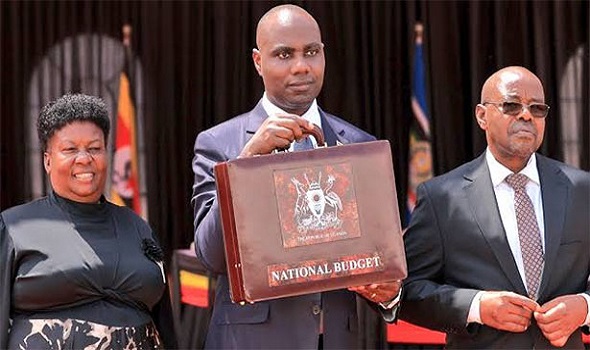
Henry Musasizi (middle) holding the Uganda Budget briefcase
HABARI DAILY I Kampala, Uganda I Uganda’s GDP per capita is projected to increase to $ 1,420, equivalent to approximately Shs 5.1 million per person, while the size of the economy is expected to reach $69.3 billion, or about Shs 250.4 trillion, by the end of June 2026, according to the 2026/27 National Budget presented by the Minister of Finance, Planning and Economic Development, Henry Musasizi.
The projections signal continued economic expansion and reflect the gains made through sustained government investment in security, infrastructure, human capital development, industrialisation, and wealth creation over the last three decades.
Presenting the budget, Musasizi said Uganda’s economic transformation has been built on deliberate policy choices that have created a strong foundation for growth and resilience.
“For more than three decades, Government has prioritised peace and security, macroeconomic stability, infrastructure development, human capital development, wealth creation and regional integration,” Musasizi said.
He noted that these interventions have positioned Uganda among the strongest-performing economies on the African continent.
Strongest foundations in Africa
“As a result, Uganda has built one of the strongest foundations for socio-economic transformation on the African continent,” he said.
According to the minister, Uganda has consistently maintained economic growth above five percent despite facing numerous global and regional shocks, including disruptions in international trade, geopolitical tensions, and the aftermath of the COVID-19 pandemic.
Musasizi highlighted several milestones achieved by the economy, including surpassing the lower-middle-income threshold.
“Uganda has sustained long-term economic growth above five percent despite repeated global shocks and has surpassed the lower-middle-income threshold of USD 1,136, with gross national income per capita reaching USD 1,389,” he said.
He further noted that Uganda’s external sector performance has strengthened significantly in recent years.
“Uganda has recorded one of the strongest external sector performances in recent history, nearly doubling exports over the last five years,” Musasizi told Parliament.
The minister said government investments have also expanded access to health services, education, and other social services while improving infrastructure needed to support investment and competitiveness.
“Government has built critical infrastructure that supports investment and competitiveness and established a solid foundation for industrialisation and private-sector-led growth,” he added.
Benefits for ordinary citizens
While celebrating the progress achieved, Musasizi emphasized that the country’s next challenge is ensuring that economic growth translates into tangible benefits for ordinary citizens.
“Mr. Speaker, the challenge before us is no longer simply growing the economy. The challenge is ensuring that growth translates into jobs, household incomes, enterprise development and prosperity for every Ugandan,” he said.
He described this objective as being at the heart of President Yoweri Museveni’s vision of full monetisation of the economy and the implementation of the Tenfold Growth Strategy.
“That is the essence of full monetisation, as His Excellency the President has consistently emphasized. That is the focus of the Tenfold Growth Strategy. And it is the central objective of this Budget,” Musasizi said.
The minister explained that the 2026/27 financial year marks an important milestone as it begins implementation of the NRM Manifesto while also serving as the second year of the Fourth National Development Plan (NDP IV), which is specifically designed to deliver Uganda’s ambitious Tenfold Growth Strategy.
To maintain momentum, government has retained the budget theme: “Full Monetisation of Uganda’s Economy through Commercial Agriculture, Industrialisation, Expanding and Broadening Services, Digital Transformation, and Market Access.”
Musasizi said the theme aligns closely with regional priorities under the East African Community framework, which seeks to deepen integration, improve regional security, strengthen domestic revenue mobilisation, and promote digital transformation for inclusive growth.
Turning to recent economic performance, the minister described Uganda’s outlook as strong despite uncertainties in the global economy.
“Despite geopolitical tensions, global trade disruptions and continued uncertainty, Uganda’s economic outlook remains strong and positive. The economy is stable. Growth is accelerating. Inflation is low. The exchange rate is stable. Exports are rising. Investment is increasing. And confidence in Uganda’s future remains strong,” he said.
10.2 percent growth in FY 2026/27
Economic growth for the current financial year is estimated at 6.4 percent, slightly higher than the 6.3 percent recorded in FY 2024/25.
However, the most significant boost is expected next financial year when commercial oil production commences.
“With commercial oil production commencing later this calendar year, growth is projected to accelerate to 10.2 percent in FY 2026/27. This will mark Uganda’s first return to double-digit growth since the reforms of the 1990s,” Musasizi said.
He stressed that the anticipated growth would not merely increase national output but would also create opportunities for citizens.
“Most importantly, a larger economy will create more jobs, raise household incomes, expand opportunities for business, and generate the resources required to invest in quality education, healthcare, infrastructure, security, and other public services that improve the lives of Ugandans,” he said.
On inflation, Musasizi reported that Uganda has maintained one of the most stable macroeconomic environments in the region.
Inflation stable
“Inflation remains low and stable. Average inflation during FY 2025/26 is estimated at 3.8 percent compared to 3.5 percent recorded the previous financial year,” he said.
He attributed the stability to effective coordination between fiscal and monetary policies, stable food prices, and improved fuel supply management, adding that low inflation remains critical in protecting household incomes, supporting business planning, and strengthening investor confidence.
As Uganda moves toward a projected economy of Shs 250.4 trillion, government believes the country is entering a new phase of accelerated growth, with a focus on ensuring that prosperity reaches households, businesses, and communities across the country.







About the Author