
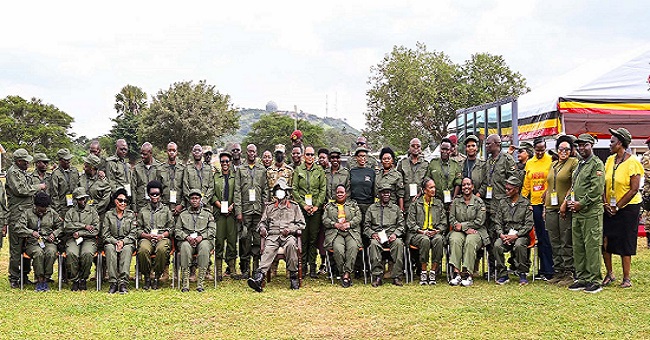
President Museveni (C) poses for a photo with Ministers of State during a cabinet retreat that started off on Monday at Kyankwanzi
HABARI DAILY I Kampala, Uganda I President Yoweri Museveni has urged Cabinet Ministers and Ministers of State to embrace ideological clarity and dedicate themselves to Uganda’s historic mission of socio-economic transformation, arguing that an understanding of how societies evolve is essential for effective leadership.
Speaking at the opening of a 10-day Cabinet Induction Retreat at the National Leadership Institute (NALI) in Kyankwanzi, President Museveni reflected extensively on the evolution of human societies, drawing lessons from history to explain Uganda’s development challenges and opportunities.
The President surprised many by citing the work of German philosopher and economist Karl Marx, whom he described as one of history’s most insightful analysts of social and economic systems.
“By 1848, Karl Marx had identified several social systems. I do not agree with some of his conclusions, but he was one of the best analysts,” Museveni told ministers and senior government officials gathered at the retreat.
Using Marx’s analysis as a point of reference, Museveni outlined the historical progression of societies from primitive communalism to slave societies, feudalism, capitalism and socialism. He argued that leaders who fail to understand these transitions risk misunderstanding the challenges facing their own countries.
According to the President, Uganda’s primary task is to complete the transition from pre-capitalist structures to a modern economy built on production, industrialization, value addition and wealth creation.
“The purpose of leadership is to transform society. We must move our people from subsistence production into the money economy and build a modern society,” he said.
Museveni used the historical reflection to explain why Uganda continues to grapple with poverty despite significant economic progress over the years. He criticized the colonial economic model introduced by the British after 1894, saying it deliberately confined Uganda to the production and export of raw materials.
“They were not interested in creating a modern society. By 1962, only nine percent of Uganda’s population was in the money economy,” he noted.
The President explained that Uganda’s economy at Independence revolved around what he described as the “3Cs and 3Ts” — Coffee, Cotton and Copper; and Tobacco, Tea and Tourism. Most of these products were exported in raw or semi-processed form, limiting the country’s ability to generate jobs and higher incomes.
Museveni argued that the same challenge persists today and emphasized the need for local processing, packaging and branding of Ugandan products to capture greater value from the country’s resources.
His reflections on economic history formed part of a broader message to ministers about the importance of ideological grounding. He warned that public service should not be driven by personal ambition but by a clear understanding of national objectives.
“This is a place of sacrifice. The NRM is a party of sacrifice. People who let us down are people looking for their own things,” he said, describing Kyankwanzi as a symbol of selflessness and service.
The President expressed concern about what he termed a decline in political awareness among leaders, warning that some government institutions had over the years attracted careerists, opportunists, criminals and individuals seeking personal enrichment.
“Political education is knowledge and understanding, whereas propaganda is merely about exciting people,” he said.
Museveni reiterated that the National Resistance Movement’s mission since coming to power in 1986 has been socio-economic transformation through participation in the money economy and access to education.
He identified commercial agriculture, manufacturing, services and Information and Communication Technology (ICT) as the four strategic sectors that should drive Uganda’s economic growth.
The President challenged ministers to take a more active role in mobilizing citizens to embrace commercial production and wealth creation, saying leadership should be measured by tangible improvements in people’s livelihoods.
Drawing from experiences in Uganda’s cattle corridor, he highlighted progress made in transforming communities from traditional pastoralism to commercial agriculture. However, he cautioned against persistent challenges such as land fragmentation, low productivity, poor pasture management and inadequate irrigation.
“We cannot continue to have peasants in Uganda. Every family must move from subsistence living into the middle class or the skilled working class,” he emphasized.
Museveni said the historical responsibility of African leaders, both during the independence struggle and after independence, has always been socio-economic transformation.
“We must build a middle class in Africa. We must build a skilled working class in Africa,” he said.
As ministers begin the retreat themed “Leading Government with Integrity, Discipline and Results: Delivering Uganda to Upper Middle-Income Status,” the President’s message was clear: understanding the historical evolution of societies is not merely an academic exercise, but a practical guide for transforming Uganda into a modern and prosperous nation.







About the Author