
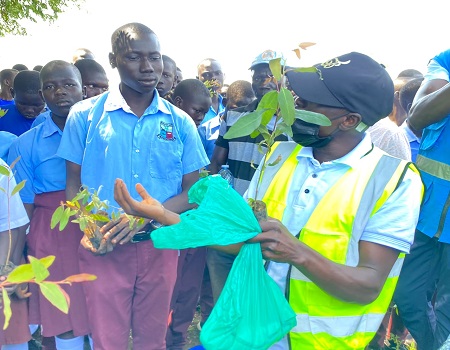
Denis Emmanuel Oweka- ECOTRUST’s regional project coordinator training students on how to use aqua soil during the tree planting session
HABARI DAILY I Kampala, Uganda I As climate change continues to take its toll on the district, the Environmental Conservation Trust of Uganda (ECOTRUST) has taken the lead in restoring degraded landscapes through large-scale tree planting, bringing together communities, schools and development partners to strengthen resilience against the growing environmental crisis.
World Environment Day 2026 took place on Thursday, June 11, 2026. The global event, which is led by the United Nations Environment Programme (UNEP), is observed annually on this date to raise environmental awareness and encourage action for climate preservation.
This sat well with Adjumani, which experiences extreme heat during dry seasons and severe flooding during rainy seasons, making environmental restoration a priority.
On June 11, 2026, students, local leaders, conservation experts and development partners converged at Arinyapi Seed Secondary School in Adjumani District to commemorate World Environment Day with a large-scale tree planting exercise under the Investing in Forests and Protected Areas for Climate-Smart Development (IFPA-CD) Project.
The initiative marked one of the final activities under the IFPA-CD Project, which concludes this month. The project is an initiative of the Government of Uganda through the Ministry of Water and Environment with financial support from the World Bank. It is being implemented by a consortium comprising NIRAS International Consulting, ECOTRUST, Havilah Company Limited and Green Life International.
During the exercise, participants planted 5,000 high-quality clonal eucalyptus seedlings across five acres of the school’s woodlot. The trees were carefully spaced at the recommended two-by-two-metre intervals to promote healthy growth, maximize survival rates and ensure long-term sustainability.
The exercise demonstrated the remarkable achievements already registered by the project in Adjumani District. Initially, the district had been assigned a target of establishing 368 hectares of institutional woodlots. However, through effective coordination and strong community participation, the district has surpassed expectations by establishing 601 hectares.
Similarly, the project targeted enrollment of 1,000 farmers into climate-smart forestry initiatives. Through ECOTRUST’s extensive community mobilization and awareness campaigns, 1,085 farmers have successfully joined the programme, pushing overall implementation to 108.5 percent of the original project targets.
As the lead partner responsible for community engagement and model farmer enrollment, ECOTRUST coordinated the entire World Environment Day activity. The organisation mobilized students, district leaders and surrounding communities, supervised the layout of the woodlot and guided participants throughout the planting exercise to ensure the seedlings were properly established.
The selection of Arinyapi Seed Secondary School was strategic. District authorities identified the area as one of the locations experiencing the harshest impacts of climate change within Adjumani. During prolonged dry spells, temperatures become extremely high, while heavy rains frequently trigger flooding that threatens livelihoods, infrastructure and agricultural production.
Adjumani District Natural Resources Officer Charles Gayoyo said the tree planting initiative forms part of wider efforts to protect critical water sources while helping communities adapt to increasingly unpredictable weather patterns.
He explained that restoring tree cover around the Tete River catchment and the River Nile would improve water conservation, reduce land degradation and strengthen the district’s natural ecosystems for future generations.
School administrators welcomed the initiative, noting that beyond environmental conservation, the woodlot will create a healthier learning environment and serve as an educational resource for students.
Deputy Head Teacher Dricih Festo Lahn expressed gratitude that Arinyapi Seed Secondary School had been selected to host the exercise, saying the trees would improve the school environment while benefiting future generations of learners.
To improve the survival rate of the newly planted trees, ECOTRUST introduced aqua soil technology, an innovative water-retention solution that stores moisture around plant roots during prolonged dry periods. The technology is expected to significantly increase survival rates, especially in areas prone to drought.
Denis Emmanuel Oweka, ECOTRUST Regional Coordinator for the West Nile Northeast Region covering Adjumani, Moyo, Lamwo, Amuru and Obongi districts, said the organisation continues to prioritize community engagement, farmer training and environmental education to ensure communities appreciate the long-term value of forest conservation.
He noted that the 5,000 seedlings supplied by NIRAS were being planted with active participation from students, adding that the learners would grow alongside the trees and become future custodians of the environment.
Local leaders also urged the school community to protect the woodlot, emphasizing that trees provide both environmental and economic benefits.
Adjumani District Vice Chairperson Geoffrey Obulejo encouraged students and school administrators to take ownership of the plantation, explaining that mature trees would beautify the school compound, shield buildings from strong winds and eventually generate income. Drawing from his own experience, he said tree planting had transformed his livelihood over the years and encouraged young people to embrace forestry as a long-term investment.
NIRAS International Consulting, the lead contract holder implementing the project on behalf of the Ministry of Water and Environment, commended ECOTRUST for its outstanding mobilization efforts and strong partnership with local communities.
Speaking on behalf of NIRAS, Community Engagement Expert Deziderius Irumba attributed the project’s success to teamwork, active community participation and effective mobilization that had enabled farmer registration and institutional woodlot establishment to exceed planned targets.
As the IFPA-CD Project draws to a close, the achievements in Adjumani stand as a model of how coordinated partnerships between government, development partners, conservation organisations, schools and local communities can deliver lasting environmental and socio-economic benefits.
Through support from the Government of Uganda, the Ministry of Water and Environment, the World Bank and implementing partners led by NIRAS, thousands of trees are now taking root across the district, helping communities combat climate change, restore degraded landscapes, protect vital water catchments and improve livelihoods for generations to come.







About the Author