
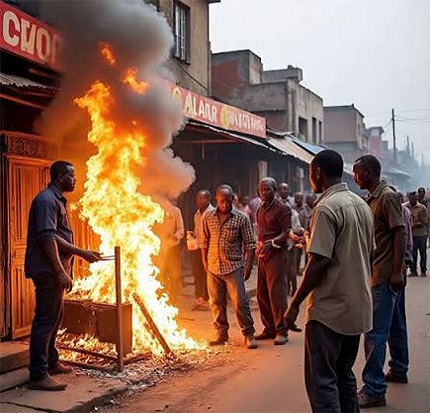
Indigenous South Africans on rampage, burning foreign-owned businesses
The National Carrier, Uganda Airlines is set to kick off flights to evacuate hundreds of Ugandans caught up in xenophobic attacks in South Africa, officials have disclosed.
“All preparations are done, and flights to Uganda will commence either today or tomorrow,” said a Uganda Airlines official on condition of anonymity. He however didn’t devulge how many Ugandans have been booked on flights, and how much the Ugandan Government would pay for this operation.
This new development followed the numerous distress calls at the Ugandan High Commission in Pretoria, South Africa, from hundreds of Ugandans seek urgent assistance to return home amid escalating anti-migrant violence and xenophobic attacks sweeping across parts of the country.
The growing insecurity has compelled the Government of Uganda to launch a state-funded evacuation exercise for citizens who fear for their safety.
The decision follows a directive by President Yoweri Kaguta Museveni after reports of increasing violence against foreign nationals, including Ugandans, particularly in South Africa’s KwaZulu-Natal Province. Authorities say the worsening security situation has forced hundreds of Ugandans to abandon their businesses, jobs and homes as vigilante groups intensify attacks and issue threats against migrants.
In a statement issued on June 28, 2026, the Ministry of Foreign Affairs confirmed that arrangements were underway to repatriate Ugandans wishing to return home. The ministry said the operation is being coordinated jointly with the Office of the Prime Minister, the Ministry of Internal Affairs, the Ministry of Works and Transport, the Uganda High Commission in Pretoria, and Ugandan community leaders in South Africa.
Minister speaks out
According to Haruna Kyeyune Kasolo, the Acting Minister of Foreign Affairs, at least 746 Ugandans had voluntarily registered for evacuation due to growing security concerns, with the number expected to rise as more citizens continue to seek assistance.
“The Government of Uganda has resolved to facilitate the voluntary repatriation of Ugandan nationals who feel unsafe following the escalating xenophobic protests and anti-migrant violence in South Africa,” the ministry said.
The government says the evacuation exercise is entirely voluntary and targets Ugandans who no longer feel secure remaining in South Africa. Officials noted that many citizens had already left independently following reports that anti-immigration vigilante groups had circulated a June 30, 2026 deadline demanding that foreigners leave the country.
The evacuation process will involve registering Ugandans across South Africa’s provinces before transporting them to secured assembly centres where they will receive assistance. Emergency travel documents will be issued to those who require them before immigration authorities facilitate their departure.
Kasolo added that the Government of Uganda will fully fund the rescue operation, including chartering Uganda Airlines flights to transport evacuees back home. Authorities believe this coordinated approach will ensure the safe and orderly return of citizens while avoiding unnecessary risks associated with individual travel.
One Ugandan dead
One of the major factors behind the government’s decision was the killing of a Ugandan national during the recent wave of violence. Uganda’s High Commissioner to South Africa, Ambassador Paul Amoru Omiat, identified the deceased as Wilber Niwamanya, also known as Joseph Ainebyona.
Niwamanya reportedly earned a living operating a motorcycle delivery service in KwaZulu-Natal Province before he was attacked by a group of assailants who allegedly stole his motorcycle. The incident sent shockwaves through the Ugandan community and heightened fears among migrants already living under increasing pressure.
Ambassador Amoru said the Ugandan mission had formally requested South African authorities to preserve the body pending repatriation to Uganda. The High Commission has also asked police to conduct thorough investigations to identify, arrest and prosecute those responsible for the killing.
Officials say the tragic death demonstrated the seriousness of the security threats facing Ugandans and reinforced the need for urgent government intervention.
Migrant-owned businesses razed
The current unrest represents one of South Africa’s most significant outbreaks of xenophobic violence in recent years. For months, anti-immigration groups have organised demonstrations in several provinces, accusing foreign nationals of taking jobs, contributing to crime and placing additional strain on public services.
The protests have been accompanied by increasing intimidation, attacks on migrant-owned businesses and calls for undocumented foreigners to leave the country. The circulation of a June 30 deadline by some vigilante groups has further heightened anxiety among migrant communities, prompting many to seek refuge at embassies or request assistance to return to their countries of origin.
Although South African President Cyril Ramaphosa has publicly condemned attacks on foreign nationals and warned against vigilantism, security agencies have acknowledged growing public frustration over illegal immigration. Police have increased deployments in several areas ahead of the June 30 deadline in an effort to prevent further violence.
The latest unrest recalls previous episodes of xenophobic violence that have periodically erupted in South Africa since 2008, when attacks targeting foreign nationals claimed more than 60 lives and displaced thousands.
African countries respond
Uganda is not the only African country responding to the crisis. Several governments have launched voluntary repatriation programmes for their citizens as tensions continue to escalate. Malawi recently began bringing home nationals who fled attacks and sought refuge in temporary camps around Durban.
Nigeria has also organised emergency flights to evacuate hundreds of its citizens, while Ghana, Mozambique and Zambia have initiated similar arrangements for nationals wishing to return home. Namibia has advised its citizens in South Africa to remain vigilant and maintain contact with consular officials.
International humanitarian organisations have expressed concern that refugees, asylum seekers and other vulnerable migrant populations remain at significant risk as anti-migrant sentiment continues to spread.
Meanwhile, the Ministry of Foreign Affairs has urged all Ugandans in South Africa who wish to return home to register with the Uganda High Commission in Pretoria. Officials say the government remains in constant engagement with South African authorities to ensure the safety of Ugandans who choose to remain while finalising arrangements to evacuate those seeking immediate repatriation.







About the Author