

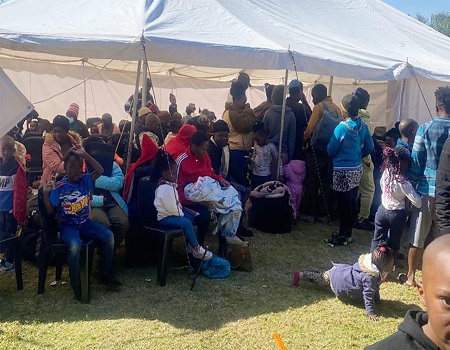
Ugandans in Pretoria and Joboug registering to be evacuated
HABARI DAILY I Kampala, Uganda I The Government of Uganda is facing mounting logistical and financial demands as it prepares for the possible evacuation of Ugandans stranded in South Africa following a surge in xenophobic attacks targeting foreign nationals.
Officials say the need is substantial, with hundreds of Ugandans already expressing interest in returning home and more expected to register in the coming days.
Uganda’s High Commissioner to South Africa, Paul Amoru, revealed that the Ugandan mission has so far received reports from frightened citizens seeking assistance amid renewed violence that has unsettled immigrant communities.
As of Wednesday, at least 250 Ugandans had officially registered with the embassy as intending to return home. However, officials believe the number will rise significantly because registration remains ongoing.
Online registration launched
The embassy has launched an online registration exercise to establish the exact number of Ugandans requiring evacuation and to determine the scale of resources that will be needed for the operation.
According to Amoru, the mission initially prioritised the registration of vulnerable groups, including women, the elderly, unemployed Ugandans and those living illegally in South Africa.
“Ugandans living in South Africa who are in vulnerable situations should register with the embassy to facilitate any possible assistance,” he said.
Evacuation depends on available resources
Although preparations are underway, the government has made it clear that evacuation will only proceed if adequate funding is secured.
Amoru said the Ministry of Foreign Affairs in Kampala had been alerted to the growing humanitarian concern and that discussions on possible interventions were ongoing.
“The evacuation process is dependent on resources,” he explained, noting that officials are assessing both the number of beneficiaries and the financial implications before any final decision is made.
The High Commission has also been gathering detailed information from applicants, including their legal status, location, family size and immediate needs, to help determine the most appropriate evacuation arrangements.
Officials estimate that transporting hundreds of people, together with coordinating travel documentation and airport logistics, will require considerable financial support from the government.
Who qualifies for evacuation?
The embassy has outlined clear eligibility criteria to ensure that assistance reaches those in greatest need.
It has further disclosed that priority is being given to Ugandans who are unemployed or unable to support themselves, women and children facing heightened vulnerability, as well as the elderly Ugandans requiring special assistance.
They also consider persons whose immigration status has left them particularly exposed during the unrest, as well as other vulnerable individuals unable to independently finance their return to Uganda.
Amoru stressed that the exercise is humanitarian rather than administrative, intended to protect lives amid growing insecurity.
The embassy has also urged Ugandans to remain calm while avoiding unnecessary travel to areas experiencing violence.
Call for support
The online registration process allows Ugandans across South Africa to submit their personal details and indicate whether they require government-assisted evacuation.
Officials say the data being collected will help determine the total number of Ugandans seeking evacuation, their geographical distribution across South Africa, the level of financial assistance required, the appropriate transport arrangements and consular documentation needs before departure.
The embassy believes the final figures could be considerably higher than the current registrations because many Ugandans remain fearful or have not yet accessed the registration platform.
Government processing emergency documents
Besides planning for possible evacuation flights, the Ugandan mission has intensified efforts to assist citizens whose travel documents have expired or been lost.
The High Commission says it has deployed additional staff to process emergency travel documents and other consular services.
Amoru disclosed that embassy officials have been working extended hours to ensure affected Ugandans receive assistance quickly.
The mission has also maintained communication with South African authorities regarding the safety of Ugandan nationals.
Worsening xenophobic climate
The renewed concern follows sporadic outbreaks of xenophobic violence that have targeted immigrants from several African countries.
South Africa has experienced repeated waves of anti-foreigner attacks since 2008.
The violence intensified again in 2015, followed by another major outbreak in 2019 that primarily targeted Nigerians, Zimbabweans, Ethiopians, Somalis, Bangladeshis and other immigrant communities.
Fresh concerns resurfaced in 2022 with the launch of Operation Dudula, a movement whose members accuse foreign nationals of taking jobs, engaging in crime and placing pressure on public services.
Since 2024, authorities have also witnessed continuing anti-immigrant demonstrations organised by groups such as March and March, further heightening tensions.
These developments have left many foreign nationals living in fear despite South Africa’s constitutional protections.
Regional impact
Ugandans are not the only foreign nationals seeking assistance. Neighbouring Zimbabwe has also activated contingency measures for its citizens.
The Government of Zimbabwe recently extended its Zimbabwe Exemption Permit, allowing thousands of Zimbabweans to remain legally in South Africa while longer-term immigration issues are addressed.
South African authorities have also introduced stricter immigration enforcement measures, including inspections of businesses employing foreign nationals and closer scrutiny of documentation.
These developments have increased anxiety among immigrant communities, many of whom depend on informal employment for survival.
Funding remains the challenge
While Uganda has experience repatriating citizens during emergencies, officials acknowledge that financing remains the single greatest obstacle.
Organising evacuation requires chartered or commercial flights, airport coordination, temporary accommodation where necessary, processing travel documents, transportation within South Africa and reception arrangements upon arrival in Uganda.
The Uganda Government had also made prior arrangements to fly its citizens back on Uganda Airlines.
The exact budget cannot yet be determined until the registration exercise is completed.
Officials say the government is committed to protecting Ugandan citizens abroad but must first establish the scale of the operation before mobilising resources.
For now, the High Commission continues to encourage every Ugandan wishing to return home to register as soon as possible.
As xenophobic tensions persist, the number of people seeking government assistance is expected to grow, increasing both the logistical complexity and financial cost of any eventual evacuation programme.







About the Author