

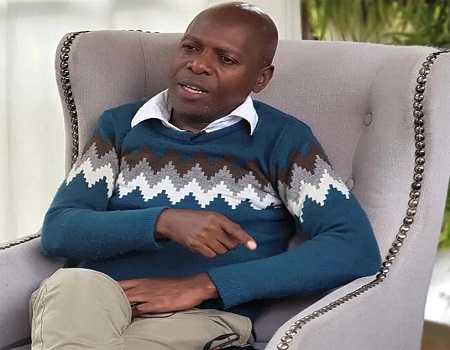
Timothy Kalyegira
HABARI DAILY I Kampala, Uganda I Veteran Ugandan journalist and political commentator Timothy Kalyegira has been formally charged before the Kira Magistrates Court over allegations that he operated online media platforms without obtaining the required broadcasting licences from the Uganda Communications Commission (UCC), in a case that has reignited debate over the regulation of digital journalism and freedom of expression.
According to the charge sheet, prosecutors accuse Kalyegira of operating two online publications—The Kampala Express and The Uganda Records—without authorization, contrary to Section 28(1) and (2) of the Uganda Communications Act. The State alleges that he broadcast content through The Kampala Express between 2013 and 2026 and operated The Uganda Records from 2014 to 2026 without securing the licences required by Uganda’s communications regulator.
The charges place at the centre of the case a legal question that has become increasingly significant in Uganda’s evolving media landscape: whether online news websites and digital commentary platforms should be treated as broadcasters subject to the same licensing requirements as radio and television stations.
Kalyegira appeared before Kira Magistrates Court on Monday after several days of uncertainty over his whereabouts. Family members, neighbours and colleagues had expressed concern after he reportedly disappeared on Friday, with his mobile phone switched off throughout the weekend.
Reports later emerged that the journalist had been arrested in Fort Portal before being transferred to Kira Magistrates Court for arraignment. Human rights lawyer Tumusiime Kato, who attended the proceedings, confirmed that Kalyegira also faces charges under the Computer Misuse Act linked to content allegedly published on the social media platform X.
While Kalyegira took plea before the court, authorities had not publicly disclosed the specific social media posts forming the basis of the Computer Misuse charges by the time of publication. As a result, attention has largely focused on the broadcasting licence allegations outlined in the charge sheet.
The prosecution argues that by operating The Kampala Express and The Uganda Records over an extended period without UCC approval, Kalyegira contravened provisions of Uganda’s communications law governing broadcasting services.
The case has revived longstanding questions about whether legislation enacted during an era dominated by traditional broadcast media adequately addresses today’s digital publishing environment.
Uganda’s communications laws were largely drafted when radio and television were the country’s primary sources of mass communication. However, the rapid expansion of internet-based journalism, websites, blogs and social media has blurred the distinction between broadcasting and online publishing.
Supporters of stricter regulation argue that digital publishers should comply with the same licensing standards imposed on conventional broadcasters. They contend that equal regulation promotes accountability, combats misinformation and ensures consistent professional standards across all media platforms.
Critics, however, argue that extending broadcasting licence requirements to online publishers risks creating unnecessary barriers to journalism and freedom of expression. They warn that independent journalists increasingly depend on digital platforms to reach audiences outside established media institutions, making regulatory requirements particularly significant for press freedom.
Kalyegira’s prosecution also intersects with continuing legal debates surrounding Uganda’s Computer Misuse Act.
In March 2026, Uganda’s Constitutional Court struck down key provisions of the Computer Misuse (Amendment) Act, 2022 after ruling that Parliament passed the amendments without meeting constitutional quorum requirements. Those provisions had been widely criticised by journalists, civil society organisations and digital rights advocates, who argued that they had been repeatedly used to criminalise online speech and political commentary.
Following the Constitutional Court ruling, only the original Computer Misuse Act of 2011 remains in force. That law primarily addresses offences such as hacking, unauthorised access to computer systems, electronic fraud and related cybercrime offences.
Legal observers are therefore closely watching how prosecutors intend to apply the remaining provisions of the Act in cases involving journalism, political commentary and online expression.
“According to the chargesheet, he being charged with broadcasting without a valid license. But in actual sense, he didn’t broadcast any content but published online,” said Job Magara, a Kampala-based political commentator.
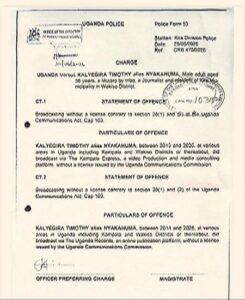
Chargesheet documented
Media freedom advocates have already expressed concern that Kalyegira’s prosecution reflects broader trends involving increased regulation of online speech and growing pressure on independent media voices.
Uganda has faced repeated criticism from international press freedom organisations over arrests of journalists, restrictions on media coverage, internet shutdowns during election periods and the use of regulatory agencies against media organisations.
Government supporters, however, maintain that licensing requirements and regulatory oversight remain essential tools for ensuring responsible journalism, protecting the public from misinformation and maintaining accountability within the media sector.
Critics counter that enforcement often appears selective, arguing that regulatory action disproportionately affects journalists and commentators who are critical of government policies or public officials.
The latest proceedings also revive memories of Kalyegira’s earlier encounters with Uganda’s criminal justice system.
In 2010 and 2011, he faced charges of sedition and criminal libel following articles published on his platforms, including commentary relating to the July 2010 Kampala bombings. Authorities alleged that some of his published opinions defamed President Yoweri Museveni. Those criminal proceedings continued for several years before the charges were eventually dismissed in 2015.
Widely regarded as one of Uganda’s most influential political analysts, Kalyegira has built a substantial following through his historical research, political analysis and commentary on governance, military affairs and national security. His writings have frequently addressed politically sensitive issues, including succession politics and the role of powerful state institutions.
His latest prosecution comes at a politically sensitive moment, following heightened debate over media regulation and freedom of expression in Uganda. In recent months, Kalyegira has written extensively about the country’s security sector, military leadership and high-profile political developments.
Although prosecutors have not publicly linked those writings to the charges currently before court, the timing of the case has intensified public discussion about the relationship between journalism, digital regulation and political accountability.
Kalyegira has since joined a growing list of high-profile political figures and activists detained at Luzira Prison while legal proceedings continue.
Whether the case ultimately remains a straightforward dispute over broadcasting licences or develops into a landmark legal test defining the regulation of online journalism in Uganda remains uncertain.
This current prosecution has once again placed Uganda’s legal framework governing digital media, online publishing and freedom of expression under intense national and international scrutiny.







About the Author