
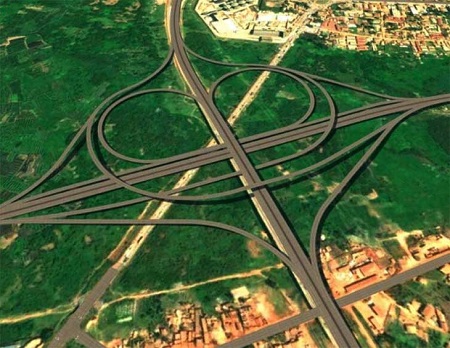
Busega systems interchange layout
HABARI DAILY I Kampala, Uganda I The government’s widening probe into the troubled Busega–Mpigi Expressway has drawn several former officials of the Uganda National Roads Authority (UNRA) into investigations over alleged financial mismanagement, questionable design changes and escalating project costs that have nearly doubled from the original contract value.
The exact embezzled amount remains unquantified, though President Yoweri Museveni has ordered forensic investigations into suspected fraudulent compensation and route manipulations that caused project costs to balloon from an initial Shs600 billion to over Shs1.3 trillion, despite only 40% of the work being completed
The investigations, which have now become one of the biggest infrastructure accountability inquiries in recent years, are focusing on decisions made during the planning and implementation of the 23.7-kilometre expressway linking Kampala to Mpigi.
The road is expected to ease traffic congestion along the busy Kampala-Masaka highway but has instead become the subject of intense scrutiny over ballooning costs, delayed implementation and compensation claims.
The probe has particularly sucked in engineers and technical officials who previously served under the Uganda National Roads Authority before the agency’s road functions were transferred to the Ministry of Works and Transport.
Several of the officials currently under investigation either supervised, approved or implemented various aspects of the project while working under UNRA’s mandate.
Extensive investigation launched
President Museveni recently ordered an extensive investigation into the project after receiving reports alleging irregular expenditure, alteration of the original road alignment and possible abuse of office. According to the presidential directive, government borrowed approximately Shs600 billion from the African Development Bank to finance the project, but despite substantial payments, only about 40 percent of the works have reportedly been completed.
The President further questioned allegations that the original road alignment was changed after compensation had already been paid, resulting in fresh compensation claims and pushing the estimated project cost to about Shs1.3 trillion. The directive asks investigators to establish how such decisions were reached and whether public officials benefited from the revised alignment.
Following the directive, the Ministry of Works and Transport announced that several senior officials had been removed from active duty to pave the way for investigations. Permanent Secretary Waiswa Bageya was instructed to proceed on leave, while three senior engineers—Edwin Raymond Kiyaga, Dickens Ahimbisibwe and Patrick Muleme—were suspended pending the outcome of the investigations. Barbara Namugambe was appointed acting Permanent Secretary.
The suspensions have effectively drawn into the investigations officials whose careers span both the former UNRA and the current Ministry of Works structure, highlighting how decisions taken before the merger continue to have implications today.
Gen. Edward Katumba Wamala defends position
Former Works and Transport Minister Gen. Edward Katumba Wamala has consistently maintained that the increase in the project’s cost was driven by legitimate engineering considerations rather than corruption.
Appearing before Parliament’s Committee on Physical Infrastructure earlier this year, Katumba explained that the revised estimates resulted from changes in the design and scope of the project.
According to the minister, “the cost escalation is due to changes in the project’s design and scope,” including revised road alignments, construction of additional interchanges and new connecting roads intended to improve the functionality of the expressway.
Engineer-in-Chief Stephen Kitonsa also defended the revised figures before legislators, explaining that a technical review team had reassessed the project requirements before arriving at the updated cost estimates.
“The revised cost was arrived at after a technical review of the project,” Kitonsa told MPs, insisting the additional works reflected updated engineering requirements rather than arbitrary increases.
MPs adamant
However, Members of Parliament rejected the ministry’s explanation, saying the increase from approximately Shs547.5 billion to more than Shs1.2 trillion required much deeper scrutiny.
The committee, chaired by Dan Kimosho, questioned how the project cost could nearly double while physical progress on the ground remained relatively limited. MPs demanded that the ministry submit the original contract documents together with all subsequent variations for detailed examination.
“This is science, not gambling,” Kimosho told ministry officials while dismissing explanations that lawmakers considered insufficient to justify the enormous increase in project costs. The committee subsequently ordered the ministry to provide the original contract to facilitate a comprehensive investigation.
The Busega-Mpigi Expressway has also faced persistent challenges beyond financing. The project has experienced delays arising from compensation disputes, encroachment on the road reserve and funding constraints that slowed implementation.
Earlier this year, the Inspectorate of Government separately ordered investigations into fresh encroachment along the expressway corridor after discovering that some individuals had allegedly reoccupied land that had already been compensated or developed new structures within the gazetted road reserve.
IGG thrown into fray
During a joint inspection, Deputy Inspector General of Government Anne Twinomugisha Muhairwe criticised what she described as inadequate enforcement by the Ministry of Works.
“We were not satisfied with the explanation given. If there is encroachment, the ministry should have acted,” she said, warning that those responsible would be held accountable.
The expressway remains one of Uganda’s flagship transport projects and is expected to significantly reduce congestion on the Kampala-Masaka corridor once completed. Originally contracted at about Shs547 billion, the project was intended to improve movement of people and goods between Kampala and western Uganda while supporting regional trade.
Instead, the project has become a focal point in the government’s anti-corruption drive, with investigators now examining procurement decisions, payment schedules, engineering approvals, compensation processes and the role played by current and former officials who served under both UNRA and the Ministry of Works and Transport.
The outcome of the investigations is expected to determine whether the dramatic increase in project costs resulted from genuine engineering requirements, administrative failures or criminal misconduct, findings that could shape future accountability in Uganda’s multi-billion-shilling infrastructure sector.







About the Author