

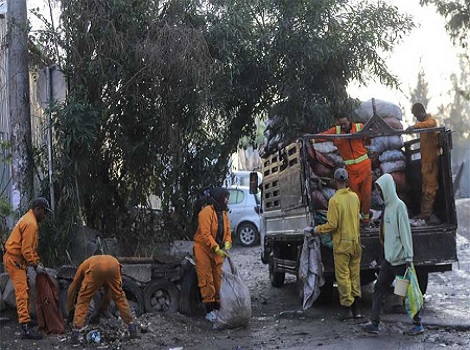
Volunteers engaged in the cleaning process
HABARI DAILY I Kampala, Uganda I More than 750,000 volunteers have been mobilised across Ethiopia’s capital, Addis Ababa, in one of the city’s largest community clean-up campaigns, demonstrating how mass public participation can dramatically improve urban sanitation in the shortest possible time and at minimal cost to government.
The campaign, which has attracted civil servants, students, members of the business community, security personnel, youth groups and ordinary residents, is being hailed as an example of how coordinated civic action can tackle long-standing environmental challenges without relying on expensive government-funded operations.
According to city officials, the exercise is part of a broader initiative aimed at restoring cleanliness, improving public health and creating a more attractive urban environment through community ownership rather than costly contracted services.
The clean-up campaign has been organised under Addis Ababa’s “Clean City” initiative, which seeks to instil a culture of environmental responsibility among residents while encouraging every citizen to contribute to keeping the capital clean.
Volunteers donate their time and labour
Unlike conventional sanitation programmes that depend heavily on municipal budgets, machinery and hired contractors, the Addis Ababa model relies primarily on volunteers who donate their time and labour for the benefit of their communities.
The initiative has enabled the city to carry out extensive cleaning exercises simultaneously across numerous neighbourhoods while keeping public expenditure to a minimum.
Officials estimate that more than three-quarters of a million volunteers have taken part in the exercise, making it one of the largest citizen-led environmental campaigns undertaken in the Ethiopian capital.
Participants have been drawn from government institutions, civic organisations, educational institutions, businesses, youth associations and community groups, all working together toward the common goal of improving sanitation across the city.
The mobilisation demonstrates how governments can leverage community spirit to undertake labour-intensive public works that would otherwise require enormous financial resources.
Mayor Adanech Abiebie upbeat
Speaking during the campaign, Addis Ababa Mayor Adanech Abiebie praised residents for embracing the initiative and making environmental cleanliness a shared responsibility.
The mayor said the city administration had succeeded in bringing together government institutions, businesses, communities and development partners under a common objective of creating a cleaner and healthier Addis Ababa.
She noted that the mobilisation had shown the willingness of residents to volunteer their time for the public good when provided with proper organisation and leadership.
According to the city administration, the campaign is not simply about removing waste but also about changing public attitudes towards environmental conservation and encouraging people to take responsibility for the cleanliness of their surroundings.
Officials believe that sustained community participation will significantly reduce littering while lowering the financial burden on municipal authorities.
Proper waste disposal pertinent
The programme has also become an important public awareness campaign, educating residents on proper waste disposal, environmental protection and the health benefits associated with cleaner neighbourhoods.
Authorities say cleaner communities contribute directly to reducing disease outbreaks by eliminating breeding grounds for mosquitoes, rodents and other disease-causing organisms.
The exercise therefore combines environmental conservation with preventive public health measures, making it a cost-effective investment for the city’s future.
The city administration has further indicated that maintaining cleanliness should not be viewed as the sole responsibility of municipal authorities but as a shared obligation involving every resident.
Officials argue that when communities actively participate in keeping their environment clean, government can redirect limited financial resources towards other priority services instead of spending heavily on waste collection and emergency clean-up operations.
The campaign has also highlighted the efficiency of coordinated volunteerism in delivering rapid results.
Rather than carrying out clean-up activities over several weeks using paid workers, Addis Ababa has demonstrated that massive mobilisation can transform large sections of the city within a single day.
Thousands of volunteers spread across different districts have worked simultaneously to remove accumulated waste, clear drainage channels, collect litter from roadsides and public spaces and improve the overall appearance of the capital.
Operational costs low
The coordinated approach has enabled city authorities to maximise impact while keeping operational costs exceptionally low.
Officials say the only significant public expenditure has involved coordination, provision of basic equipment and logistical support, while the actual labour has been provided free of charge by volunteers.
The initiative has therefore emerged as a practical example of how civic participation can complement government programmes, particularly in developing cities where municipal budgets often struggle to meet growing urban sanitation demands.
The campaign has also attracted support from private companies and community organisations that have contributed equipment, supplies and technical assistance to facilitate the exercise.
This public-private-community partnership has further reduced costs while expanding the reach of the programme.
City officials say the clean-up initiative forms part of Addis Ababa’s long-term urban transformation strategy, which aims to improve sanitation standards, strengthen environmental management and enhance the city’s attractiveness for residents, investors and tourists.
The administration believes that maintaining clean public spaces contributes to economic development by creating a more welcoming environment for businesses while improving the quality of life for city residents.
Sustained public engagement
Environmental experts have also welcomed the initiative, noting that volunteer-driven programmes can achieve impressive results when supported by effective planning and sustained public engagement.
They argue that while municipal sanitation services remain essential, they are significantly strengthened when communities become active partners rather than passive beneficiaries.
The Addis Ababa experience illustrates how large-scale citizen mobilisation can produce immediate and visible improvements without placing enormous pressure on government finances.
By bringing together more than 750,000 volunteers from all walks of life, the Ethiopian capital has shown that environmental transformation does not always require massive expenditure. Instead, with strong leadership, effective coordination and widespread public participation, cities can achieve cleaner neighbourhoods, healthier communities and better urban environments in remarkably short periods and at almost no cost.







About the Author