
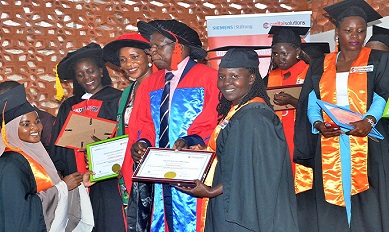
L-R Dr Joyce Tamale, the CEO, Capital Solutions Ltd, Prof Ntamu a lecturer at MUBS, Prof Turyakira from King Ceaser University, among graduates, during the graduation ceremony held recently at Kajjansi (Photo by John Ricks Kayizzi)
HABARI DAILY I Kampala, Uganda I There is alot of good work being done by social entrepreneurs and innovators, as they use business as a force for good.
According to Dr Joyce Tamale, the Capital Solutions Ltd’s Executive Director and Co-founder, across Uganda, social entrepreneurs are redefining what it means to do business transforming challenges into opportunities and purpose into impact.
“From recycling plastic waste into school furniture, empowering women and youth through sustainable livelihoods, to introducing clean energy and climate-smart solutions, these changemakers are building an inclusive and resilient future for all,” she said in a recent statement.
She said that at Capital Solutions, they are proud to walk alongside these enterprises from offering advisory services, financing, and capacity-building support that helps them grow and scale their impact.
“Social entrepreneurship is not just about profits; it’s about people, planet, and purpose. It’s about creating solutions that drive inclusion, protect our environment, and strengthen communities,” she noted, adding that they reaffirm their commitment to supporting African social entrepreneurs who are reshaping the future one idea, one enterprise, and one impact at a time.
Transformative movement taking shape
In Uganda’s urban markets and rural communities, a transformative movement is taking shape. Innovators are converting plastic waste into durable school furniture, women-led cooperatives are rehabilitating degraded wetlands while generating sustainable livelihoods, and digital platforms are linking smallholder farmers to international carbon-credit markets.
Dr Tamale said that these initiatives transcend philanthropy, since they represent social enterprises engineered to address societal challenges through viable, market-driven solutions. “We usually highlight how these ventures integrate inclusion as a core strategy for climate resilience, demonstrating that financial sustainability and social impact are mutually reinforcing.”
Investors making a difference
Social entrepreneurship emerges where conventional markets fall short, particularly for marginalised populations. In Uganda, 41 per cent of citizens subsist on less than $1.90 daily, and women hold fewer than 30 per cent of registered businesses. Social enterprises invert this paradigm. Green Treasures, a Kampala-based operation, engages formerly incarcerated youth in collecting and recycling plastic bottles into high-quality paver tiles.
“Employees receive competitive wages, financial literacy training, and equity through profit-sharing. Outcomes include reduced recidivism, enhanced urban sanitation, and a scalable product now deployed in school courtyards across three districts,” she said.
She added that inclusion is integral to the enterprise model, adding that by transforming excluded groups into active producers, these ventures amplify systemic resilience.
Research from the Uganda National Bureau of Standards (2024) indicates that firms with at least 50 per cent female leadership are 60 per cent more likely to implement circular-economy practices. This correlation reflects lived experience: as primary caregivers, women confront climate-induced disruptions—droughts depleting food reserves, floods destroying homes—and devise grounded, community-centric responses.
Low-income households burdened
“Climate change imposes an immediate and disproportionate burden on low-income households. The World Bank projects that, absent adaptive interventions, Uganda could forfeit up to 20 per cent of GDP by 2030 due to unpredictable rainfall and soil degradation,” said Dr Tamale.
She added that social enterprises are constructing market-based safeguards that traditional systems overlook. “In the cattle corridor, Barefoot Power deploys pay-as-you-go solar kits paired with micro-insurance for crop failure. Farmers remit $0.50 weekly via mobile money, securing illumination, device charging, and financial protection against climatic shocks,” she pointed out.
She added that in the past year, the model prevented default for 12,000 households and offset 18,000 tonnes of CO₂ by supplanting kerosene lamps. The enterprise channels 30 per cent of profits into reforestation, establishing indigenous species that serve as windbreaks and income-generating orchards.
In another example which features in northern Uganda, Eco-Fuel Africa transforms agricultural residues into clean-burning briquettes using kilns co-designed with South Sudanese refugee artisans.
These briquettes outperform charcoal by 40 per cent in burn time, mitigating indoor air pollution responsible for 20,000 annual deaths. Refugee women, compensated per kilogram produced, have established savings collectives that fund biogas infrastructure—creating a closed loop from waste to energy to soil enhancement.
Patient capital required
“Despite proven models, scaling remains constrained by limited patient capital and regulatory inertia. Uganda’s pending Social Enterprise Policy proposes tax incentives for firms generating at least 50 jobs in underserved regions, yet enactment is delayed,” Dr Tamale further noted.
She said that the African Social Enterprise Fund, seeded by the Mastercard Foundation in 2025, addresses this gap through blended finance: 40 per cent grant, 60 per cent concessional loan, repayable only beyond a revenue threshold. “Initial beneficiaries report a 300 per cent expansion in working capital within 18 months.”
Real-world conditions
She further pointed out that technology is further equalising opportunity. “Ensibuuko, a fintech cooperative, leverages blockchain to authenticate impact metrics, enabling rural enterprises to access European green-bond markets directly. A sorghum cooperative in Soroti secured €47,000 in under 72 hours to install solar dryers, reducing post-harvest losses from 30 per cent to below 5 per cent.”
She referred to the future not as a passive inheritance but an iterative prototype. “Social entrepreneurs are rigorously testing this prototype under real-world conditions. They affirm that inclusion is strategic risk mitigation, not benevolence, and that climate solutions can originate locally—through a briquette, a solar kit, a recycled tile—without awaiting international consensus.”
Dr Tamale concluded that at Capital Solutions, they celebrate the creativity, resilience, and determination of Uganda’s social entrepreneurs who continue to drive inclusion, innovation, and sustainability.
“Together, we are reshaping the future — one enterprise, one community, and one solution at a time.”







About the Author