
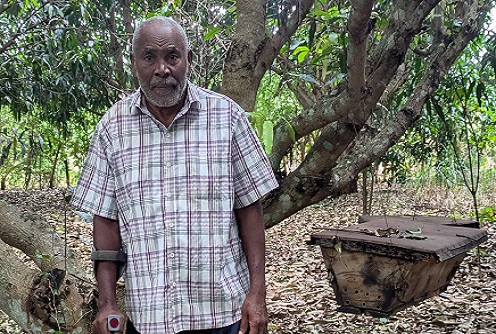
Sabiiti Mbabazi one of the individual beekeepers in Kimanya village, Rwentumba parish1, supported by ECOTRUST
HABARI DAILY I Kampala, Uganda I Partnerships for life are built on trust, and so is Sabiiti Mbabazi’s association with the Environmental Conservation Trust of Uganda (ECOTRUST). At 73, the retired civil servant can look back on a farming journey that has grown from a childhood fascination with nature into a thriving story of trees, bees, conservation and livelihood.
Long before beekeeping became a livelihood opportunity in his community, Mbabazi had already developed a deep love for farming and tree planting. Having spent 37 years in government service, retirement gave him more time to return to the land, but farming was never simply something he picked up after leaving public service.
It was a lifelong passion.
His family recalls that at just four years old, Mbabazi planted his first orange tree. For a young boy, it may have seemed like an ordinary act, but watching that tree grow nurtured a fascination with nature that stayed with him into adulthood.
“I have always loved farming,” Mbabazi says. “Even when I was working for government, farming was still in my blood. Whenever I got time, I went back to the farm.”
In 1978, he settled on his land in Kamanya Village, Rwentumba Parish, Masindi District, where he began combining crop farming with tree planting. His ambition was straightforward: produce enough from the land while protecting it for future generations.
“I wanted a productive farm, but I also wanted a farm that respected nature,” he says. “I knew that if you destroy the environment, you are also destroying your own future.”
A forest that almost became too much
Like many farmers, Mbabazi learnt through trial and error. His enthusiasm for tree planting was so great that he eventually planted more trees than his crops could comfortably tolerate. The shade became a problem for some of his crops.
“I planted trees everywhere,” he recalls with a laugh. “At one point, some of my crops were complaining because there was too much shade!”
But among the trees were mangoes, and the mango orchard would eventually take his farming in an unexpected direction.
As the mangoes matured, bees began arriving in increasing numbers. “I started seeing bees coming to the mangoes,” he says. “That made me curious. I began asking myself: Why are the bees here? What are they doing for my farm?”
The questions led him into beekeeping. “I realised that trees and bees are partners. The trees give the bees a home and food, and the bees help the crops through pollination. That opened my eyes.”
“I looked for ECOTRUST”
Mbabazi’s relationship with the Environmental Conservation Trust of Uganda (ECOTRUST) also began with his own initiative.
“ECOTRUST didn’t look for me: I looked for ECOTRUST,” he says emphatically. After hearing about an organisation supporting farmers to plant trees, he travelled to the ECOTRUST office in Masindi to find out more.
His determination caught the attention of a forestry officer, who later visited his farm. That visit marked the beginning of a partnership that would influence the direction of his farming enterprise for years to come.
At the time, ECOTRUST’s support was largely focused on technical guidance rather than simply distributing free seedlings.
Farmers were encouraged to invest in their own tree planting while receiving professional advice on forestry practices. Tree survival was monitored, and farmers were encouraged to adopt sustainable land-management practices.
For Mbabazi, that knowledge was worth more than a free seedling. “Knowledge is something nobody can take away from you,” he says. “ECOTRUST taught us how to think about trees, how to manage them and how to make the land work for us without destroying it.”
Over the years, his farm was transformed into a thriving landscape of indigenous and fruit trees. The benefits became practical and immediate.
The trees provide firewood, improve soil health and create a favourable environment for farming. His family no longer has to depend on collecting firewood from natural forests because the farm produces enough fuel throughout the year.
“Today, I don’t need to send my family into a natural forest looking for firewood,” he says. “The trees I planted are giving us what we need. That is what I call an investment.”
From a few hives to a honey enterprise
Before ECOTRUST introduced its community beekeeping initiatives, Mbabazi had already begun experimenting with traditional hives made from local materials.
But he wanted to do more. “I started with the traditional hives because I wanted to understand bees,” he explains. “But when I saw the opportunity, I said, ‘Why not improve?’”
He adopted Kenya Top Bar (KTB) hives and began working to improve his honey production. In 2019, ECOTRUST introduced a community beekeeping project under the Rwentumba Community Forest Association. Mbabazi embraced it enthusiastically.
The training provided practical knowledge on modern beekeeping, hive management and safe honey harvesting. For a farmer who had already developed an interest in bees, the training provided the missing technical skills.
“I already had the passion,” he says. “ECOTRUST helped me add knowledge to that passion.” The results soon became visible.
Honey became an important source of income, with Mbabazi’s premium natural honey finding customers across Uganda and even reaching markets in South Sudan and Kenya.
“People come looking for my honey because they know what they are getting,” he says. “I don’t want to compromise on quality. Honey must be pure. If you produce something good, the market will find you.” But the benefits of bees did not end with honey.
Mbabazi noticed that his mangoes, coffee and other crops became more productive because of increased pollination.
“The bees are not only working for me,” he says. “They are working for the whole community. A bee does not stop at my boundary and ask, ‘Is this Mbabazi’s garden?’ It moves from farm to farm.” That, he says, is one of the greatest lessons he has learnt.
A farm that became a classroom
Mbabazi’s partnership with ECOTRUST has also taken his farm beyond production. His farm became a demonstration site where members of the Rwentumba community could learn practical lessons in tree growing and beekeeping.
Farmers continue to visit to learn from his experience, while his work has connected him with researchers, development partners, government officials and farmers from other parts of Uganda.
“These connections have opened my eyes,” he says. “You learn something from a researcher, something from another farmer and something from a government officer. You never stop learning.” His dedication has earned him recognition as a model farmer, with organisations and government programmes holding up his farm as an example of community-led conservation.
Message to the next generation
Age has inevitably slowed Mbabazi down. Advancing age and health challenges have limited how actively he can manage his apiary. But they have not diminished his enthusiasm. His message remains clear: farmers should not wait for opportunities to come knocking.
“I looked for ECOTRUST,” he repeats. “That is the lesson. If you want something, go and look for knowledge. Do not sit at home waiting.”
He believes forestry and beekeeping should be integrated into farming because they offer both environmental and economic benefits. “Plant a tree today and you may not benefit tomorrow, but somebody will,” he says. “Keep bees and you get honey, but you also get pollination. Protect nature and nature will protect you.”
For Mbabazi, conservation is therefore not about choosing between the environment and making money. “You can protect nature and earn a living at the same time,” he says. “That is what my farm has taught me.”
His journey is ultimately a story of initiative. He planted trees when few people around him may have seen the bigger picture. He followed the bees when they appeared. He searched for ECOTRUST instead of waiting to be found. He embraced new knowledge, adopted improved hives and turned his farm into both an enterprise and a learning centre.
At 73, Mbabazi’s greatest harvest may therefore not be the honey in his hives or the mangoes hanging from his trees.
It is the legacy. “I planted those trees for myself, but they have become useful to my family, my neighbours and the environment,” he says. “That is why I tell people: plant trees, keep bees and learn. When you take care of nature, nature takes care of you.”







About the Author