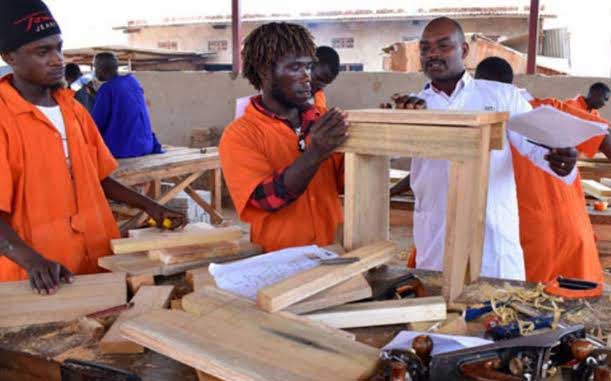

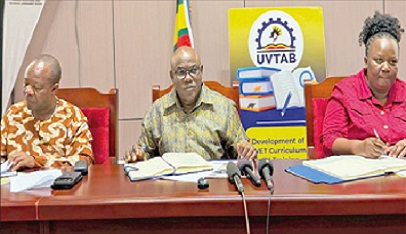
Oyesigye (centre) with other officials during the unveiling of the July/August national TVET assessment exercise at the UVTAB secretariat in Ntinda, Kampala
HABARI DAILY I Kampala, Uganda I Uganda’s education system is taking a turn for better days as Government moves to overhaul the assessment system for technical and vocational education and training (TVET) trainees, with a new model designed to produce more disciplined, practical and employable graduates.
Under the proposed reforms, 70 percent of a trainee’s final assessment will be conducted continuously at the training institution, giving instructors greater responsibility for evaluating practical competence, workplace discipline and behavioural readiness throughout the training period.
The remaining assessment will be conducted through the national examination system.
The reform is intended to address what officials describe as poor work ethics among some young workers and the persistent preference for white-collar employment, even among graduates trained in practical fields.
The Uganda Vocational and Technical Assessment Board (UVTAB) executive secretary, Onesmus Oyesigye, announced the changes on Saturday while unveiling the July/August national TVET assessment exercise at the board’s secretariat in Ntinda, Kampala.
Practical skills over office jobs
Oyesigye said the decision to introduce a stronger continuous assessment component was informed by tracer studies conducted by UVTAB, which found that many TVET graduates secure employment relatively soon after completing their training.
“Our tracer studies show that our students don’t struggle to find work, except those who expect office jobs after training,” Oyesigye said.
He argued that the problem is not necessarily a shortage of opportunities, but rather the attitudes of some graduates who are reluctant to perform practical work.
“If you go to a construction site, you will find one engineer supervising hundreds of technicians. The opportunities are there, but trainees must be willing to work with their hands,” he said.
The new model will allow instructors to assess trainees beyond what they can demonstrate during a final examination.
Their attendance, discipline, ability to work with others, practical competence and general workplace behaviour can be monitored throughout their training.
Oyesigye said this would enable institutions to identify weaknesses early and nurture appropriate work attitudes from the beginning rather than waiting until the end of a course.
TVET enrolment surges
The reforms come as Uganda witnesses a major increase in interest in vocational and technical education.
According to Oyesigigye, the number of candidates participating in national TVET assessments has risen from about 18,000 when national assessments began to more than 100,000 today.
He attributed the growth partly to changing attitudes towards vocational education.
Many university graduates who have struggled to find formal employment are increasingly returning to vocational institutions to acquire practical skills such as welding, electrical installation and plumbing.
The shift reflects a growing recognition that technical skills can provide direct routes into employment, entrepreneurship and self-employment.
Government hopes the revised assessment system will ensure that the rapid growth in enrolment translates into a workforce whose skills match actual labour-market requirements.
Linking TVET to mainstream education
UVTAB is also aligning its assessment system with Uganda’s lower secondary competence-based curriculum, creating a clearer progression pathway for learners who enter technical education after Primary Seven or Senior Four.
Under the emerging framework, learners will be able to progress through different TVET qualifications and, where applicable, transition into university programmes.
The aim is to eliminate the perception that vocational education is a dead-end route reserved for learners who cannot pursue academic education.
Instead, TVET is increasingly being positioned as part of a broader education pathway in which learners can acquire practical skills, advance academically and ultimately pursue higher-level technical or professional qualifications.
International certification for Ugandan technicians
Another major component of the reforms is the development of internationally recognised certification frameworks.
UVTAB is finalising standardised qualifications intended to make Ugandan technicians more competitive in regional and international labour markets.
This could be particularly important for workers seeking employment abroad, including in the Middle East, where demand for skilled construction, electrical, plumbing and other technical workers remains significant.
The objective is to ensure Ugandan workers travel with recognised qualifications that enable them to compete for skilled positions rather than being confined to unskilled jobs.
Record assessment exercise
The assessment reforms are being introduced alongside what UVTAB describes as its largest formal vocational assessment exercise since the enactment of the TVET Act No. 3 of 2025.
A total of 55,788 candidates are scheduled to sit the July/August assessments, which begin Monday and run until August 21 at 427 centres across the country.
Of the candidates, 38,957 are male and 16,831 are female.
They will be assessed under Competence-Based Training programmes leading to National Certificates at Level Three and Community Polytechnic Certificates at Level Two.
To protect the integrity of the exercise, UVTAB has begun dispatching assessment materials to designated storage facilities under Police escort.
Area coordinators and centre supervisors have been briefed on the safe custody of materials, distribution of scripts and deployment of supervisors.
More than 650 scouts have also been deployed to monitor compliance and detect assessment offences, while more than 3,500 practical assessors will conduct competency-based evaluations.
Special-needs candidates included
The assessment will also accommodate 153 candidates with special needs, including learners with visual and hearing impairments, physical disabilities, amputations, chronic illnesses, epilepsy and intellectual impairments.
UVTAB has deployed more than 150 personnel, including sign-language interpreters, transcribers and guides, to support the candidates.
Those requiring additional assistance will also receive extra time in accordance with assessment regulations.
The reforms therefore signal a broader attempt to reposition vocational education in Uganda—from an alternative for learners unable to pursue university education into a central pillar of workforce development.







About the Author