

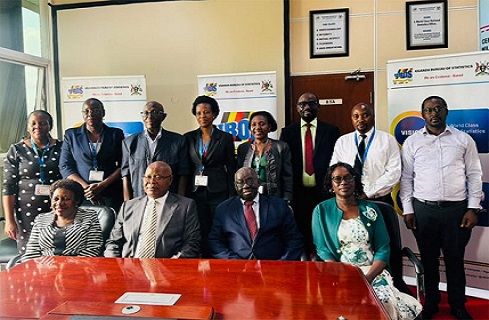
A cross section of ASAC members and UBOS staff enjoying a photo opportunity after the recent meeting
HABARI DAILY I Kampala, Uganda I The Accountability Sector Audit Committee (ASAC) has commended the Uganda Bureau of Statistics (UBOS) as it vowed to step up its oversight of governance and accountability systems.
This was revealed at a recent high-level engagement which was aimed at strengthening internal controls and ensuring that audit recommendations are implemented.
Held on August 11, 2026, at Statistics House, the engagement brought together the ASAC delegation and UBOS management to assess the Bureau’s accountability mechanisms and identify areas requiring greater attention.
Chaired by UBOS Executive Director Dr Chris Mukiza, the meeting focused on a range of institutional matters, including the implementation of audit recommendations, the statutory instruments governing the establishment and operations of UBOS and its committees, staff welfare and the effectiveness of the Internal Audit Directorate.
Strengthened institutional systems
The discussions also examined areas in which the Ministry of Finance, Planning and Economic Development (MoFPED) could continue supporting the Bureau to strengthen its institutional systems and improve performance.
ASAC operates under MoFPED and provides independent oversight of governance, risk management and internal control systems within public sector institutions. Its mandate also includes monitoring compliance with financial management regulations and following up on recommendations arising from audits.
The committee’s role is therefore central to ensuring that weaknesses identified through audit processes do not remain unresolved, but instead translate into concrete improvements in public institutions.
The ASAC delegation was led by Justice Emeritus Ralph W. Ochan, Chairperson of the Committee, who commended UBOS for producing high-quality audit reports.
Prompt reporting critical
However, the committee stressed that the quality of an audit report must be matched by timely submission. According to the committee, prompt reporting is critical because it enables oversight bodies to examine findings, follow up on recommendations and ensure that corrective measures are implemented.
The meeting subsequently examined challenges that have affected the timely submission of quarterly audit reports at UBOS.
Management and ASAC agreed on measures to address the identified gaps and improve compliance with reporting deadlines. They also agreed to prioritise critical audit recommendations for short-term implementation while maintaining close collaboration between the Bureau and the Accountability Sector.
The emphasis on audit recommendations reflects a broader concern in public financial management: identifying weaknesses is only the first step, while ensuring that institutions act on those findings is what ultimately strengthens accountability.
Dr Mukiza also highlighted the importance of the Internal Audit Directorate in maintaining a strong internal control environment at UBOS.
Audit management software hailed
He said the Directorate is adequately resourced and facilitated with the necessary tools, including audit management software, to execute its mandate effectively.
The Executive Director further reaffirmed the commitment of both UBOS Management and the Board to continuously support the Internal Audit Directorate by strengthening its systems, mechanisms and capacity.
An effective internal audit function, he noted, is essential in ensuring that institutional systems and processes operate efficiently and that potential weaknesses are identified before they develop into larger governance or financial management problems.
The ASAC visit therefore provided an opportunity for both sides to assess existing accountability mechanisms while agreeing on practical steps to improve them.
Beyond the boardroom discussions, the delegation also toured the National Statistical Resource Centre, where members were briefed on its role in facilitating access to statistical information and promoting the use of official statistics.
The Centre provides an important link between statistical information and the people and institutions that depend on it for decision-making, planning, research and policy development.
Increased use of official statistics
The committee appreciated the Centre’s contribution to improving accessibility and dissemination of official statistics, as well as efforts to enhance their utilisation in response to stakeholders’ data demands.
The engagement ultimately underscored the connection between strong accountability systems and the effective production and use of official statistics.
For UBOS, implementing audit recommendations, strengthening internal controls and improving reporting timelines are not merely compliance obligations. They are important elements in maintaining public confidence in an institution whose statistics inform government planning, resource allocation and national development decisions.
The ASAC engagement is expected to provide renewed momentum for UBOS to address outstanding audit issues, strengthen governance structures and sustain cooperation with MoFPED in improving accountability across the Bureau.







About the Author