
HABARI DAILY I Kampala, Uganda I With the latest outbreak having claimed the lives of up to 2,500 people, the Democratic Republic of Congo (DRC) has received the first shipment of an Ebola vaccine as health authorities race to contain the country’s deadliest outbreak of the disease.
An initial consignment of 16,250 doses of the Ervebo Ebola vaccine arrived at N’djili International Airport in the capital Kinshasa late on Friday, August 21, 2026, marking the beginning of a larger emergency vaccination effort.
The shipment is part of 70,000 doses authorised for the DRC by the International Coordinating Group (ICG) on Vaccine Provision, following an urgent request for assistance as infections continue to rise across several provinces.
The remaining doses are expected to arrive in the coming days, with health authorities and international partners preparing to deploy them in the areas most affected by the outbreak.
According to the World Health Organization (WHO), 50,000 of the 70,000 doses will be used to protect frontline and healthcare workers who are at particularly high risk of exposure while treating Ebola patients.
The other 20,000 doses will be used in a late-stage Phase 3 clinical trial aimed at determining whether Ervebo can provide protection against the particular strain of Ebola currently circulating in the DRC. This presents one of the biggest challenges in the vaccination campaign.
Ervebo is licensed for protection against the Zaire ebolavirus strain, but the current outbreak is being driven by the rarer Bundibugyo ebolavirus. There is currently no officially approved vaccine or treatment specifically for the Bundibugyo strain.
However, early laboratory and animal studies have suggested that Ervebo could provide some level of cross-protection against the strain. The planned human trial is therefore expected to provide crucial evidence on whether the vaccine can protect people exposed to Bundibugyo Ebola.
The trial could become particularly important as the outbreak continues to spread at an alarming rate.
The DRC’s Health Minister, Samuel Roger Kamba, said Ervebo had previously been used during Ebola outbreaks, including on a very large scale during the 2018 to 2020 epidemic.
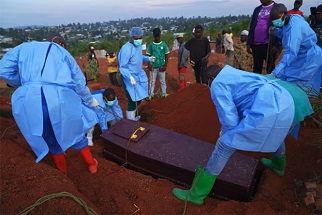
The arrival of the vaccine comes as the scale of the latest outbreak continues to grow. It is the DRC’s 17th recorded Ebola outbreak, with the United Nations warning that transmission is expanding exponentially across six provinces.
Available figures put confirmed infections at about 5,290, with 2,516 deaths recorded, translating into a case-fatality rate of about 47.6 percent.
The outbreak was officially declared in mid-May, although health experts believe transmission had begun several weeks earlier. Data from the Africa Centres for Disease Control and Prevention indicates that the outbreak has not yet reached its peak, raising fears that transmission could increase substantially in the coming weeks.
The arrival of the vaccine therefore offers a critical new weapon, but health authorities face significant obstacles in getting it to communities that need it most.
Much of the affected eastern region has poor health infrastructure, while ongoing armed conflict, including fighting involving the M23 rebel group, has restricted movement and made access to some communities extremely difficult.
The security situation has also complicated efforts to identify cases quickly, trace contacts and isolate infected people before they can spread the virus further.
Health experts have warned that delays in detecting infections could allow the outbreak to move faster than containment efforts.
For the DRC and its international partners, the arrival of the first 16,250 doses is therefore both a major logistical achievement and the beginning of a difficult vaccination campaign.
The 50,000 doses designated for frontline workers are expected to provide immediate protection to those at the centre of the response, while the 20,000 doses reserved for the clinical trial could determine whether Ervebo can become an effective tool against the Bundibugyo strain.
With more than 2,500 people already dead and thousands more infected, authorities are under pressure to ensure the vaccine reaches vulnerable communities quickly.
The remaining 53,750 doses are expected in Kinshasa in the coming days, as the DRC and its international partners intensify efforts to prevent the outbreak from becoming even more devastating.







About the Author