

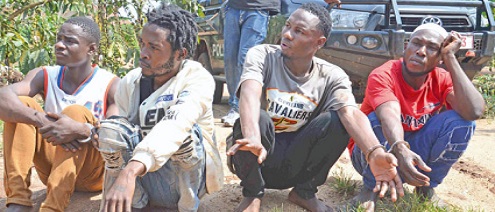
Some of the suspects affected recently
HABARI DAILY I Kampala, Uganda I A new wave of violent street gangs is turning parts of Kampala and its surrounding metropolitan suburbs into hunting grounds, with criminals wielding concrete pavers, stones and pangas to terrorise residents for little more than mobile phones, cash, laptops and other household valuables.
The gangs, operating through loosely organised urban networks and using names such as “Eggaali”, have developed a reputation for sudden, brutal attacks in which violence appears disproportionate to the value of property being stolen.
In some cases, victims have been left unconscious, critically injured or dead after being struck on the head with heavy concrete blocks.
The rise of the paver-wielding gangs has renewed concerns about the security of pedestrians, motorists and boda-boda riders travelling through poorly lit roads and densely populated settlements around Kampala, Wakiso and Mukono.
Pavers become weapons of terror
Unlike conventional street robbers who may rely on knives or threats, the paver gangs have turned ordinary construction materials into lethal weapons.
Detectives say gang members can trail pedestrians returning home after dark before suddenly attacking them. A heavy paver is used to strike the victim, often on the head, after which the attackers grab phones, money and other valuables.
Motorists and boda-boda riders are also vulnerable. Along poorly lit stretches, criminals can throw stones or paving blocks at moving vehicles or motorcycles. A crash or a driver stopping to establish what has happened can provide the gang with an opportunity to swarm the victim.
The gangs then disappear on motorcycles, using narrow roads, informal settlements and dark alleys as escape routes.
Areas around Kira, Kyaliwajjala, Namugongo, the Northern Bypass, Mukono and parts of Wakiso have featured prominently in reports of such attacks.
The danger is heightened by the fact that many attacks happen within metropolitan residential areas, sometimes only metres from victims’ homes.
One of the cases that brought the brutality of the gangs into sharp focus was the killing of corporate manager Susan Alweny in Kiwatule. She was reportedly attacked before 9pm and struck with a stone paver as criminals took her phone and bag.
From street gangs to organised networks
Police investigations suggest that the criminals are more organised than their spontaneous attacks might suggest.
During a crackdown, detectives arrested several suspects, including Umar Kigenyi, 21, alias Ian; Reagan Kalyango, 24, alias Mylord; Ismail Ssenyonga, 19, alias Kaasagama; Frank Kasagga, 21; and Hussein Muteesaasira.
Investigators say questioning of suspects revealed that gangs divide responsibilities before executing an operation.
One suspect told detectives: “We operate in a group of 10 people. For instance, before we execute any mission, we ensure that our motorcycle riders have a backup to guard them.”
He added that another team waits outside a targeted home while others enter to search for valuables.
The suspect’s account provides a glimpse into how these networks function: one group identifies the target, another provides security and transport, while others execute the robbery.
Police have also uncovered coded language allegedly used by gang members to conceal their activities.
According to investigators, “okuba ku gaadi” refers to someone deployed to watch for security threats, while “okwecoka emmaali” refers to under-declaring stolen property.
Other codes reportedly include “okugoba emmaali”, meaning wrecking or attacking the targeted area; “gukubye”, indicating that a member has been arrested; “kuteekako”, referring to calling a colleague; and “deal kawaani”, meaning that an operation has failed.
During one operation, detectives recovered more than 40 stolen mobile phones.
A network stretching beyond Kampala
The police investigations indicate that the problem is not confined to Kampala city.
Affected areas identified by detectives include Matugga, Maganjo, Soweto, Kagoma, Kawanda, Bwaise and Kawempe-Ttula, as well as Kibiri-Masajja and Gangu in Makindye-Ssaabagabo.
Other reported areas include Kakinzi village in Luwero town, Kiwoko in Nakaseke, Kasomo, Kasana, Mabaale, Ngogolo, Wobulenzi, Butuntumula and Kiwogozi.
This geographical spread points to a criminal ecosystem that can move between urban, peri-urban and rural communities depending on police pressure and opportunities for robbery.
Detectives are also investigating claims that some gangs use substances to incapacitate victims. One of their priorities, according to investigators, is establishing how and where the suspects obtain chloroform allegedly used to render victims unconscious.
The scale of the problem is further illustrated by the 2025 Uganda Police crime statistics. The police recorded 7,823 robbery cases, 11,818 break-ins and 56,360 theft cases during the year.
The report put Uganda’s crime victimisation rate at 427.8 victims per 100,000 people.
Police target gangs and their markets
The Uganda Police Force, through the Flying Squad, Directorate of Crime Intelligence and Criminal Investigations Directorate, has intensified intelligence-led operations against suspected gang networks.
Police operations have resulted in arrests in several hotspots, with detectives pursuing suspected leaders and recovering stolen property.
Investigators say the arrest of one suspect can provide leads to other members because the groups operate through interconnected networks.
One detective said police had previously arrested accomplices known as “Dog City” and “Kim Yo”, while another suspect, “Mbalaatira”, alias Young, remained on the run.
The Police have also warned that the gangs cannot survive without buyers willing to purchase stolen goods.
Police attribute continued criminal activity in urban and semi-urban areas partly to “promoters” who provide ready markets for stolen phones, televisions, laptops and other electronic appliances.
This makes the fight against violent robbery a two-sided battle: dismantling the gangs while disrupting the businesses that turn stolen property into quick cash.
The deeper security challenge
The growing violence also exposes pressure on Uganda’s policing and investigative capacity.
The 2025 Police crime report shows that while the United Nations recommends a detective-to-case ratio of about 1:12, Uganda’s ratio stands at approximately 1:54.
That disparity means individual detectives are handling far more cases than the recommended workload, potentially slowing investigations and prosecutions.
Meanwhile, unemployment, urban poverty and the availability of quick markets for stolen goods continue to provide fertile ground for criminal recruitment.
For residents, however, the statistics have translated into something much more immediate: fear of walking home after dark, riding through poorly lit roads or stopping to inspect a damaged vehicle.
The panga and paver have become symbols of a particularly ruthless form of urban robbery—one in which a phone or a small amount of cash can trigger violence capable of taking a human life.
Until the gangs’ networks, escape routes and stolen-goods markets are dismantled, Kampala’s rapidly expanding metropolitan population will continue to face the uncomfortable reality that danger can be waiting not only in isolated crime zones, but along the road home.







About the Author