

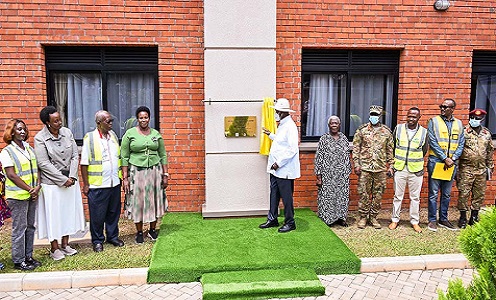
President Museveni commissions one of the SFC detach dormitoriues at Nakasero on Wednesday as State House Comptroller and other officers look on. PPU Photo
More than 500 personnel of the Special Forces Command (SFC) are set to benefit from modern accommodation after President Yoweri Museveni commissioned new facilities at Nakasero in Kampala.
The two newly constructed dormitory blocks, which provide accommodation for 518 people, are part of government efforts to improve the welfare and living conditions of Uganda’s armed forces while strengthening their discipline, morale and operational readiness.
The project, which was undertaken between 2023 and 2025, has provided the SFC with organised accommodation designed to offer personnel a more modern and conducive living environment.
President Museveni, who is also the Commander-in-Chief of the Uganda People’s Defence Forces (UPDF), said investment in military accommodation was necessary as the country’s resources increased, arguing that soldiers should be housed in organised facilities.
He said the improvement of welfare should, however, be undertaken according to the resources available to the institution.
Quoting a Banyankole proverb, “The shape of the head determines the hairstyle,” Museveni said institutions should prioritise their most essential needs and develop in line with their financial capacity.
The President recalled that when the National Resistance Army (NRA) began its armed struggle, it had only 27 guns while facing an army of about 60,000 soldiers.
He said the NRA therefore prioritised weapons and training instead of immediately spending heavily on soldiers’ remuneration and accommodation.
“What a soldier needs, apart from food and some clothes, is weapons and training. Even if that is all you have, you can still fight,” Museveni said.
He said the force gradually expanded its capabilities as resources became available, allowing government to invest in advanced military equipment, training and infrastructure, including accommodation.
Facilities to improve soldiers’ welfare
Museveni said proper accommodation for soldiers serves more than a welfare function, arguing that keeping personnel together in organised facilities also has strategic importance, particularly during periods of conflict.
He credited Chief of Defence Forces Gen. Muhoozi Kainerugaba with supporting efforts to redirect resources towards military infrastructure and barracks.
“He would get that money which was used for operations and instead use it to build barracks. We were always insisting that commanders must stay in the barracks,” Museveni said.
He said the availability of resources now allows government to address some of the accommodation challenges that have faced the armed forces over the years.
“Now that we have a bit of money, let’s address that,” he said.
The State House Comptroller, Jane Barekye, said the project was delivered through cooperation between the State House Estates Department, consultants, contractors and SFC personnel.
She said the Estates Department provided technical supervision, while consultants led by Prof. John Stanley Ralph Senfuma monitored quality and ensured that the project was delivered within the required standards and timeframe.
“Thank you, Mzee, for believing in us to serve and for the support in terms of resources to deliver this assignment in time. We promise to serve you at all times, Your Excellency,” Barekye said.
She also thanked the SFC for its cooperation throughout the construction process.
Modern housing for 518 personnel
Maj. Gen. Asaph Mweteise Nyakikuru, the Commander of the SFC, described the commissioning as an important milestone for the command, saying improved accommodation would contribute to the welfare and professional development of its personnel.
“On behalf of the SFC, it is my honour to welcome you on this important occasion of the opening of these dormitories for our soldiers,” Nyakikuru said.
He said better accommodation contributes to the morale and effectiveness of soldiers, while the investment demonstrates government’s commitment to improving conditions in which SFC personnel live and work.
Nyakikuru said the accommodation investment forms part of wider improvements within the SFC, including investments in technology, command centres, situational awareness, coordination and decision-making systems.
He urged the personnel who will occupy the new facilities to take responsibility for maintaining the structures and ensuring that they remain in good condition.
Prof. Senfuma, the technical adviser to the project, said the team was tasked with improving soldiers’ living conditions without compromising construction quality.
“We have not compromised on the quality because our objective is to deliver work of a quality that should not shame you for having tasked us to do it,” he said.
He stressed the importance of regular maintenance and proper budgeting to preserve the facilities, noting that even high-quality buildings require continuous care.
Prof. Senfuma also said the project demonstrated the capacity of Ugandan professionals and workers, noting that the construction was carried out entirely by Ugandans.
“This work has been done by Ugandans, 100 percent,” he said, dismissing claims that foreign labour was necessary for projects of such a nature.
The commissioning was attended by senior SFC commanders and State House administrators, marking the completion of a project that has added accommodation for more than 500 military personnel while providing the command with modern facilities intended to improve their welfare and living environment.







About the Author